
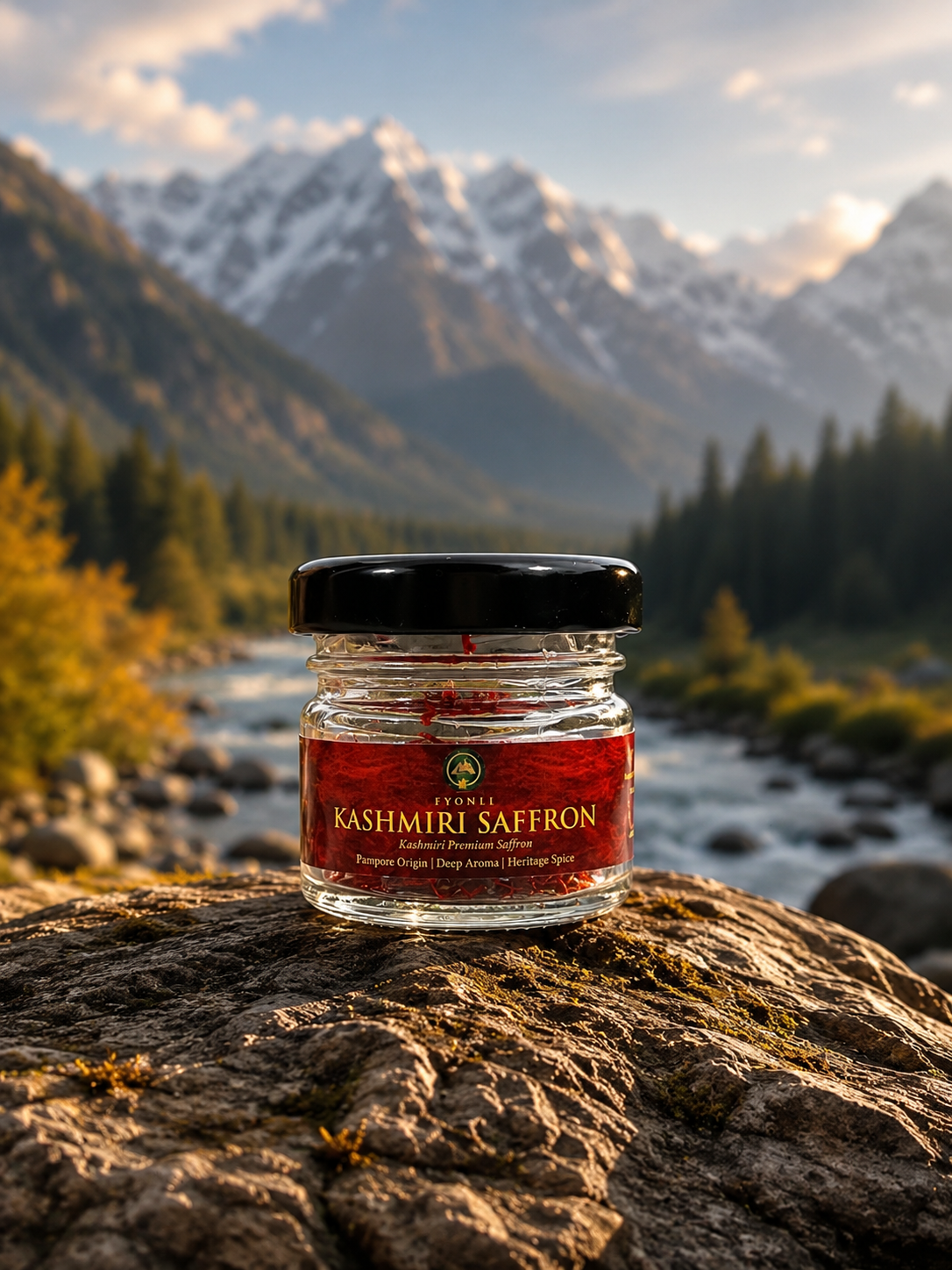
Description
Grade 1 Kashmiri saffron from Pampore — the world’s most prized saffron origin. Deep red threads, high crocin content, a strong honey-hay aroma. Hand-harvested, naturally dried, GI-tagged. This is 1g of pure, unadulterated Kashmiri kesar — nothing blended in, nothing added.What Is Kashmiri Saffron?
Kashmiri Saffron is Grade 1 saffron grown on the Pampore plateau near Srinagar, Jammu & Kashmir, at roughly 1,600 metres altitude — the growing region that holds India’s Geographical Indication (GI) tag for saffron. The combination of thin, well-drained soil, cold winters and specific altitude conditions gives Pampore saffron among the highest crocin content of any saffron origin in the world. Crocin is the compound responsible for saffron’s deep colour and is the primary quality marker used in international grading. Fyonli sources it as hand-harvested, naturally dried thread — no blending, no additives.Why This One Is Different
- GI-tagged origin — grown specifically in the Pampore region, which holds India’s official Geographical Indication for Kashmiri saffron
- ISO 3632 Grade 1 — meets the international Category I threshold for crocin content, the recognised marker of saffron quality
- Hand-harvested, naturally dried — no mechanical processing or heat-drying that can degrade aroma compounds
- Trumpet-shaped threads — deep red at the tip, lighter at the base, the visual signature of genuine, unblended saffron
- Zero adulteration — pure saffron thread only, nothing bulked out with dyed corn silk, safflower, or other fillers common in cheap saffron
Kashmiri Saffron vs. Common Market Saffron
| What You’re Buying | Common Market Saffron | Fyonli Kashmiri Saffron |
|---|---|---|
| Origin | Often unstated or mislabelled Iranian/Spanish saffron sold as Kashmiri | GI-tagged Pampore, Kashmir |
| Grade | Ungraded or lower crocin content | ISO 3632 Grade 1 |
| Colour release | Often instant (a sign of added dye) | Gradual, over 5–10 minutes in warm water or milk |
| Aroma | Flat, sometimes chemical | Honey-hay aroma, genuinely fragrant |
| Adulteration risk | Common — dyed corn silk or safflower sold as saffron | Pure thread only, no fillers |
Ingredients & Allergens
Ingredients: Kashmiri Saffron (Crocus sativus stigma threads). Nothing else — no added colour, oil, or fillers.
Allergens: None known. Packed in a facility that also handles other spices.
How to Identify Genuine Kashmiri Saffron
Real Kashmiri saffron threads are deep red at the top with a slightly lighter (yellow-orange) base — trumpet-shaped, not uniform. Added to warm water or milk, they slowly release a golden-orange colour over 5–10 minutes, not instantly. They smell of honey and dried hay — not sharp or chemical. Saffron that releases colour instantly or smells flat or metallic is a sign of artificial dye.How to Use
Soak 5–8 threads in 2 tablespoons of warm (not boiling) water or warm milk for 15 minutes before adding to your dish. This releases the colour and aroma fully. For 1 cup of biryani rice, 6–8 threads is correct. For kesar doodh (250ml), 5–6 threads. Do not add threads directly to hot oil — the colour and aroma compounds are water-soluble.
Sourcing & Story
Pampore, near Srinagar, sits at around 1,600 metres and is the heart of India’s GI-tagged saffron belt — thin, well-drained soil and cold Kashmiri winters are what the region’s growers say produce the crop’s distinctive crocin-rich threads. The crocus flowers bloom for a brief window each autumn, and the stigma threads are still hand-picked from each flower and naturally dried, a labour-intensive process that hasn’t changed with modernisation. Saffron has been part of Kashmiri Ayurvedic and culinary tradition for centuries, valued in warm milk, biryani and festive cooking. Fyonli sources it as pure, unblended thread from this GI-tagged region.Storage & Shelf Life
Store in an airtight, light-blocking container in a cool, dry place, away from direct sunlight and moisture. Does not require refrigeration. Best used within 24 months of the packing date — properly stored saffron keeps its potency far longer than most spices.
How Much Is 1g of Saffron?
1g is approximately 460–500 threads and provides around 60–70 servings at normal culinary use. Saffron is potent — more than 10–12 threads per recipe adds bitterness, not more aroma. Used correctly, 1g lasts a very long time.Who It’s For
- Cooks who want to be certain it’s real — GI-tagged origin and ISO 3632 grading, not a generic “Kashmiri saffron” label with no verification
- Anyone making biryani, kesar doodh, or festive sweets — the classic culinary uses saffron has held in Kashmiri and broader Indian cooking for generations
- Gift buyers — a genuinely premium, traceable spice, not a bulk commodity
Frequently Asked Questions
What makes Kashmiri saffron different from other saffron?
Kashmiri saffron is grown specifically in the Pampore region near Srinagar, which holds India’s Geographical Indication (GI) tag for saffron. The region’s cold winters and well-drained soil produce threads with among the highest crocin content of any saffron origin, and this batch is graded Category I under ISO 3632.
How can I tell if my saffron is real?
Genuine Kashmiri saffron threads are trumpet-shaped, deep red at the tip with a lighter base, and release colour gradually over 5–10 minutes in warm water or milk — not instantly. They smell of honey and dried hay, not chemical or flat. Instant colour release is a common sign of added dye.
How much saffron should I use per dish?
5–8 threads soaked in 2 tablespoons of warm water or milk for 15 minutes is right for most dishes — 6–8 threads for a cup of biryani rice, 5–6 for a cup of kesar doodh. More than 10–12 threads per recipe adds bitterness rather than more aroma.
How long does 1g of saffron last?
1g is approximately 460–500 threads, enough for around 60–70 servings at normal culinary quantities. Used correctly, a single gram lasts most households a long time.
What is the shelf life of Kashmiri Saffron, and how should I store it?
Up to 24 months from the packing date. Store in an airtight, light-blocking container in a cool, dry place, away from direct sunlight and moisture — saffron holds its potency far longer than most spices when stored this way.
Is this saffron GI-tagged and independently graded?
Yes. It’s sourced from Pampore, the region holding India’s official Geographical Indication tag for Kashmiri saffron, and is Grade 1 under the ISO 3632 international saffron classification system.
Looking for another traditional Himalayan Ayurvedic ingredient? Try Pure Himalayan Shilajit.