
Description
The Dal Your Grandmother Made — Without Compromise
Most dal on supermarket shelves is a uniform, factory-grade commodity — sorted for uniformity, not flavour. Varieties that once filled the stone mortars of Garhwali kitchens have been quietly replaced by single-pulse, polished, mass-processed options that cook fast and taste like nothing.
Meanwhile, in the terraced farms of Devprayag and Rudraprayag, small-holder families still grow four heritage pulses together — rajma, toor, urd and ryansh — rotating them across the same plots their grandparents cultivated. The blend they make isn’t a recipe. It’s a tradition passed down through seasons and shared meals.
Fyonli’s Garhwal Traditional Dal Mix brings that tradition to your kitchen exactly as it has always been: four pulses, nothing added, nothing removed. Just the flavour, the protein, and the memory of a mountain meal cooked slowly over firewood.
Why This Dal Mix Works
- 24g protein per 100g — one of the highest natural protein concentrations in any whole-pulse blend, without any fortification
- Four-pulse synergy — each variety contributes a different amino acid and fibre profile, making the blend more complete than any single dal
- 11g dietary fibre — supports digestion, satiety, and gut health with every serving
- Grown at altitude — Garhwal’s slow-growing season (1,200–2,400m) concentrates nutrients and deepens flavour in ways lowland crops cannot match
- Zero additives — no preservatives, no anti-caking agents, no colour enhancement, no salt — just the four pulses as harvested
- Heirloom varieties — ryansh in particular is a rare Garhwali pulse rarely found outside the region; its earthy depth is part of what makes this blend distinctive
- Slow-crafted sourcing — purchased directly from small-holder farmers in Devprayag and Rudraprayag, with full traceability back to the village level
- Versatile cooking — works as a dal, a soup base, a dal makhani variation, or a slow-cooked stew; adapts to nearly every regional Indian cooking style
- Balanced energy — complex carbohydrates paired with plant protein means sustained energy without blood sugar spikes
What’s Inside
Rajma — The anchor of this blend. Garhwali rajma is smaller and darker than the Kashmiri variety, with a firmer skin and an earthy, rich flavour that holds up to long simmering. High in iron, folate and slow-digesting starches, it forms the protein and mineral backbone of the mix.
Toor (Arhar Dal) — The most widely eaten pulse in India, but not like this. Mountain-grown toor has a nutty sweetness that factory-processed varieties rarely retain. It provides quick-cooking depth to the blend and adds a warmth that ties the other pulses together.
Urd (Black Gram) — Revered in Ayurvedic tradition for its ability to sustain energy and support muscle recovery. Whole urd adds a slightly sticky, rich body to the cooked dal and contributes essential B vitamins, magnesium and phosphorus to the nutritional profile.
Ryansh — A heritage pulse native to the Garhwal hills and rarely cultivated outside this region. Ryansh has a mild, slightly grassy flavour with a delicate texture after cooking. It is this pulse that sets the Garhwal Traditional Dal Mix apart from any blend you’ll find in a city market. High in protein and traditionally associated with post-harvest community feasts, it carries the spirit of the Garhwali kitchen in every bite.
How to Use
Classic Garhwali Dal: Soak the mix for 6–8 hours (or overnight). Pressure-cook with water, turmeric and salt. In a separate pan, heat ghee with cumin, dried red chilli and a pinch of asafoetida. Pour the tempering over the cooked dal. Serve with rice or mandua roti.
Weeknight Dal Tadka: Skip the soak and pressure-cook the mix for 5–6 whistles with extra water. The blend becomes creamy and thick — season simply with salt, ghee and cumin for a quick, deeply satisfying weeknight meal.
Protein-Rich Dal Soup: Blend the cooked dal with roasted garlic and a squeeze of lemon. Season with black pepper and coriander. Serve as a warming, high-protein soup that works equally well as a meal or a post-workout recovery dish.
Dal Makhani Variation: Cook the rajma-forward blend slowly overnight on low heat with tomatoes, onions and cream. The four-pulse depth gives this variation an earthier, more complex flavour than standard dal makhani, with considerably more protein per serving.
Who Should Use This
- Home cooks who care about provenance — if you want to know exactly where your food comes from and how it was grown, this blend has a story that goes all the way back to the farm
- Health-conscious families — a convenient, high-protein, high-fibre dal that works for every age group, from children to elderly members, without any ingredient concern
- Gym-goers and athletes — 24g plant protein per 100g is a serious nutritional contribution; pair with rice for a complete amino acid profile and sustained recovery fuel
- Traditional food enthusiasts — if you’ve been searching for heirloom dal varieties that have disappeared from city markets, ryansh alone makes this blend worth seeking out
- Vegetarians and vegans — a four-pulse blend with complete nutritional coverage, naturally free from every animal-derived ingredient
- Busy professionals — the blend cooks well in a pressure cooker with minimal preparation; a batch cooked on Sunday keeps well through the week
Why Fyonli Is Different
Fyonli is based in Devprayag, Tehri Garhwal — a small town at the confluence of the Alaknanda and Bhagirathi rivers, where the Himalayas begin to rise steeply. The farmers who grow this dal mix are our neighbours, not vendors on a supply list. We know their names, their plots, and the varieties they’ve saved across generations.
The altitude at which these pulses grow — between 1,200 and 2,400 metres above sea level — means shorter growing seasons, slower cell development, and higher natural nutrient concentration than lowland equivalents. The cold nights at harvest time lock in flavour compounds that warm-climate growing simply cannot replicate. This isn’t a marketing claim; it’s agricultural fact.
We pay fair prices directly to these families and do not use intermediaries. That means the farmer earns more, the supply chain stays honest, and you get a product that has been handled by fewer hands and stored for less time between harvest and your kitchen. The Garhwal Traditional Dal Mix is not a convenience product — it’s a connection to a mountain food culture that has sustained communities through centuries of hard winters and good harvests.
Clean. Simple. Just 4 Ingredients.
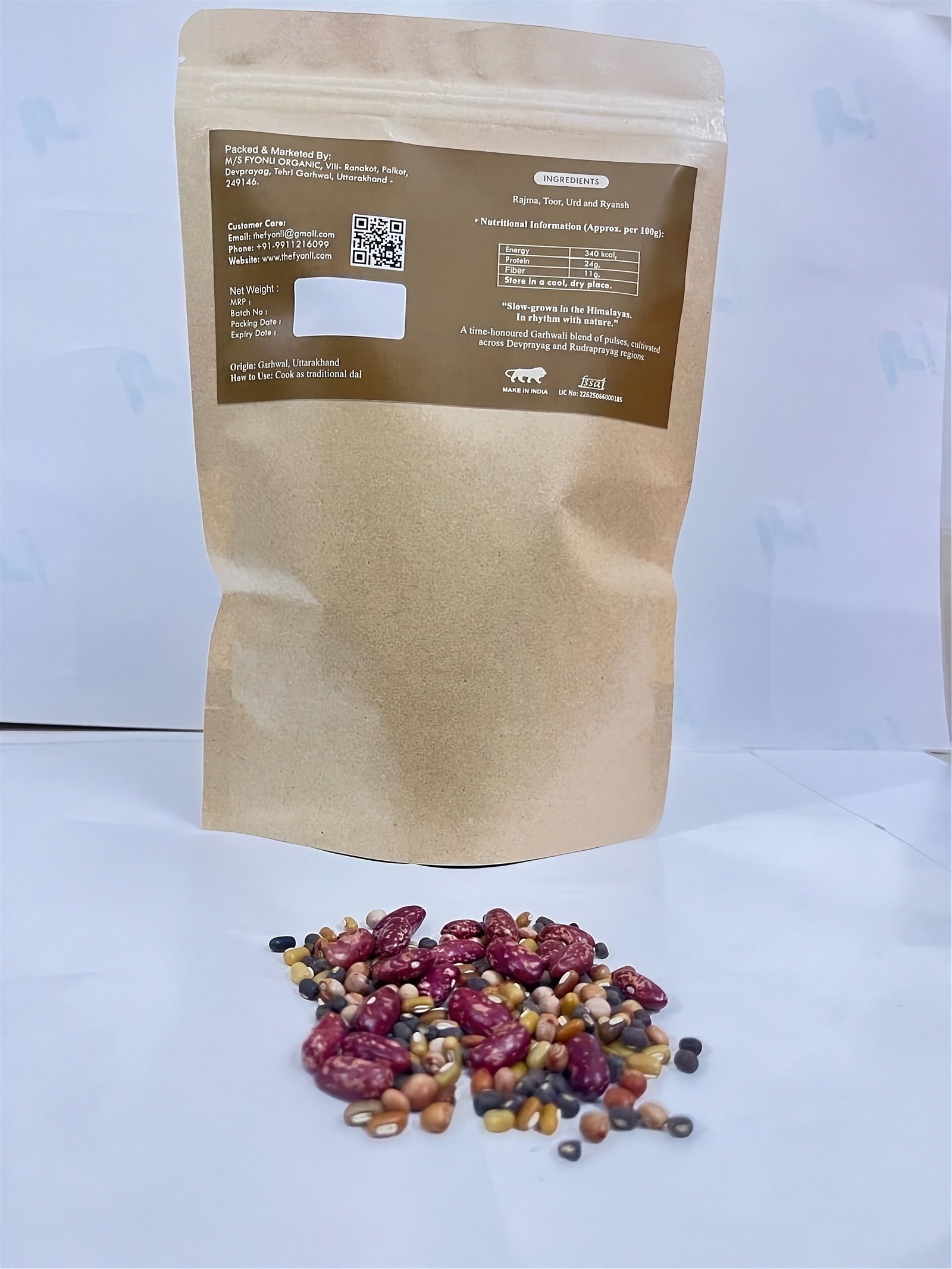
Rajma. Toor. Urd. Ryansh. That’s the entire ingredient list. No salt. No oils. No artificial flavours. No preservatives. No anti-caking agents. No fortification. Nothing that wasn’t grown in a field.
Slow-grown in the Himalayas. In rhythm with nature.
Frequently Asked Questions
What pulses are in the Garhwal Traditional Dal Mix?
The blend contains four heritage pulses grown in the Garhwal region of Uttarakhand: rajma (kidney beans), toor (pigeon peas), urd (black gram), and ryansh — a rare heirloom pulse native to the Garhwal hills. All four are sourced directly from small-holder farmers in Devprayag and Rudraprayag.
How much protein does this dal mix provide?
The Garhwal Traditional Dal Mix delivers approximately 24g of protein per 100g — significantly higher than most single-pulse dals. A standard serving of cooked dal (from 50g dry mix) provides around 12g of plant protein, making it an excellent daily protein source for vegetarians, vegans, and anyone reducing their meat consumption.
How do I cook it, and does it need soaking?
Soaking for 6–8 hours improves texture and reduces cooking time, but it is not strictly required. Without soaking, pressure-cook on medium-high for 5–6 whistles with enough water to cover by about 3cm. With soaking, 3–4 whistles are sufficient. The cooked dal thickens as it cools, so add a little warm water when reheating. Season with your preferred tempering — ghee, cumin, and dried red chilli is the traditional Garhwali approach.
Is this dal mix suitable for gym-goers and athletes?
Yes. With 24g of protein per 100g and a balanced complex-carbohydrate profile, the Garhwal Traditional Dal Mix is well-suited for muscle recovery and sustained energy. When paired with a grain like rice or roti, it forms a complete protein — covering all essential amino acids. It’s a whole-food, additive-free alternative to protein powders for anyone who prefers real food as their performance fuel.
Does it contain any additives, preservatives or salt?
No. The Garhwal Traditional Dal Mix contains four pulses and nothing else. There are no preservatives, no anti-caking agents, no added salt, no flavour enhancers, and no artificial ingredients of any kind. The 400g pack is the weight of the pulses alone — nothing added to bulk it up or extend shelf life artificially.
What is ryansh, and why is it special?
Ryansh is a heritage pulse variety cultivated primarily in the Garhwal hills of Uttarakhand. It is rarely available outside the region and is not commonly found in city markets or commercial dal blends. Nutritionally, it is high in protein and fibre with a mild, slightly earthy flavour that adds depth to the cooked blend. Traditionally, ryansh was a staple of Garhwali village feasts and winter cooking. Its inclusion in this mix is one of the key reasons the flavour and nutritional profile differs from any standard supermarket dal blend.
Can I use this for meal prepping?
Absolutely. A batch cooked from the full 400g pack yields enough dal for 8–10 generous servings. Cooked dal stores well in the refrigerator for 4–5 days and freezes without any loss of texture or nutritional quality. Many customers cook a large pot on the weekend and portion it out across the week — reheated with a fresh tempering each time, it tastes as good as a freshly made batch.