
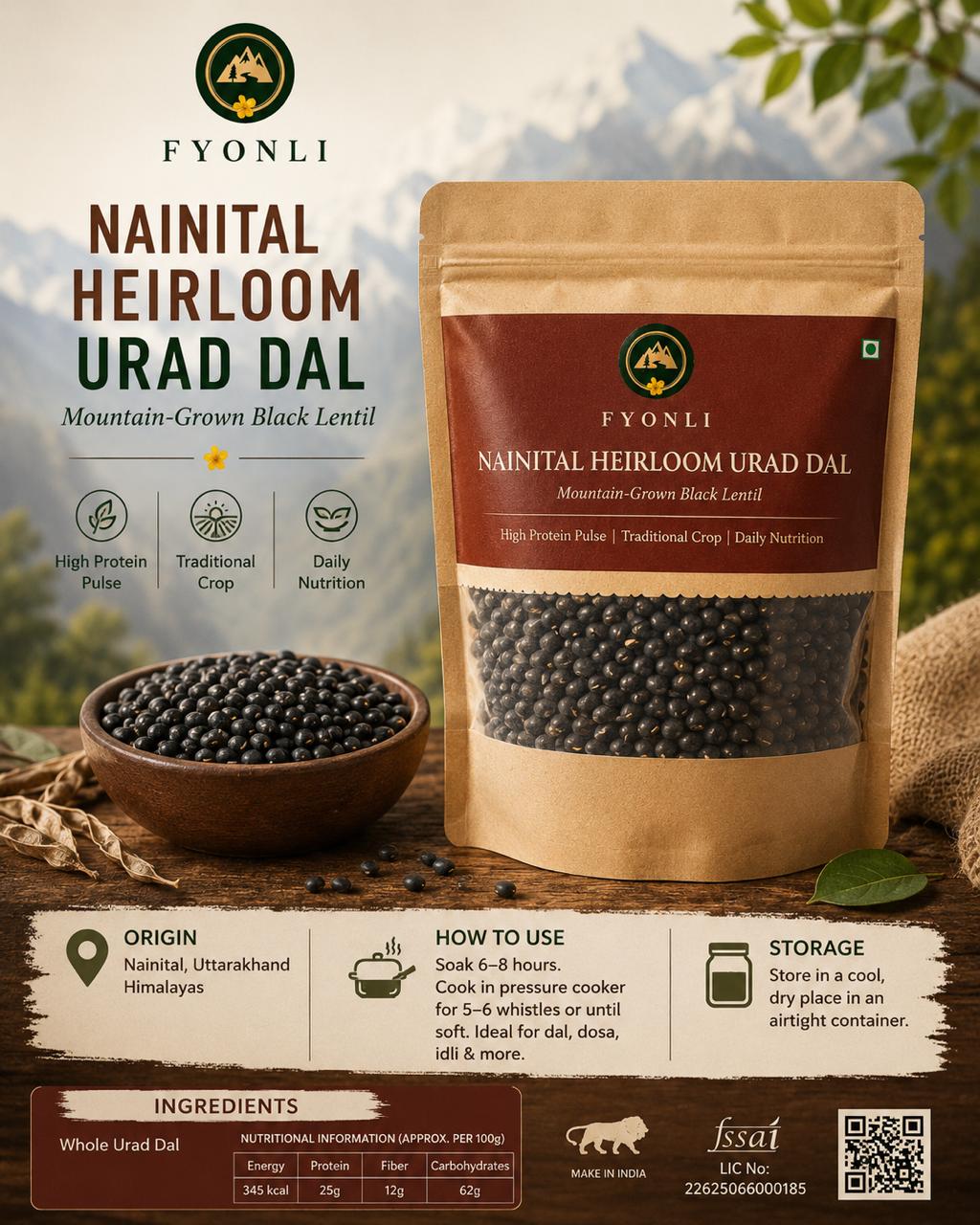
Description
The Lentil Your Kitchen Has Been Missing
Most dals on store shelves today have one thing in common: they were bred for yield, not flavour. Grown in plains-level soil, rushed through harvest cycles, and blended from mixed origins before they reach your bag. The result is a dal that’s nutritionally adequate but distinctly forgettable — pale broth, thin texture, and none of the deep earthiness that makes a bowl of dal feel like a real meal.
There is another way. The small-hold farmers in the terraced fields above Nainital have been growing urad dal the old way for generations — heirloom seed stock, slow-ripening mountain altitude, mineral-dense soil, and a harvest window that waits for the crop rather than the calendar. The difference is immediate and unmistakable.
Nainital Heirloom Urad Dal from Fyonli is a single-origin, whole black lentil sourced directly from these farms. No blending, no additives, no processing shortcuts. Just the real thing — grown the way it was always meant to be grown.
What Makes This Dal Different
Why This Dal Stands Apart
- 25g protein per 100g — one of the highest protein densities among everyday lentils, supporting muscle repair, satiety, and sustained energy.
- Heirloom seed variety — a traditional cultivar preserved across generations, delivering richer flavour, deeper colour, and a creamier cooked texture than commercial varieties.
- Mountain altitude advantage — grown above 1,200m in the Nainital hills, where cooler temperatures slow growth and concentrate nutrients, flavour, and natural resilience into every seed.
- Mineral-rich mountain soil — Kumaon’s terraced hillside soils carry higher mineral content than irrigated plains farmland, giving this dal its naturally earthy depth.
- Small-batch harvested — picked in small quantities at peak ripeness by the same families who tend the crop year-round. No industrial combine harvesting.
- Zero additives, zero preservatives — nothing added at any stage. What’s in the bag is what came off the plant.
- 12g fibre per 100g — exceptional for gut health, blood sugar balance, and sustained fullness throughout the day.
- Naturally gluten-free — safe for those managing gluten intolerance or following wheat-free diets.
- Direct source to kitchen — Fyonli works directly with the farming families, eliminating traders, aggregators, and quality-diluting middlemen.
What’s Inside
Whole Urad Dal (Black Lentil) — The entire seed, skin and all, is left intact. This matters more than it sounds. The dark outer husk of urad dal is where much of the fibre, phytonutrients, and antioxidant compounds concentrate. Commercial split urad dal removes this for convenience; whole urad dal keeps it. The result is a lentil that is nutritionally superior, slower-digesting, and far more satisfying in the bowl. The heirloom seed used here produces a distinctively thick, silky broth when cooked slowly — the characteristic that makes authentic dal makhani so different from imitations.
How to Use
Classic whole dal: Rinse and soak 150g of Nainital Heirloom Urad Dal for 6–8 hours (or overnight). Pressure cook with water, salt, and aromatics until fully tender — 3 to 4 whistles. Finish with a ghee or butter tadka of cumin, garlic, and dried red chilli. The long soak is worth it: the dal opens up and releases a naturally creamy broth that no shortcut method replicates.
Dal makhani: This heirloom variety is the traditional choice for dal makhani. Soak overnight, pressure cook until very soft, then slow-simmer with tomatoes, butter, and cream for 30–45 minutes. The starch from the intact skin naturally thickens the gravy without any flour or starch additions.
Urad dal idli/dosa batter: Soak urad dal and rice separately, grind to a smooth batter, ferment overnight, and cook as idlis or dosas. Whole urad dal produces a slightly more textured, flavour-forward batter than the dehusked variety — preferred by many traditional South Indian cooks for this reason.
Sprouted urad dal: After soaking for 8 hours, drain and leave in a damp cloth at room temperature for 24 hours to sprout. Add raw to salads for crunch and a concentrated nutrition hit, or lightly sauté with mustard seeds and curry leaves as a side.
Who Should Use This
- Home cooks and families — if you cook dal two or three times a week, this is a meaningful upgrade over what’s available in the supermarket aisle. The flavour difference is real and the nutritional quality is higher.
- Fitness-focused individuals and athletes — 25g of plant protein per 100g makes this one of the most efficient protein sources in any whole-food kitchen. Pair with rice for a complete amino acid profile post-workout.
- Traditional food lovers — this is the urad dal that regional cuisine in Uttarakhand and UP was built on. If you’ve ever wondered why restaurant dal makhani tastes different from what you make at home, seed quality is a major factor.
- Parents cooking for young children — no additives, no chemical residues, no ambiguity about origin. Easy to digest when well-cooked, and a natural source of iron and folate for growing children.
- People managing blood sugar — the intact fibre content slows glucose release significantly. Low glycaemic index, high satiety: an ideal everyday pulse for those monitoring blood sugar levels.
- Vegetarians and vegans — high protein, iron, folate, and B-vitamins make whole urad dal an essential pillar of any plant-based diet. This heirloom variety delivers all of that without compromise.
Why Fyonli Is Different
Fyonli is rooted in Devprayag, Tehri Garhwal — deep in the Garhwal Himalayas — and works directly with farming communities across Uttarakhand and Kumaon. The Nainital Heirloom Urad Dal is sourced from small-hold terraced farms in the Kumaon hills, where traditional mountain agriculture has continued with minimal industrial disruption. These are not contract farms optimised for throughput. They are family-held plots where the same heirloom seed varieties are replanted season after season, knowledge passed down intact.
The altitude at which this dal is grown — above 1,200 metres in the Nainital district — matters in a direct, measurable way. Cooler temperatures extend the growing period. Slower growth means denser seed structure, higher protein concentration, and a more complex flavour profile. The terraced hillside soil in this region is not irrigated plains earth; it carries a distinct mineral signature from centuries of mountain weathering and natural organic matter accumulation.
Fyonli buys directly from these farmers — no aggregators, no brokers, no trading hands that introduce blending and quality dilution. Every bag of Nainital Heirloom Urad Dal is traceable to the farming community that grew it. That traceability is the foundation of everything the brand stands for.
Clean. Simple. Just One Ingredient.
There is exactly one ingredient in this product: whole urad dal. That’s it. No added salt, no oils, no artificial flavours, no anti-caking agents, no preservatives of any kind. Nothing was added. Nothing was removed except the obvious. What you’re getting is the lentil, and only the lentil — heirloom, mountain-grown, harvested at the right moment and handled with care from field to bag.
Slow-grown in the Himalayas. In rhythm with nature.
Frequently Asked Questions
Where is this urad dal grown, and what does “heirloom” mean?
This urad dal is grown on terraced farms in the Nainital district of Uttarakhand, in the Kumaon hills. “Heirloom” refers to seed varieties that have been passed down within farming communities for generations — never cross-bred with commercial hybrids, never modified for industrial yield. Heirloom varieties typically produce lower quantities per acre than commercial hybrids, but the seed quality, flavour depth, and nutritional density are noticeably higher. Fyonli sources exclusively from farmers who still maintain and replant these traditional seed lines.
How much protein does this dal provide?
Whole urad dal delivers approximately 25g of protein per 100g dry weight — placing it among the highest-protein everyday pulses alongside black-eyed peas and horse gram. A standard cooked serving (around 60g dry, yielding roughly 150g cooked) provides approximately 15g of protein. Combined with rice or roti — which supply complementary amino acids — this becomes a nutritionally complete meal for both vegetarians and omnivores looking to increase plant-based protein intake.
How do I cook it? Does it really need overnight soaking?
The overnight soak (6–8 hours minimum) is strongly recommended for whole urad dal, especially the heirloom variety. Soaking softens the outer skin, reduces cooking time, improves digestibility by reducing phytic acid content, and allows the dal to absorb water evenly — which is what produces that characteristic thick, silky broth. If you’re short on time, a 2-hour hot soak (cover with boiling water, lid on) is a reasonable shortcut. After soaking, pressure cook for 3–4 whistles, or slow-cook in a heavy-bottomed pot for 45–60 minutes. For dal makhani, longer slow simmering after pressure cooking is the traditional approach.
Is this suitable for gym-goers and athletes?
Yes, and it is genuinely well-suited to high-performance nutritional needs. At 25g protein per 100g, this is one of the most protein-dense whole foods you can cook from scratch. The protein in urad dal is naturally complemented by its carbohydrate content, making it an effective post-workout recovery meal when paired with rice. It also provides iron — critical for oxygen transport and endurance — along with B-vitamins that support energy metabolism. Unlike protein powders, there are no fillers, sweeteners, or synthetic additives to manage.
Does it contain any additives or preservatives?
No. The only ingredient is whole urad dal. Nothing is added at any stage of growing, harvesting, cleaning, or packing. No salt, no preservative agents, no anti-caking compounds, no oil coating. The shelf stability comes entirely from the naturally low moisture content of dried lentils — not from any chemical treatment. This is as clean as a packaged food product gets.
How is this different from the urad dal I buy at the supermarket?
Supermarket urad dal is typically either split and dehusked (white urad), or if whole, it is usually a plains-grown commercial variety blended from multiple farm sources with no single origin. The differences from Nainital Heirloom Urad Dal are: seed variety (heirloom vs commercial hybrid), growing altitude and soil type, the presence of the full outer husk (for superior fibre and antioxidant content), and sourcing traceability. In terms of cooking, the heirloom whole variety produces a noticeably creamier broth, a deeper earthy flavour, and a more satisfying cooked texture.
Can I use this for idli and dosa batter?
Yes, and many traditional cooks prefer whole urad dal for fermented batters over the standard dehusked variety. The outer skin contributes natural wild yeasts that support fermentation, and the result is a batter with slightly more character and flavour complexity. Soak the urad dal for 6–8 hours, grind to a smooth or slightly coarse batter depending on preference, combine with soaked rice in a 1:3 or 1:4 ratio, and ferment at room temperature for 8–12 hours before cooking.