
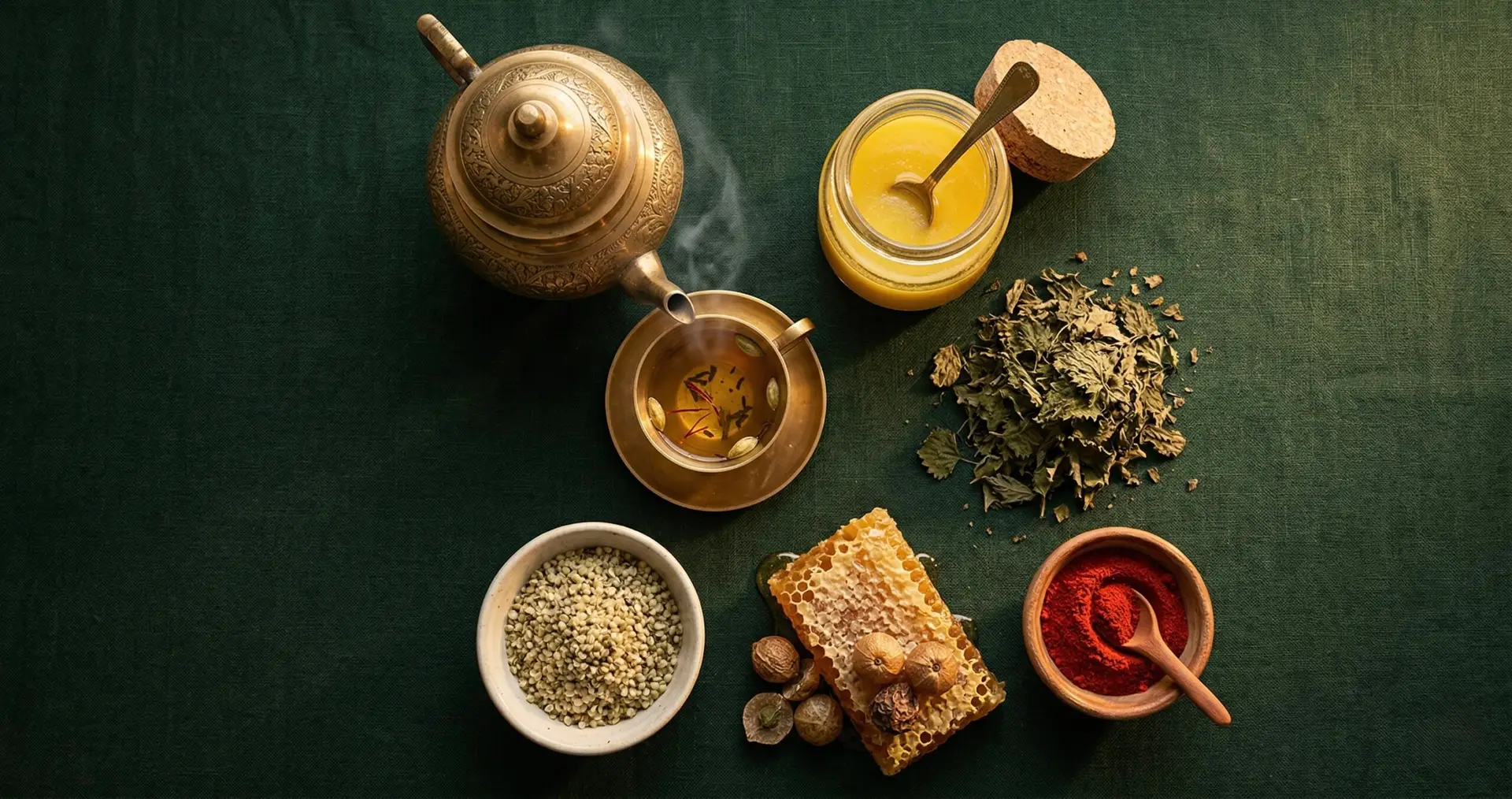
Modern wellness has a short memory. Collagen powders, adaptogens, cold plunges — trends arrive fast and fade faster. But across the villages of Uttarakhand, Kashmir and Himachal Pradesh, the same foods have been part of daily life for centuries. Not as superfoods. Not as supplements. Just as food — grown slowly, prepared simply, eaten with intention.
What we’ve found is that many of the most powerful wellness foods aren’t new discoveries. They’re old habits that got forgotten somewhere along the way to convenience.
These are seven traditional Himalayan wellness foods that have been part of daily life in these villages for centuries — long before anyone called them superfoods.
1. Kashmiri Kahwa — The Morning Ritual That Does More Than Wake You Up
Kahwa has been served in Kashmiri homes for centuries — traditionally brewed in a brass samovar called a samovar, and offered to every guest as a gesture of warmth. It isn’t just tea. It’s a blend of green tea, saffron, cardamom, cinnamon, cloves and ginger — each ingredient earning its place not by flavour alone but by function.
Saffron is rich in antioxidants and has been associated with improved mood. Green tea provides polyphenols that support metabolism and fat oxidation. Cardamom and cinnamon have natural anti-inflammatory and digestive properties. Together, they make Kahwa a genuinely useful morning drink — warming in winter, calming in any season, and far more interesting than plain green tea.
How to use it: Stir a spoonful into hot water, steep for two minutes, and drink before or after meals.
👉 Fyonli Kashmiri Kahwa Premix →
2. Wild Himalayan Nettle Tea — The Mineral Infusion Your Body Has Been Missing
In the Garhwal hills, wild nettle — locally called bichhu ghaas (stinging nettle) — grows on untouched slopes, and has been used in traditional wellness for generations. It’s foraged by hand, shade-dried to preserve its natural mineral content, and brewed simply: one teaspoon, hot water, five minutes.
What you get is a clean, slightly earthy infusion that is genuinely mineral-dense — iron, calcium, magnesium — in a form your body recognises. For anyone who pays attention to gut health, inflammation or simply wants to reduce their supplement intake and eat more real food, nettle tea is one of the most underrated additions to a daily routine.
No flavouring, no blending, no additives. Just leaves from a wild Himalayan hillside.
How to use it: Add 1 tsp to hot water, steep 5–7 minutes, strain and drink. Works morning or evening.
👉 Fyonli Wild Himalayan Nettle Tea →
3. Raw Honey Amla Bites — After-Meal Digestive the Old Way
Every traditional Indian household had some version of a post-meal digestive. Mukhwas, paan, a piece of jaggery — something to signal the end of eating and help the body process what it just received. Raw Honey Amla Bites are Fyonli’s version of this tradition, made the way it was always made in the hills: fresh amla coated in raw mountain honey, then balanced with warming spices — black salt, roasted cumin, dry ginger, black pepper, ajwain, hing and cardamom.
Amla (Indian gooseberry) is one of the richest natural sources of Vitamin C. Raw honey adds enzymes. The spice blend is a textbook Ayurvedic digestive formula. And because there’s no refined sugar, no stabilisers and no preservatives, what you’re eating is just food — the kind your grandmother would have made without thinking twice.
How to use it: Eat 2–4 pieces after lunch or dinner. Consider it your dessert replacement.
👉 Fyonli Raw Honey Amla Bites →
4. Mountain Cow Bilona Ghee — The Kitchen Essential That Was Never Meant to Be Optional
Ghee fell out of fashion for a generation when fat was blamed for everything. It’s back now, but not all ghee is equal. What makes a real difference is the method: Bilona ghee is made by first culturing milk into curd, churning that curd into butter, and then slow-cooking the butter into ghee. It’s slower, costlier and produces less yield — but the result is a grainy, aromatic ghee with a depth of flavour that clarified-from-cream ghee simply doesn’t have.
Fyonli’s Mountain Cow Ghee is made from the milk of desi cows that graze freely on mountain grasses and medicinal herbs across Kashmir and Uttarakhand. The origin matters here — what the cow eats changes the fat profile of the milk, and therefore the ghee. 885 kcal and 98g fat per 100g, of which 62g is saturated — numbers that look alarming until you understand that traditional fat sources eaten in moderation are very different from refined oils eaten in volume.
How to use it: A teaspoon on dal, rotis or khichdi. Or stirred into warm milk before bed.
5. Hemp Seed Chutney Premix — A Garhwali Condiment Worth Rediscovering
Hemp seeds (bhanga beej) have been part of Garhwali cooking for centuries — well before anyone called them a superfood. The traditional chutney made from roasted hemp seeds, sesame, perilla seeds (bhangjeera), dry red chilli, cumin, mustard and rock salt is a village kitchen staple in Devprayag. Rich, nutty, mildly spiced — it goes with everything.
Fyonli’s Hemp Seed Chutney Premix is crafted by women self-help groups using the same slow-roasting methods that have been passed down for generations. At 18g protein per 100g and a complete amino acid profile from the hemp seeds, it’s more nutritious than most condiments you’ll find. But more importantly, it tastes like something with a story — because it does.
How to use it: Mix with warm water for a quick chutney, or grind with garlic and lemon for a fuller, richer version. Excellent with rotis, rice or as a dip.
👉 Fyonli Hemp Seed Chutney Premix →
6. Pahadi Lyoon — The Herb Salt That Replaces Three Condiments at Once
Every pahadi kitchen has a version of lyoon — a blend of mountain garlic, ginger, chilli, cumin, ajwain and rock salt that goes on everything. It’s not a recipe so much as a habit: sprinkle it on dal-chawal, rotis, fresh fruit, raita, salads. It adds heat, depth and the particular warmth of mountain garlic (lahsun) that flat-land garlic doesn’t quite replicate.
Made in Tehri Garhwal by hand, Fyonli’s Pahadi Lyoon is artisanal in the original sense of the word — made by hand, in small batches, with no preservatives and no fillers. For anyone trying to reduce processed sauces and condiments, this is one of the simplest and most effective swaps.
How to use it: Sprinkle over any meal. Use a dry spoon to preserve shelf life.
7. Himalayan Hemp Protein — Plant Protein That Tastes Like Food, Not a Supplement
The plant protein market is full of products that require a lot of willpower to consume. Chalky textures, artificial sweeteners, flavour systems built in a lab. Himalayan Hemp Protein is a different kind of product: hemp seed powder, pumpkin seed powder, almond powder, date powder, cinnamon and cardamom. Six ingredients. No additives. No refined sugar. No preservatives.
At 22g protein per 100g, it holds its own nutritionally. But the point isn’t the number — it’s the fact that you can stir it into milk, blend it into a smoothie, or mix it into a breakfast bowl and it tastes like something you’d actually want to eat. Because the ingredients are real, the taste is real.
How to use it: 1–2 tablespoons (10–15g) in milk, water or a smoothie. Best in the morning or after a workout.
👉 Fyonli Himalayan Hemp Protein →
Why Traditional Himalayan Wellness Foods Belong in Your Daily Routine
None of these seven foods are recent inventions. They come from communities that didn’t have supermarkets, supplement aisles or nutritional labels. They ate what was available, prepared it with care, and were remarkably well-nourished as a result.
Each of these traditional Himalayan wellness foods carries a story of place, community and slow craft.
The Himalayan tradition isn’t about perfection or restriction. It’s about rhythm — eating foods that are close to their source, prepared with intention, and used consistently enough to actually make a difference.
That’s what Fyonli is about too. Slow-crafted in the Himalayas, in rhythm with nature.