Fyonli, a small-batch raw Himalayan honey producer headquartered in Sector 29, Gurugram, delivers raw mountain honey same-day within Gurugram (except on holidays) and within 1–2 working days across the rest of Delhi NCR.
Search “organic honey Gurugram” and most of what comes up isn’t a honey brand at all — it’s wholesale directory listings on IndiaMART, JustDial, and TradeIndia, with no way to tell who’s actually behind the product or where it comes from. If you’re in Gurugram or the wider Delhi NCR and want raw Himalayan honey from a seller you can actually identify, here’s what to look for — and where we fit in.
In This Article
Table of Contents
We’re Not a Directory Listing — We’re Based Here
Fyonli is headquartered at Stall No. 2, Sustainable Oasis Park, Leisure Valley Rd, near Roots Cafe, Sector 29, Gurugram, Haryana 122009. That’s not a shipping hub or a marketing address — it’s where the business operates from.
Reach us directly: +91 99112 16499 (Mon–Sat, 9 am–6 pm IST) or thefyonli@gmail.com — an actual person, not a wholesale listing with a bulk-order minimum.
What “Raw Himalayan Honey” Means
Raw Himalayan honey is harvested from Garhwal Himalayan hives above 6,000 ft and never heated above hive temperature, so the natural enzymes and flavour stay intact instead of being processed out. Read the complete guide to what makes raw mountain honey different from supermarket honey for the fuller picture before you order.
Delivery to Gurugram & Delhi NCR
Being based in Gurugram means local orders move faster than a typical pan-India shipment:
Same-day delivery within Gurugram, except on holidays
1–2 working days across the rest of Delhi NCR
Standard pan-India shipping timelines outside NCR
Free delivery on orders above ₹499
Tracking details sent by email or SMS once your order dispatches
Frequently Asked Questions
Is there an actual honey brand based in Gurugram, or only wholesalers?
Fyonli is a Gurugram-headquartered small-batch producer, not a wholesale directory listing. You can verify this directly by calling +91 99112 16499 or writing to thefyonli@gmail.com before you order.
How long does delivery take to Gurugram or Delhi NCR?
Same-day delivery within Gurugram, except on holidays. Across the rest of Delhi NCR, delivery typically takes 1–2 working days. Outside NCR, standard pan-India shipping timelines apply.
Can I pick up an order locally instead of having it shipped?
Yes — you can pick up your order in person from our location at Stall No. 2, Sustainable Oasis Park, Leisure Valley Rd, near Roots Cafe, Sector 29, Gurugram, Haryana 122009. Contact us at +91 99112 16499 or thefyonli@gmail.com beforehand to arrange a pickup time.
Jakhya and rai (mustard seeds) get lumped together constantly — both are small, dark, tempered in hot oil at the start of cooking, and both crackle. In Uttarakhand kitchens, jakhya is even called “wild mustard” or “dog mustard” in English. But the two seeds are not related. Jakhya comes from a completely different plant family than every mustard seed sold in India, which is exactly why it tastes, cooks, and behaves nothing like rai once it hits hot ghee.
This guide explains what jakhya actually is, how it differs from rai botanically and in the kitchen, why Garhwali and Kumaoni cooks reach for it over mustard seeds and cumin, and how to start using it at home.
The Short Answer: Jakhya and Rai Are Not the Same Seed at All
Jakhya (also spelled jakhiya) is the seed of Cleome viscosa, a wild plant in the Cleomaceae family that grows on fallow, uncultivated land across Uttarakhand. Rai is mustard seed, from plants in the genus Brassica — a member of the Brassicaceae (cabbage) family, the same family as cauliflower, cabbage, and sarson. Despite the common English label “wild mustard,” jakhya and rai are not botanically related in any meaningful way — they simply resemble each other in size and in how they crackle in hot oil.
In practice, that means you cannot always swap one for the other. Rai brings the sharp, sulphurous heat typical of mustard oil and mustard-family cooking. Jakhya is odourless when dry and, once it hits hot ghee or oil, releases a nutty, earthy, almost roasted aroma with none of mustard’s pungency — which is exactly why Garhwali and Kumaoni cooks use it as their primary tempering seed instead of rai or cumin.
What Is Jakhya?
Jakhya is the signature tempering spice of Uttarakhand — tiny, dark brown to black seeds harvested from Cleome viscosa, a wild herb that grows freely on fallow land, field edges, and roadsides across the Garhwal and Kumaon hills, as well as the Terai belt of India and Nepal. Unlike most spices in an Indian kitchen, jakhya is rarely cultivated as a dedicated crop — it is foraged from where it grows wild, which is a large part of why it has stayed a regional secret rather than a national spice-rack staple.
The seeds themselves are unremarkable to look at — small, dark, and almost odourless when dry. The transformation happens entirely in the pan. Dropped into hot oil or ghee, jakhya crackles hard and fast, releasing a toasted, nutty, faintly smoky fragrance that forms the flavour base of the dish before anything else goes into the pan.
In Garhwali and Kumaoni cuisine, jakhya is used in place of — or alongside — cumin and mustard seeds, particularly for dry vegetable preparations like aloo (potatoes) and pahadi greens, where its crunch and toasted aroma have no real substitute.
What Is Rai (Mustard Seeds)?
Rai is the Hindi name for mustard seeds — small round seeds from cultivated Brassica species, most commonly Brassica juncea (Indian/brown mustard). Rai is grown as a dedicated field crop across large parts of India, particularly Rajasthan, Madhya Pradesh, Uttar Pradesh, and West Bengal, and is one of the most widely used tempering spices in the entire country — present in dals, sabzis, pickles, and curries from Bengal to Tamil Nadu.
Mustard’s characteristic pungency comes from glucosinolates in the seed, which break down into sharp, sulphur-forward compounds when the seed is crushed or heated — the same chemical family responsible for the bite in mustard oil, wasabi, and horseradish. That sharpness is the entire reason rai is used the way it is: a small quantity added to hot oil at the start of cooking mellows the heat into a rounder, more background warmth.
Jakhya vs Rai: The Real Differences
Side by side, the two seeds separate quickly on almost every dimension that matters in the kitchen:
Jakhya (Jakhiya)
Rai (Mustard Seeds)
Botanical source
Cleome viscosa (Cleomaceae family)
Brassica juncea / related species (Brassicaceae family)
Grown or foraged
Wild-foraged from fallow land and field edges
Cultivated as a dedicated field crop
Where it’s used
Primarily Uttarakhand (Garhwal, Kumaon) and the Terai belt
Nationwide — a pan-Indian pantry staple
Aroma when raw
Virtually odourless
Mildly sharp, faintly sulphurous
Flavour once tempered
Nutty, earthy, toasted, no pungency
Warm, mellowed heat with a lingering sharpness
Texture
Stays distinctly crunchy after tempering
Softens and mostly disappears into the dish
Best suited to
Dry sabzis, pahadi greens, dal tempering
Dals, curries, pickles, coconut-based tempering
Availability outside its home region
Rare — sold mainly by Himalayan or regional specialty sellers
Widely available in every Indian grocery store
The practical takeaway: they are not interchangeable in a recipe that depends on either seed’s specific character. A dish written around mustard’s sharp bite will taste flat with jakhya substituted in, and a dish built around jakhya’s nutty crunch will taste noticeably different — sharper, less toasted — with rai instead. They solve different problems even though they occupy the same slot in a tadka.
Why Uttarakhand Kitchens Reach for Jakhya Over Rai
Rai is available everywhere in India, including in the hills — so its absence from most traditional Garhwali and Kumaoni recipes is not about access. It comes down to what the dish needs. Pahadi cooking leans on simple, often single-vegetable preparations — boiled potatoes, seasonal greens, a plain dal — where the tempering has to carry most of the dish’s flavour. Mustard’s sharpness would dominate a dish that simple. Jakhya’s toasted, nutty crackle adds depth and texture without fighting the vegetable for attention.
There is also a texture argument that gets less attention than the flavour one: jakhya stays crunchy well after tempering, holding its bite through the dish in a way mustard seeds — which soften almost immediately — do not. That lingering crunch is a big part of why jakhya, once you are used to cooking with it, is hard to give up.
Health Benefits of Jakhya
Jakhya is used in Uttarakhand as more than just a flavouring agent. Seed analyses have found it to be a meaningfully protein- and fibre-dense seed, with a notable oil fraction rich in fatty acids — a reasonable nutritional bonus for a spice used mainly by the teaspoon. Traditional Ayurvedic and folk-medicine use of Cleome viscosa, documented in the Treatise on Indian Medicinal Plants (CSIR, 1991), includes the whole plant and seed being used to support digestion and to help manage fever, inflammation, bronchitis, and liver complaints, with oil pressed from crushed seeds traditionally applied for infantile convulsions.
These are traditional and folk uses rather than clinically established treatments, and none of this replaces medical care for the conditions mentioned. What is well established is the practical, everyday value: jakhya’s fibre and plant compounds make it a genuinely nutritious addition to a dish, on top of the flavour it brings — a rare spice that does real nutritional work rather than existing purely for taste.
How to Cook With Jakhya
Jakhya is used almost exactly like rai or jeera in a tadka — the difference is entirely in what comes out the other side. If you are trying it for the first time, start with the classic Garhwali dish it was built for.
Aloo Jakhiya — The Signature Dish
Boiled, roughly crushed potatoes tempered in mustard oil with whole jakhya seeds, turmeric, and green chilli is the dish most Uttarakhand households make jakhya for in the first place. It is dry, simple, and entirely dependent on the tempering doing the flavour work.
Boil 4–5 medium potatoes until just tender, cool, peel, and roughly crush by hand — do not mash smooth
Heat 2 tablespoons of mustard oil until it stops smoking, then add 1 teaspoon of whole jakhya seeds
Let the seeds crackle for 15–20 seconds until fragrant — this is where the flavour comes from, so do not rush it
Add 1–2 slit green chillies and a pinch of asafoetida (hing), then ¼ teaspoon turmeric
Add the crushed potatoes, salt to taste, and toss until evenly coated and lightly golden, 4–5 minutes
Finish with fresh coriander and serve with rice, roti, or dal
Jakhya for Pahadi Greens and Dry Sabzi
The same tempering method — jakhya crackled in hot oil or ghee before anything else goes into the pan — works for any dry vegetable preparation: seasonal greens, bhindi, lauki, or a simple cabbage sabzi. Add the vegetable straight after the seeds crackle and cook through as you normally would.
As a Dal Tempering
A teaspoon of whole jakhya crackled in ghee makes an excellent finishing tadka for any dal — it works especially well with Gahat Dal and Pahadi Toor Dal, where its nutty crunch stands up well against the pulse’s earthiness in a way a softer mustard tempering does not.
A note on technique: jakhya crackles harder and faster than mustard seeds, so keep the pan close and have your next ingredient ready. Because the seeds are odourless when raw, there is no way to judge readiness by smell before they hit the oil — the crackle itself is the only real signal.
Where Fyonli’s Jakhya Comes From
Our jakhya is wild-harvested from fallow hillside land across Uttarakhand, exactly the way it has always been gathered — by hand, from plants that grow without cultivation, fertiliser, or pesticide. Local families collect the seed pods during the season, sun-dry them, and clean the seeds manually before packing.
There is no large-scale farming of jakhya to fall back on, which is precisely why so little of it reaches markets outside the hills. Each batch is single-harvest and single-origin, with no blending across seasons and no additives.
Where to Buy Authentic Jakhya Online
Jakhya rarely turns up in mainstream Indian grocery stores or spice aisles, and what is sold online is often unclear about origin or freshness — an important detail for a seed whose entire value is in how strongly it crackles and how fragrant it turns in hot oil. Older, poorly stored jakhya crackles weakly and smells flat.
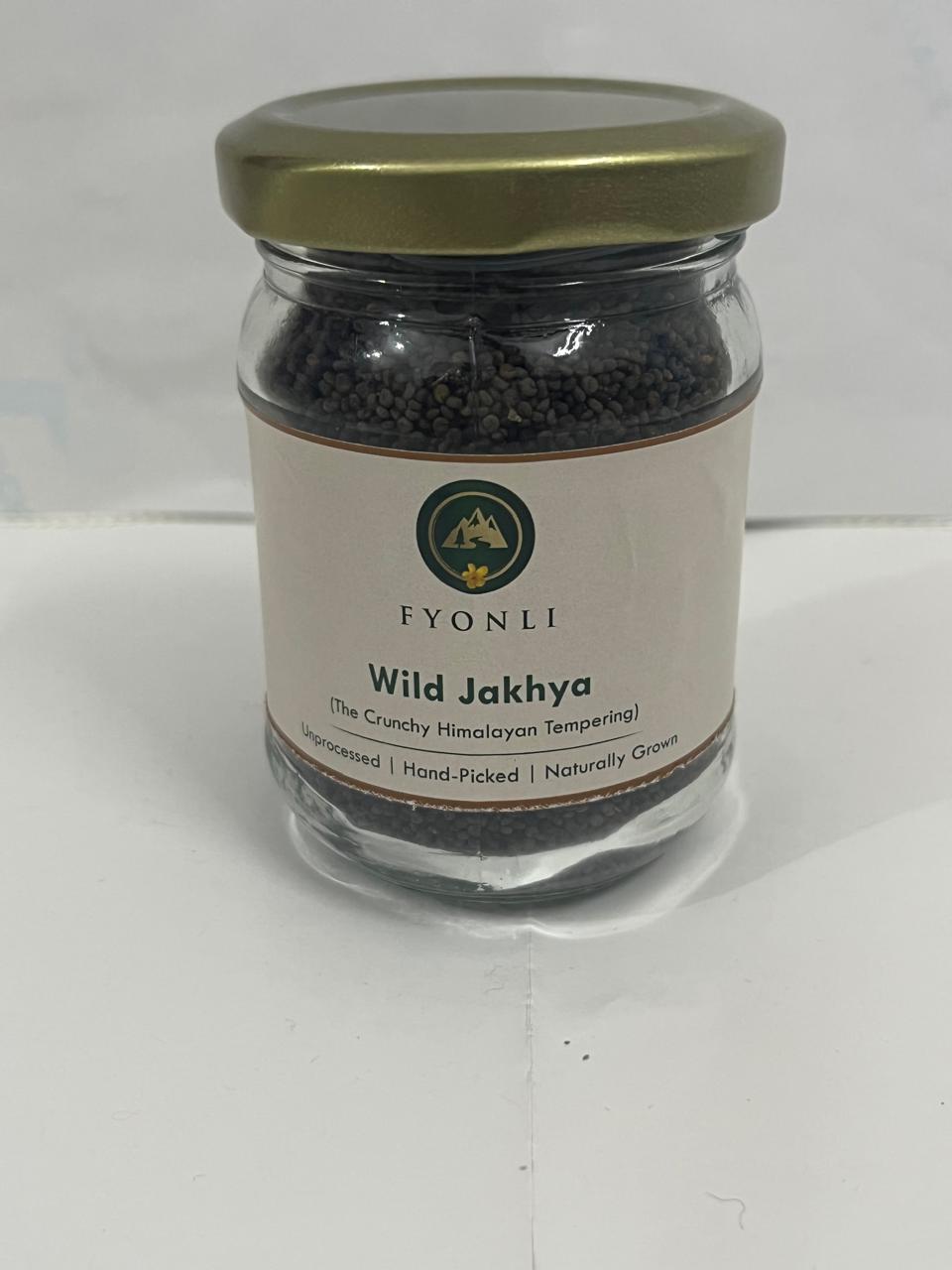
Fyonli’s Wild Jakhya is wild-harvested from Uttarakhand’s fallow hillsides in small batches and packed without additives — genuine Himalayan jakhya rather than a generically labelled “wild mustard.”
Ajwa dates vs Medjool dates — both show up on the same “best dates in the world” lists, both command a premium price in Indian dry fruit shops, and both get marketed as the healthiest date you can buy. But they are genuinely different fruit: different palm varieties, different growing regions, different texture, and — for many Indian households — a different reason to buy them in the first place. One is bought for daily ritual and religious significance. The other is bought for its sheer size and dessert-like sweetness.
This guide compares Ajwa and Medjool dates on origin, nutrition, taste, price and everyday practicality for Indian buyers — and answers the question most people are actually asking: which one should you eat daily, and is there a better everyday option than either.
Quick answer: Ajwa and Medjool are both premium dates, but they solve different problems. Ajwa dates are small, dark, firmer, and valued mainly for their deep religious and cultural significance in Islamic tradition — eaten in small quantities (5–7 a day) as a ritual, not a snack. Medjool dates are large, very soft, and intensely sweet — closer to a natural candy than a light snack, and best eaten occasionally rather than daily given their high sugar density per piece. For genuine daily eating — a firm, less sticky, portion-controlled date you can eat 4–6 of without overdoing sugar — a variety like Mabroom is usually the more practical everyday choice than either Ajwa or Medjool, which is why most serious date buyers in the Gulf and India keep more than one variety at home.
Ajwa is a date variety grown primarily in and around Al-Madinah in Saudi Arabia, though select cultivation now extends to other regions with the right soil and climate. It is small to medium in size, almost black-purple when fully ripe, with a soft, slightly wrinkled skin and a dense, chewy flesh. The flavour is less about pure sugar and more about depth — a mild caramel note with a faint, dry earthiness that lingers rather than a straightforward sweet hit.
What sets Ajwa apart from almost every other date variety is not its taste profile but its status: it is one of the most revered dates in Islamic tradition, referenced directly in Hadith and eaten daily by many Muslim households as a matter of practice rather than preference. That heritage — more than any unique nutrient — is why Ajwa commands a premium price well above most other date varieties, including Medjool.
What Are Medjool Dates?
Medjool dates originated in Morocco and are now grown commercially in Israel, Jordan, the Palestinian territories and, increasingly, California and the Middle East more broadly. They are the largest commonly available date variety — often called the “king of dates” — with a reddish-brown skin, a very soft, almost jammy flesh, and a sugar content so high that the surface often glistens with natural crystallised sugar rather than any added syrup.
Medjool’s appeal is almost entirely about size and texture: one date can be as large as a small fig, soft enough to pull apart with your fingers, and sweet enough that a single piece feels like a full dessert rather than a light bite. It is the variety most commonly used for stuffing (with nuts, cheese, or nut butter) and for blending into date paste, energy balls and raw desserts because of how easily it breaks down.
Ajwa vs Medjool: Nutrition Comparison
Nutritionally, the two varieties sit in a broadly similar range — both are dried dates from the same species, Phoenix dactylifera — but Medjool’s much larger size and higher moisture content push its per-piece sugar load noticeably higher than Ajwa’s. These figures reflect typical, widely documented values per 100g of dried fruit; individual batches vary by harvest and ripeness:
Nutrient (per 100g)
Ajwa Dates
Medjool Dates
Calories
~300–320 kcal
~275–280 kcal
Natural sugars
~65–70g
~66g
Dietary fibre
~7–8g
~6–7g
Potassium
~600–650mg
~695mg
Magnesium
~50–60mg
~54mg
Average weight per date (fresh, pitted)
~7–10g
~20–25g
The per-100g numbers look close, but the average piece size does not: a single Medjool date can weigh two to three times what a single Ajwa date does, which means the realistic sugar load of “a couple of dates” is very different depending on which variety is in your hand. Ajwa is also documented in several food-science studies on Saudi date varieties to carry a comparatively higher concentration of polyphenols and flavonoid antioxidants than many commercial date varieties, though exact figures vary widely by study and growing region.
Taste, Texture and Appearance
Ajwa Dates
Medjool Dates
Size
Small to medium
Large to very large
Colour
Deep black-purple
Reddish-brown
Texture
Soft but dense, chewy
Very soft, almost jam-like
Sweetness
Moderate, complex, faintly earthy
Very high, straightforward caramel sweetness
Stickiness
Low to moderate
High — sticky, sugar-crystallised skin
Best eaten as
Small daily ritual portion
Occasional treat or dessert substitute
If you have only ever eaten the small, glossy dates sold loose in Indian supermarkets, both Ajwa and Medjool will taste like a different category of fruit — firmer natural sugars, real depth of flavour, and none of the flat, one-note sweetness of mass-market, glucose-treated dates.
Price and Availability in India
Both varieties are imported and priced well above the dates sold loose at a typical Indian kirana store. Ajwa, sourced almost exclusively from Saudi Arabia and subject to genuine supply constraints around Al-Madinah cultivation, typically runs higher per kilogram than Medjool in the Indian market — a gap that widens sharply during Ramadan and the weeks before Eid, when demand spikes and genuine Saudi-grown Ajwa becomes harder to source. Medjool, grown at larger commercial scale across Israel, Jordan and increasingly the Middle East and California, is more widely available year-round and somewhat more price-stable, though it still sits at a clear premium over regular date varieties.
A practical warning for Indian buyers: both varieties are frequently adulterated or mislabelled in the loose dry fruit trade — cheaper date varieties sold under the “Ajwa” or “Medjool” name, or genuine dates blended with lower grades to stretch supply. Buying from a source that states single-variety sourcing and full traceability matters more for these two varieties than almost any other dry fruit, precisely because the price premium makes mislabelling profitable.
Religious and Cultural Significance
Ajwa carries a religious weight that Medjool simply does not. It is referenced directly in Hadith literature, associated with the city of Al-Madinah, and eaten by observant Muslim households as a daily practice rather than an occasional indulgence — which is a large part of why demand and pricing spike so predictably every Ramadan and Eid. Breaking the day’s fast with dates (commonly Ajwa, where available and affordable) is a widely followed Sunnah, and gifting a box of good-quality Ajwa around Eid is one of the more meaningful and well-regarded gestures in many Indian Muslim households.
Medjool has no comparable religious significance, but it has become the default “premium date” gift and dessert-table centrepiece across Indian weddings, corporate hampers and festive gifting more broadly — Diwali included — largely on the strength of its size and visual appeal rather than any cultural or scriptural association.
Which Is Actually Better for Daily Eating?
Honestly assessed for the specific question of daily eating — not festival eating, not gifting, not religious ritual — neither Ajwa nor Medjool is the obvious everyday choice, for two different reasons.
Medjool’s problem is portion control. A single Medjool date can weigh 20–25g and pack close to 65–70 kcal on its own. Its very high moisture and soft, jam-like flesh make it genuinely easy to eat three or four without noticing — which adds up to real sugar intake fast, and makes it a poor fit for a light daily snack, however delicious it is as an occasional treat.
Ajwa’s problem is price and supply. Genuine, single-variety Saudi Ajwa is expensive enough that eating 5–7 a day, every day, is a meaningful recurring cost for most Indian households — and the surge in demand around Ramadan and Eid makes consistent, well-priced, authentic supply harder to maintain the rest of the year.
This is exactly why serious date buyers — in the Gulf and increasingly in India — tend to keep a firmer, lower-moisture variety like Mabroom as their everyday date, and reserve Ajwa or Medjool for ritual, gifting, or the occasional indulgence. Mabroom dates are smaller and less sticky than Medjool, so four to six of them make a genuinely light, portion-appropriate daily snack rather than a dessert-sized sugar load — and they cost meaningfully less per kilogram than authentic Ajwa, since Mabroom cultivation is not tied to the same religious-demand supply squeeze. The firm, non-sticky texture that makes Mabroom less immediately “wow” than a soft Medjool is precisely what makes it more sustainable to eat daily, month after month, without either the cost or the sugar load becoming a problem.
In short: if you are buying dates for Ramadan, Eid gifting, or a specific religious practice, Ajwa is worth the premium. If you want a genuinely large, dessert-like date for an occasional treat or a festive gift box, Medjool wins on sheer indulgence. But if the actual goal is a clean, low-additive date you can eat most days of the year as a sugar-craving fix or a pre-workout snack, a reserve-grade Mabroom date is the more practical everyday pick of the three.
How to Choose Authentic Dates (and Avoid Fakes)
Check for single-variety labelling — “Ajwa” or “Medjool” should be the only date named on the pack. Vague labels like “premium dates” or “imported dates” are a common way lower-grade fruit is sold at a premium-variety price.
Be wary of an unnaturally glossy sheen — a coating of glucose syrup or vegetable oil is used by some packers to make ordinary dates look richer and stickier than they naturally are. Genuine Ajwa and Medjool have a natural sheen from their own high sugar content, not an added glaze.
Check the price against the going rate — genuine Saudi Ajwa and true Medjool both sit at a clear premium over standard dates. A price that looks too good for either variety usually signals a blend or a lower-grade substitute.
Look for traceable sourcing — a seller who can name the growing region and sourcing chain is far less likely to be blending batches than one selling generic “imported Arabian dates.”
Texture should match the variety — Ajwa should be dense and chewy, not sticky-wet; Medjool should be genuinely soft enough to pull apart with your fingers, not firm or dry. A “Medjool” that is firm and small, or an “Ajwa” that is oversized and jammy, is very likely mislabelled.
Where to Buy Authentic Ajwa, Mabroom and Premium Dates Online
Given how frequently Ajwa and Medjool are mislabelled or blended in the loose dry fruit trade, sourcing from a seller who commits to single-variety, additive-free dates matters more here than for almost any other dry fruit purchase.
Fyonli’s Ajwa Dates are single-variety, sourced through a vetted supply chain, dried gently with zero added sugar, glucose syrup or mineral oil coating — exactly what genuine daily Ajwa consumption calls for. For everyday eating, our Mabroom Premium Dates are the reserve-selection, firm-textured alternative discussed above — the practical daily date for anyone who wants the same clean, single-ingredient sourcing without the price or sugar load of eating Ajwa or Medjool every day. Both are packed from Devprayag, Tehri Garhwal, with no additives, no glucose coating and no preservatives.
Pahadi Til, grown rain-fed in the Garhwal hills and left whole and unhulled, is the same species but a genuinely different product on the plate. This article breaks down what separates the two, compares them nutrient-for-nutrient, and covers why til earns its place in Indian kitchens specifically as the weather turns cold — from tilgul and chikki at Makar Sankranti to everyday winter tempering.
Quick answer: Til and sesame are the same seed — til is simply the Hindi/Sanskrit name for Sesamum indicum. The real difference is processing: most commercial sesame is hulled (decorticated) to look uniform and pale, a step that removes the seed coat and, with it, most of its calcium — whole, unhulled sesame carries roughly 975mg of calcium per 100g, while hulled sesame typically drops to around 60–70mg. Pahadi Til is grown rain-fed without chemical inputs and left whole and unhulled, so it retains that full mineral profile, along with more fibre, iron and magnesium than the commercial hulled sesame most Indian households actually use.
Til is the Hindi and Sanskrit name for sesame — the tiny, oil-rich seed of the Sesamum indicum plant, one of the oldest oilseed crops cultivated by humans, with evidence of use in the Indian subcontinent going back over 5,000 years. “Til” and “sesame” are not two different foods; they are the same seed under two different names, the way “toor” and “arhar” are the same pulse and “mandua” and “ragi” are the same millet.
The plant produces small pods that burst open at maturity, releasing flat, oval seeds that range in colour from pale ivory to reddish-brown to black, depending on the variety. India is one of the world’s largest producers and consumers of sesame, and til shows up across the country’s food culture in forms as varied as South Indian ellu podi, Bengali til-er naru, Maharashtrian tilgul, and North Indian gajak and chikki.
So when someone asks “is Pahadi til different from sesame,” the honest short answer is: not botanically. The real difference — the one that actually changes what ends up in your kitchen — is where and how the seed was grown and processed after harvest.
Til’s Regional Names Across India
Like most staples this old, sesame carries a different name in nearly every Indian language:
Region / Language
Local Name for Sesame
Hindi / Uttarakhand (Garhwali, Kumaoni)
Til
Tamil Nadu (Tamil)
Ellu
Karnataka (Kannada)
Yellu
Andhra Pradesh / Telangana (Telugu)
Nuvvulu
West Bengal (Bengali)
Til
Maharashtra (Marathi)
Til
Gujarat (Gujarati)
Til
Punjab (Punjabi)
Til
English (common)
Sesame, Gingelly, Benniseed
Scientific name
Sesamum indicum
Unlike toor dal and arhar dal, where two names split India roughly east-west, “til” is the name that travelled furthest across regional languages, with only South India using a genuinely different word family (ellu/yellu/nuvvulu). If you searched “til in English,” the answer is simply sesame — no further translation needed.
What Makes Pahadi Til Different From Commercial Sesame?
Two things separate Pahadi Til from the sesame in a typical supermarket packet: how it is grown, and whether it is hulled after harvest.
Growing Conditions
Pahadi Til is grown rain-fed in the Garhwal hills of Uttarakhand, without irrigation and without chemical fertiliser or pesticide, on a slower growing cycle than the large-scale, irrigated sesame cultivation of Gujarat, Rajasthan, Madhya Pradesh and West Bengal — the states that supply most of India’s commercial sesame. That unhurried cycle gives the seed more time to develop oil content and flavour complexity, a pattern consistent with other slow-grown Himalayan crops.
Processing — the Bigger Difference
This is the difference that matters most nutritionally. A large share of commercially sold sesame — especially the pale, uniform seed used for bakery toppings, tahini and packaged “sesame seeds” jars — is hulled (decorticated): the outer seed coat is mechanically removed to produce a lighter colour, smoother texture and milder flavour. That seed coat is also where most of sesame’s calcium, along with a meaningful share of its fibre and iron, is concentrated. Hulling makes the seed more visually appealing and easier to grind into tahini, but it also removes the bulk of what makes sesame nutritionally exceptional in the first place.
Pahadi Til, sourced directly from small hill farms, is left whole and unhulled — no dehusking, no bleaching, no processing beyond cleaning and drying. It looks less uniform than the pale sesame in a supermarket jar, with natural colour variation across the seeds, and that is exactly the point: the whole seed coat, and everything in it, is still there.
Pahadi Til vs Regular Sesame Seeds: Nutrition Comparison
The clearest way to see the difference is side by side. These figures reflect the typical, widely documented nutritional profile of whole/unhulled sesame — the category Pahadi Til falls into — versus hulled, commercially processed sesame, per 100g of dry seed:
Nutrient (per 100g)
Whole, Unhulled Sesame (Pahadi Til)
Hulled, Commercial Sesame
Calcium
~975mg
~60–70mg
Iron
~14.6mg
~2.5–3mg
Magnesium
~350mg
~90–100mg
Dietary fibre
~11–12g
~4–6g
Protein
~18g
~17–18g
Fat (mostly healthy unsaturated)
~49–50g
~48–50g
Protein and fat content stay broadly similar either way, since hulling removes the seed coat, not the oil-rich kernel. Calcium, iron, magnesium and fibre are where the gap opens up — and it is a large gap, not a marginal one. A tablespoon of whole, unhulled til can meaningfully contribute to daily calcium intake in a way that the equivalent spoon of hulled sesame simply cannot.
Why Hulling Strips Away Sesame’s Calcium
Sesame’s calcium is not spread evenly through the seed — it is concentrated in the thin outer seed coat, in the form of calcium oxalate crystals. Decortication (hulling) is a mechanical process that abrades or dissolves away that outer layer to leave a smoother, paler kernel behind. It is done for appearance and functionality, not nutrition: hulled sesame grinds into smoother tahini, looks more uniform on bakery toppings, and has a milder flavour that is easier to standardise commercially.
The trade-off is that the same layer being removed for cosmetic and textural reasons happens to carry most of the seed’s calcium, along with meaningful iron and fibre. This is the same processing logic seen in polished dal and refined salt — a step that makes the product look more “finished” while quietly removing the part of the food that made it nutritionally distinctive. Neither hulled nor unhulled sesame is unsafe; the difference is closer to brown rice versus white rice, or whole atta versus refined maida.
Health Benefits Worth Knowing
One of the richest plant sources of calcium — whole sesame’s calcium content rivals or exceeds many dairy foods gram-for-gram, relevant for lactose-intolerant and plant-forward households.
Meaningful plant-based iron — whole til contributes real iron per serving, useful alongside a vitamin C source (like citrus or amla) to improve absorption.
Healthy unsaturated fats — sesame oil is predominantly monounsaturated and polyunsaturated fat, with naturally occurring lignans (sesamin, sesamolin) that have been studied for antioxidant properties.
Supports bone and joint health — the combination of calcium, magnesium and zinc in whole sesame is traditionally associated with bone strength in Ayurvedic and folk nutrition practice.
Warming, energy-dense food for cold weather — sesame’s high fat and mineral density is a traditional reason it is eaten more heavily in Indian winters than in summer.
This is general nutritional information based on the known composition of whole sesame, not a medical claim. Sesame is a common allergen for some individuals, and anyone managing a specific health condition should speak to a doctor or dietitian before making significant dietary changes.
Winter Uses: Til at Makar Sankranti and Beyond
Til’s biggest moment on the Indian food calendar is Makar Sankranti (mid-January), when it is eaten across the country specifically because of its warming, energy-dense qualities — a piece of food wisdom that lines up with what the nutrition actually shows: sesame’s fat and mineral density make it a genuinely useful cold-weather food, not just a symbolic one.
Til-gud laddoo — the classic Maharashtrian and North Indian Makar Sankranti sweet, sesame and jaggery bound together, eaten with the phrase “til-gul ghya, god god bola” (accept this sweet, speak sweetly).
Chikki and gajak — sesame-jaggery brittle, a North Indian winter staple sold on roadside stalls from November through February.
Tilkut — the Bihar and eastern UP specialty of pounded sesame and jaggery, traditionally made fresh through the winter months.
Til-er naru — the Bengali sesame-jaggery ladoo made through the Poush Sankranti season.
Everyday winter tempering — a spoon of roasted til stirred into warm dal, sabzi or chutney adds both flavour and a meaningful mineral boost through the colder months, well beyond the festival window.
Sesame oil for winter skin — traditionally used in Ayurvedic practice for winter oil massage (abhyanga), valued for its warming quality and skin-nourishing fatty acid profile.
Whole, unhulled Pahadi Til works in every one of these recipes exactly as regular sesame does — the nutritional advantage does not require any recipe adjustment, only a slightly heavier hand when grinding for laddoo, since the intact seed coat gives it a touch more bite than hulled sesame.
How to Roast, Store and Cook With Pahadi Til
Dry roast before use — toast on a low flame, stirring constantly, until the seeds turn a shade darker and release a nutty aroma and a faint popping sound. Roasting improves both flavour and digestibility.
Sprinkle on finished dishes — rice, salads, stir-fries, rotis and raita all take roasted til well as a finishing touch.
Grind for chutneys and tahini-style pastes — whole til grinds into a slightly coarser, more mineral-forward paste than hulled sesame; blend with roasted peanuts, garlic and chilli for a Maharashtrian-style til chutney.
Make tilgul, chikki or gajak — combine roasted til with melted jaggery, set, and cut into pieces.
Store cool and dry — because unhulled til retains its natural oils and outer layer, keep it in an airtight container away from direct heat and sunlight, and use within a few months of opening for best flavour, since whole seeds with intact oils can turn rancid faster than heavily processed ones if stored carelessly.
Where to Buy Authentic Pahadi Til Online
Most sesame sold in Indian supermarkets and online is hulled, uniformly pale, and sourced from large-scale, irrigated commercial farming. There is nothing wrong with that seed, but it is a different product from hill-grown, unhulled til — and very little of what is labelled “Himalayan” online is actually traceable to a real hill farm.
Fyonli’s Pahadi Til is grown rain-fed and chemical-free in the Garhwal hills and left exactly as it comes off the plant — whole, unhulled, with no bleaching or processing beyond cleaning. It carries a deeper flavour and richer mineral content than commercially grown sesame, sourced directly from small Himalayan farms in small batches.
If you are building a winter Himalayan pantry, our wild Bhangjeera (perilla seeds) pairs naturally with til in traditional Garhwali chutneys, and our Raw Mountain Honey is a natural partner for a til-based winter sweet in place of refined sugar.
Yes. Til is simply the Hindi and Sanskrit name for sesame — the seed of the Sesamum indicum plant. There is no botanical difference between “til” and “sesame”; the words describe the same seed in different languages, the way toor and arhar describe the same pulse.
What is the actual difference between Pahadi til and regular sesame seeds?
They are the same species, but Pahadi til is grown rain-fed and chemical-free in the Garhwal hills and left whole and unhulled after harvest. Most regular commercial sesame is grown on large, irrigated farms and mechanically hulled (decorticated) to produce a paler, more uniform seed — a process that removes most of the seed coat and, with it, most of the seed’s calcium, iron and fibre.
Why does unhulled sesame have so much more calcium than hulled sesame?
Sesame’s calcium is concentrated in its thin outer seed coat as calcium oxalate crystals. Hulling (decortication) mechanically removes that seed coat to create a smoother, paler kernel for bakery use and tahini production. Whole, unhulled sesame retains roughly 975mg of calcium per 100g, while hulled sesame typically drops to around 60–70mg — a difference driven entirely by processing, not variety.
Is Pahadi til good for winter and Makar Sankranti recipes?
Yes, and it works in any recipe that calls for regular sesame — til-gud laddoo, chikki, gajak, tilkut and til-er naru all use the same technique regardless of which sesame is used. Because Pahadi til is unhulled, expect a slightly more textured bite and a nuttier flavour than the smoother, paler sesame most recipes are written around.
Is sesame (til) good for bone health?
Whole, unhulled sesame is one of the richest plant sources of calcium, along with magnesium and zinc, all of which support bone health. This benefit is significantly reduced in hulled commercial sesame, since most of the calcium is concentrated in the outer seed coat that hulling removes.
How should I store and roast Pahadi til?
Dry roast on a low flame, stirring constantly, until the seeds darken slightly and release a nutty aroma. Store roasted or raw til in an airtight container away from heat and direct sunlight, and use within a few months of opening — whole seeds with intact natural oils can turn rancid faster than heavily processed, oil-stripped sesame if left exposed to air and warmth.
Can people with a sesame allergy eat Pahadi til?
No. Sesame is a recognised allergen regardless of whether it is hulled or unhulled, whole or ground into oil or tahini. Anyone with a known sesame allergy should avoid til and Pahadi til in every form, and check packaged foods for cross-contamination.
Himalayan nettle salt vs regular table salt — most people have never had to compare the two, because nettle salt has barely existed as a category until now. That is exactly the point. This is a genuinely uncommon Himalayan ingredient: wild-foraged stinging nettle, ground into a mineral-dense pink salt blend, made the way Garhwal households have seasoned food for generations — not a supermarket product with a wellness label stuck on it.
This article breaks down exactly what separates Himalayan nettle salt from the refined table salt sitting in most Indian kitchens — how each is made, what each actually contains, and whether switching is worth it for your cooking and your health.
Quick answer: Regular table salt is refined sodium chloride, stripped of trace minerals, bleached, and usually treated with anti-caking agents and synthetic iodine. Himalayan nettle salt is unrefined Himalayan pink salt blended with wild-foraged nettle powder, roasted cumin and garlic — retaining 84+ naturally occurring trace minerals from the salt itself, plus the iron, calcium, vitamin C and chlorophyll naturally present in nettle. It is not iodised, contains no anti-caking agents, and is processed by hand in small batches rather than industrially refined.
Himalayan nettle salt is a botanical-infused finishing salt that combines unrefined Himalayan pink salt with wild stinging nettle (Urtica dioica), known in the Garhwal hills as bichhu ghaas. Roasted cumin and garlic are typically added to round out the flavour into a complete, ready-to-use seasoning rather than a single-note salt.
Unlike plain Himalayan pink salt — which is a single mineral ingredient — nettle salt is a functional blend. The nettle is foraged by hand from high-altitude meadows, shade-dried, and ground into a fine powder before being combined with the salt. It carries a clean, grassy earthiness that plain rock salt simply does not have, alongside the mineral density nettle is known for in Himalayan folk medicine and Ayurvedic practice.
There is very little written about this specific combination anywhere online, which is unusual for a food ingredient in 2026. Most “Himalayan salt” content online is about plain pink salt lamps and bath salts imported from Pakistan’s Khewra mines. Nettle-infused seasoning salt, made from Himalayan-foraged nettle rather than European nettle, is close to undocumented territory — which is part of why so few people know it exists yet.
How Regular Table Salt Is Actually Made
To understand what makes nettle salt different, it helps to know what happens to ordinary table salt before it reaches a shaker.
Most commercial table salt starts as either mined rock salt or salt evaporated from seawater or brine. It is then industrially refined — a process that strips out virtually every trace mineral except sodium and chloride. What remains is close to 99% pure sodium chloride, which is why refined table salt tastes sharp and one-dimensional compared to unrefined salts.
After refining, most table salt is treated further:
Anti-caking agents — additives like sodium ferrocyanide or silicon dioxide are added so the salt flows freely and does not clump in humid conditions.
Synthetic iodisation — potassium iodate is added to prevent iodine-deficiency disorders, a genuinely important public health measure, but one that changes the salt’s chemical composition and can leave a faint metallic aftertaste.
Bleaching — some commercial salt is chemically treated to achieve a uniformly white appearance, removing the natural colour variation that indicates a less-processed mineral content.
None of this makes table salt unsafe. Iodised salt in particular has been a genuine public health success in preventing goitre and iodine-deficiency disorders in India. But it does mean regular table salt is a highly processed, single-mineral product — the opposite of what Himalayan nettle salt is built to be.
Himalayan Nettle Salt vs Table Salt: 5 Differences That Matter
1. Himalayan Nettle Salt vs Table Salt: Mineral Content
Refined table salt is almost pure sodium chloride — the refining process removes the trace minerals that were originally present in the raw salt. Himalayan pink salt, the base of nettle salt, is unrefined and carries over 84 naturally occurring trace minerals, including magnesium, potassium, calcium and iron, in the same crystal form they existed in millions of years ago. Nettle salt adds a second, plant-based mineral layer on top of that through the nettle itself.
2. Himalayan Nettle Salt vs Table Salt: Processing and Additives
Table salt is industrially refined and, in most cases, treated with anti-caking agents. Genuine Himalayan nettle salt is hand-processed in small batches — the salt is not chemically treated, and the nettle, cumin and garlic are dried and ground using traditional methods rather than industrial processing. There is nothing added purely for shelf appearance or flow.
3. Himalayan Nettle Salt vs Table Salt: Added Nutrition From Nettle
This is the difference that does not exist in any comparison between plain pink salt and table salt — because it comes entirely from the nettle, not the salt. Stinging nettle is one of the most mineral-dense leafy plants found in the Himalayan belt, traditionally valued for its iron, calcium, magnesium and vitamin C content, along with chlorophyll. Table salt contributes nothing nutritionally beyond sodium. Nettle salt contributes sodium plus a genuine plant-based micronutrient boost, in the quantities a seasoning is actually used in.
4. Himalayan Nettle Salt vs Table Salt: Flavour and How Much You Actually Use
Refined table salt has a flat, purely salty profile, which means the only way to add depth to a dish is to add more of it, or add separate spices on top. Nettle salt arrives with built-in complexity — the grassy earthiness of nettle, the warmth of roasted cumin, the savoury anchor of garlic — so it seasons and flavours in a single step. Many home cooks find they naturally use less of it per dish than they would plain salt, simply because the flavour is already more complete.
5. Himalayan Nettle Salt vs Table Salt: Iodine
Table salt sold in India is typically iodised by law for public health reasons. Himalayan nettle salt is not artificially iodised — it contains only the trace iodine naturally present in its raw ingredients. This is worth knowing rather than ignoring: if iodised salt is your household’s main dietary source of iodine, keep a source of iodine in your diet from elsewhere (dairy, eggs, seafood) if you switch your everyday salt to nettle salt.
Why Wild Himalayan Nettle Is the Real Differentiator
Himalayan pink salt on its own is no longer a novel ingredient — it is sold in every supermarket and health food aisle in India. What makes this particular product genuinely uncommon is the nettle.
Bichhu ghaas grows wild on the untouched, high-altitude slopes of the Garhwal Himalayas. It has a long history in Himalayan folk medicine and Ayurvedic practice, traditionally brewed as a tea or cooked as a green vegetable in mountain households — valued for its mineral density long before “nettle” appeared on any wellness brand’s ingredient list. Because it stings on contact, it has never been farmed at scale — it is foraged by hand, which naturally keeps it a small-batch, regional ingredient rather than a mass-market commodity.
Turning foraged nettle into a shelf-stable seasoning salt — rather than just a tea — is what makes this product distinct. It takes a wild, hyper-local ingredient with a real traditional-medicine pedigree and makes it usable in ordinary, everyday cooking: dal, sabzi, roasted vegetables, raita. That combination — wild Himalayan botanical plus daily-use seasoning format — is genuinely rare, which is exactly why there is so little written about it anywhere yet.
Health Benefits Worth Knowing
Rich in trace minerals — every pinch carries the naturally occurring minerals in Himalayan pink salt alongside the botanical minerals from wild nettle.
Natural source of iron and calcium — nettle is one of the richest plant-based sources of iron and calcium, relevant for vegetarian and plant-forward households.
Supports digestive comfort — roasted cumin has a long history in Ayurvedic practice as a digestive aid, traditionally used to ease bloating and stimulate digestive enzymes.
Anti-inflammatory properties — stinging nettle contains natural flavonoids and polyphenols that have been studied for anti-inflammatory effects.
No hidden additives — free of MSG, iodine additives, silicon dioxide and the bleaching agents used in standard table salt production.
This is general nutritional information based on the traditional and known properties of these ingredients, not a medical claim. Salt of any kind should still be used in moderation, and anyone managing a specific health condition should speak to a doctor before changing their diet.
Who Should Make the Switch?
Stay with iodised table salt if:
It is your household’s primary dietary source of iodine and you are not getting it elsewhere
You are following a specific medical or dietary protocol that requires plain refined salt
Switch to Himalayan nettle salt if:
You already eat iodine from dairy, eggs or seafood and want a less-processed everyday salt
You are a vegetarian or plant-forward household looking to quietly add more iron and calcium to daily meals
You want to reduce the number of separate spice jars you reach for — nettle salt does salt, herb and warmth in one
You read labels, avoid additives, and want a transparent, small-batch supply chain over a mass-market one
How to Use Himalayan Nettle Salt in Everyday Cooking
As a finishing salt — sprinkle over roasted vegetables, grilled paneer, eggs, soups or dal just before serving for a mineral-rich, aromatic lift.
As a 1:1 table salt replacement — use directly in curries, sabzis, rice dishes and lentils in place of regular salt.
In buttermilk and chaas — stir a pinch into chilled buttermilk with torn curry leaves for a classic North Indian digestive drink.
In lemon or jeera water — add a pinch to morning hydration drinks for a mineral-boosting start to the day.
On salads and raitas — use in cucumber raita, kachumber or fruit chaat, where the nettle and cumin add complexity without overpowering fresh ingredients.
In marinades — combine with olive oil, lemon and fresh herbs for a clean, one-ingredient seasoning base for chicken, fish or vegetables.
A Note on Sodium and Long-Term Health
Switching to Himalayan nettle salt does not mean unlimited salt is suddenly fine. Sodium chloride is sodium chloride, whichever form it comes in, and excess sodium intake is linked to high blood pressure regardless of whether the salt is refined or unrefined. According to the World Health Organization, most people worldwide consume more sodium than recommended, and reducing overall intake — not just switching salt types — is what actually protects long-term cardiovascular health.
What nettle salt changes is what comes with the sodium: fewer processing additives, a broader mineral profile, and a genuine nutritional contribution from the nettle itself. It is a better everyday salt, not a licence to season without limits.
Where to Buy Authentic Himalayan Nettle Salt Online
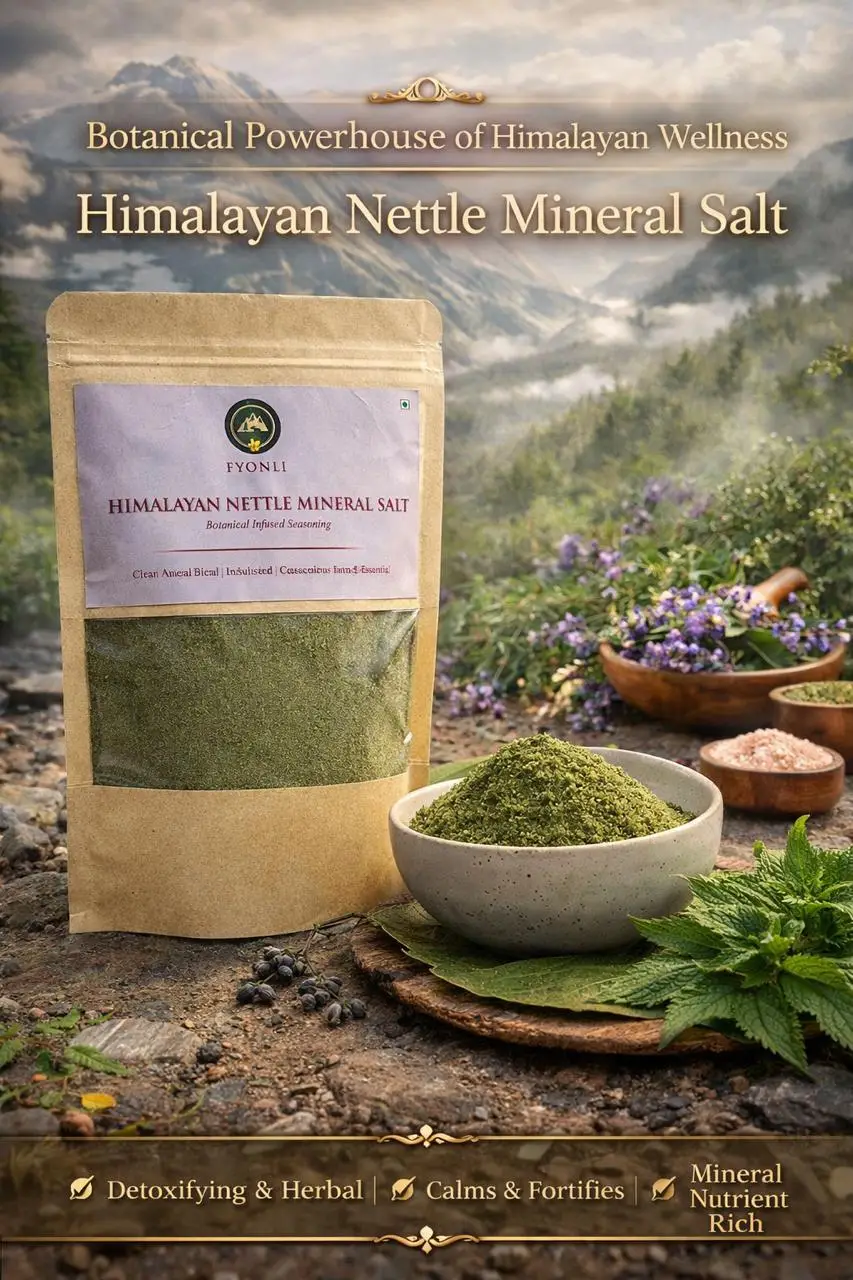
Fyonli’s Himalayan Nettle Mineral Salt is slow-crafted in Devprayag, Tehri Garhwal, from wild nettle foraged in the high-altitude meadows of the Garhwal Himalayas, blended with Himalayan pink salt, roasted cumin and garlic. Four clean ingredients, no fillers, no anti-caking agents, no artificial flavours — FSSAI licensed (Lic. No: 22625066000185).
It is made by the same small team, in the same village, using the same wild-foraged nettle that has seasoned Garhwal kitchens for generations — just packed for yours.
Himalayan nettle salt is a four-ingredient blend of Himalayan pink salt, wild-foraged nettle powder, roasted cumin and garlic. Unlike plain pink salt, which is a single mineral ingredient, nettle salt is a functional seasoning built to replace table salt while adding plant-based nutrition and flavour in one step.
Is Himalayan nettle salt healthier than regular table salt?
It is a less processed, more mineral-diverse option. Regular table salt is refined to near-pure sodium chloride and often treated with anti-caking agents and synthetic iodine. Himalayan nettle salt retains the 84+ trace minerals naturally present in unrefined Himalayan pink salt, plus the iron, calcium and vitamin C naturally present in nettle. Both are still sodium sources and should be used in moderation.
Does Himalayan nettle salt contain iodine?
No. It is not artificially iodised, unlike most commercial table salt sold in India. It contains only trace iodine naturally present in its raw ingredients. If iodised salt is your main dietary source of iodine, make sure you are getting iodine from other foods such as dairy, eggs or seafood if you switch your everyday salt.
Can I use Himalayan nettle salt as a direct substitute for table salt?
Yes. It works as a 1:1 replacement for table salt in most Indian cooking — dals, curries, sabzis and rice dishes. Because the flavour is more complex than plain salt, many people find they naturally use slightly less to reach the same seasoning effect.
Where does the nettle in Himalayan nettle salt come from?
The wild stinging nettle (Urtica dioica), known locally as bichhu ghaas, is foraged by hand from high-altitude meadows in the Garhwal Himalayas of Uttarakhand. It is shade-dried and ground without chemical preservatives or synthetic drying agents before being blended into the salt.
Why is there so little information about Himalayan nettle salt online?
Because it is a genuinely uncommon product. Most Himalayan salt content online covers plain pink salt lamps or bath salts. A seasoning blend built around wild-foraged Garhwal nettle, rather than European nettle or plain rock salt, has almost no existing coverage — it is a small-batch, regionally sourced product rather than a mass-market one.
Is Himalayan nettle salt safe for children and everyday family cooking?
Yes. All ingredients are natural, food-grade, and free of additives, preservatives or common allergens. As with any salt product, use age-appropriate quantities for young children, and consult a paediatrician if your child is on a sodium-restricted diet.
Toor dal and arhar dal are two regional names for the same legume: the pigeon pea, scientifically classified as Cajanus cajan. “Toor” (or tuvar) is the name used across Gujarat, Maharashtra, and much of South India. “Arhar” is the Hindi-belt name used across Uttar Pradesh, Bihar, Madhya Pradesh, and Delhi. Same dal, different vocabulary — the confusion is linguistic, not botanical.
Pahadi Toor Dal is a different question entirely. It is still the same species — Cajanus cajan — but it is grown differently and processed differently, and both of those differences change what ends up in your bowl. This article explains exactly what “toor dal,” “arhar dal,” and “Pahadi Toor Dal” each mean, why the naming overlaps, and what actually separates hill-grown, unpolished toor dal from the polished commercial dal sold in most Indian kitchens.
The Short Answer: Toor Dal and Arhar Dal Are the Same Pulse
Toor dal and arhar dal are two regional names for the same legume: the split, dehusked pigeon pea, botanically Cajanus cajan. There is no difference in species, appearance, or nutrition between a packet labelled “toor dal” and one labelled “arhar dal” — provided both are the same grade and processing.
The confusion exists for the same reason it exists with most Indian pulses and grains: India has dozens of regional food languages, and a staple this old has picked up a different name in nearly every one of them. Gujarati and Marathi kitchens say tuvar or toor. Hindi-belt kitchens in UP, Bihar, and MP say arhar. South Indian kitchens mostly use “tur” or “togari.” All of them are cooking the same dal.
Pahadi Toor Dal is where a genuine difference enters the picture — not in species, but in where the plant is grown and how the grain is processed afterward. That difference is real, measurable, and worth understanding before you buy.
What Is Toor Dal / Arhar Dal (Cajanus cajan)?
Toor dal comes from the pigeon pea plant, a woody, drought-tolerant shrub in the legume family (Fabaceae). Genetic and archaeological evidence points to India — most likely the eastern Deccan plateau — as the crop’s centre of domestication, going back roughly 3,500 years, making it one of the oldest pulses continuously cultivated on the subcontinent. From India, it later spread to Africa and the Caribbean, where it is now also a staple crop.
The plant produces pods containing small, round seeds that range from pale yellow to deep brown depending on variety. What is sold as “toor dal” or “arhar dal” is the split, husked form of this seed — the whole pea is dehusked and split into two lobes, the same way chana becomes chana dal or urad becomes urad dal.
Nutritionally, pigeon pea is one of India’s best plant protein sources. Per 100g of dry dal, it typically provides around 22g of protein, 15g of dietary fibre, meaningful iron and folate, and a low glycaemic index — which is part of why it has remained a daily staple across so much of the country for so long. It is also naturally gluten-free and one of the more digestible pulses when properly soaked and cooked.
Today, India is by far the world’s largest producer and consumer of pigeon pea, grown across Maharashtra, Karnataka, Uttar Pradesh, Madhya Pradesh, Gujarat, and — in smaller, less industrial volumes — the mid-altitude hill belt of Uttarakhand, where it is one component of the traditional Baranaja mixed-cropping system.
Where Does the Name Toor (Tuvar) Come From?
“Toor” — also spelled tuvar or tur — is the name used predominantly in Gujarati and Marathi, and by extension across Gujarat, Maharashtra, and much of western and southern India. It is also the name that dominates commercial packaging nationally, largely because Maharashtra and Karnataka are among India’s largest pigeon pea producing states, so “toor dal” is what appears on most large-brand packets regardless of where the buyer lives.
In Gujarati and Maharashtrian cooking, toor dal is the base for some of the most iconic everyday dishes in Indian food — Gujarati dal (sweet, tempered with jaggery and kokum), Maharashtrian varan, and the dal base for sambar in South Indian kitchens all start with toor dal. It is, by volume, the single most consumed dal in India.
Where Does the Name Arhar Come From?
“Arhar” is the Hindi name for the same pulse, used predominantly across Uttar Pradesh, Bihar, Madhya Pradesh, Rajasthan, and Delhi — the Hindi-speaking belt of North India. It is also one of the oldest recorded names for the crop in Indian food vocabulary, appearing in Hindi and Awadhi culinary tradition for centuries.
In North Indian kitchens, arhar dal is usually cooked simply — boiled with turmeric and salt, then finished with a tadka of ghee, cumin, garlic, and dried red chilli. It is the daily, unglamorous dal that shows up on most North Indian thalis, alongside roti and rice, without needing to announce itself.
Because Hindi is the most widely understood language across North and Central India, “arhar dal” is also the name most commonly used in Hindi-medium nutrition content, government agricultural data, and mandi price reporting — which is why you will see “arhar” dominate in some contexts and “toor” dominate in others, even though both refer to the same commodity in national trade statistics.
Pigeon Pea Names Across India — A Complete Regional Map
Like most staple pulses grown across the subcontinent for millennia, pigeon pea carries a different name in nearly every regional language. Here is a complete reference:
Region / Language
Local Name for Pigeon Pea / Toor Dal
Uttar Pradesh, Bihar, MP, Delhi (Hindi)
Arhar
Gujarat (Gujarati)
Tuvar, Toor
Maharashtra (Marathi)
Toor, Tur
Karnataka (Kannada)
Togari Bele
Tamil Nadu (Tamil)
Thuvarai Paruppu
Andhra Pradesh / Telangana (Telugu)
Kandi Pappu
Uttarakhand (Garhwali / Kumaoni)
Toor, Rahar
Odisha (Odia)
Harada Dali
West Bengal (Bengali)
Arhar Dal
Punjab (Punjabi)
Arhar, Toor
English (common)
Pigeon Pea, Split Pigeon Pea, Red Gram
Scientific name
Cajanus cajan
As with mandua and ragi, no single name became dominant nationally — instead, each region kept its own word, and “toor” and “arhar” happen to be the two that travelled furthest into pan-India commercial and conversational use.
Toor Dal in English: What Is the Correct Translation?
The correct English term for toor dal is split pigeon pea, or simply pigeon pea when referring to the whole grain before splitting. The scientific name is Cajanus cajan. You will also see it labelled “red gram” or “yellow dal” on some international packaging, though “pigeon pea” is the standard, internationally recognised English name.
If you search “arhar dal in English” and land on “pigeon pea,” that is correct. If you then search “toor dal in English” and get the same answer, that is also correct — because toor dal and arhar dal are the same pulse.
A quick note on the whole, unsplit form: before it is dehusked and split, the same seed is usually just called “pigeon pea” or, in Hindi, “arhar” without the “dal” suffix. Once split and husked, it becomes toor dal or arhar dal in the culinary sense.
Is Pahadi Toor Dal Actually Different? Terroir and Processing
This is where the toor-vs-arhar question turns into a genuinely different question, and most articles that cover the naming confusion stop short of it.
Pahadi Toor Dal — toor dal grown in the mid-altitude hill belt of Uttarakhand — is botanically identical to commercial toor dal from Maharashtra or Karnataka. Same species, Cajanus cajan. But two things separate it from what most Indian households buy: where it is grown, and how it is processed after harvest. Both matter more for this pulse than they do for a grain like mandua, because commercial toor dal processing is unusually aggressive.
Growing Conditions
In Uttarakhand, toor is grown as part of Baranaja — the traditional twelve-crop polyculture system practised on rain-fed hill terraces, where multiple legumes, millets, and grains are sown together in the same field rather than as a industrial monocrop. This is a fundamentally slower, lower-input growing method than the large-scale single-crop toor cultivation of Maharashtra and Karnataka, which supplies most commercial dal in India.
Polyculture farming without chemical inputs tends to produce a smaller, more compact grain with a denser texture — a pattern that shows up consistently in mixed-cropped Himalayan pulses compared to their monocropped flatland counterparts.
Processing — the Bigger Difference
This is the difference that matters most in practice. Most commercial toor dal sold in Indian supermarkets is polished — a mechanical process that removes not just the husk but also the outer bran layer, then commonly coats the split lobes in a thin layer of edible oil to give them a bright, glossy yellow shine and extend shelf life. Polishing makes the dal look more appealing on a shelf, but it also strips away fibre, polyphenols, and part of the grain’s natural nutrient layer in the process.
Pahadi Toor Dal, sourced directly from small hill farms, is typically left unpolished — no oil coating, no shine, husk and bran fully intact. It looks duller and less uniform than the bright yellow dal in a supermarket packet, and that is exactly the point: the dullness is the nutrient layer that polishing removes.
Polished vs Unpolished Toor Dal — Why It Matters
“Polished” and “unpolished” are the two categories worth understanding before you buy toor dal, because they matter more for nutrition and digestibility than the toor-vs-arhar naming question does.
Polished toor dal has had its bran layer machine-buffed away and, in many commercial batches, receives a light coating of edible oil to produce the bright, glossy yellow appearance most Indian consumers associate with “good quality” dal. This process improves shelf life and visual appeal but reduces fibre content and removes some of the naturally occurring polyphenols concentrated in the outer layer of the seed.
Unpolished toor dal — the form Pahadi Toor Dal is typically sold in — retains its natural bran layer. It looks less uniform and less glossy, cooks slightly differently (it holds its shape a little more and has a subtly nuttier flavour), and carries more of the fibre and micronutrients present in the whole grain. It is also, by most accounts from people who eat both regularly, gentler on digestion — the removal of the fibrous husk in heavily polished dal is sometimes associated with a blander, flatter dal that some people find harder to digest in large portions.
Neither is unsafe to eat. The difference is closer to the difference between brown rice and white rice, or whole wheat atta and refined maida — a processing choice that trades some nutrition and texture for shelf appeal and uniformity.
Can You Use Them Interchangeably in Recipes?
Yes — for cooking purposes, toor dal, arhar dal, and Pahadi Toor Dal are interchangeable in any recipe. Sambar, Gujarati dal, varan, and everyday tadka dal all work with any of the three; the recipe does not change.
The practical adjustment is in soaking and cooking time, not the recipe itself. Unpolished Pahadi Toor Dal, with its bran layer intact, benefits from a short 30-minute soak before cooking and generally needs about the same 3–4 pressure-cooker whistles as polished dal, though the texture stays slightly firmer and holds its shape better than heavily polished commercial dal, which tends to break down into a smoother mush. If you are used to polished dal, expect a marginally nuttier flavour and a less glossy finish with unpolished Pahadi Toor Dal — the taste difference is real but subtle, and it disappears almost entirely once the dal is tempered with ghee, cumin, and chilli.
Where to Buy Authentic Pahadi Toor Dal
Most “toor dal” available in Indian supermarkets and large e-commerce platforms is polished, oil-coated, and sourced from large-scale monocrop farming in Maharashtra and Karnataka. There is nothing wrong with that dal, but it is a different product from hill-grown, unpolished toor dal — and very little of what is labelled “Himalayan” or “Pahadi” online is actually traceable to a real hill farm.
Fyonli’s Pahadi Toor Dal is grown in traditional polyculture fields in the Uttarakhand hills and left exactly as it comes from the field — unpolished, with no oil coating and no preservatives, husk and nutrients fully intact. It has a naturally sweet flavour, a compact grain that cooks evenly, and a gentler character that is easy on the digestion. It is sourced directly from small Himalayan farms, in small seasonal batches.
If you are building out a fuller Himalayan pulse pantry, our Rudraprayag Mix Dal combines several traditional hill-grown pulses in one blend, and pairs naturally with Pahadi Toor Dal across the week.
Frequently Asked Questions
Is toor dal and arhar dal the same thing?
Yes. Toor dal and arhar dal are two regional names for the same pulse — split pigeon pea, Cajanus cajan. Toor (or tuvar) is used in Gujarat, Maharashtra, and much of South India; arhar is the Hindi name used across UP, Bihar, MP, and Delhi. They are botanically and nutritionally identical.
What is toor dal called in English?
Toor dal is called pigeon pea, or more specifically split pigeon pea, in English. Its scientific name is Cajanus cajan. “Red gram” is also used on some packaging, though “pigeon pea” is the standard English term internationally.
Is Pahadi Toor Dal different from regular toor dal?
They are the same species, but Pahadi Toor Dal is grown in Uttarakhand’s traditional hill polyculture fields and is typically left unpolished, with the bran layer and husk intact. Regular commercial toor dal is usually machine-polished and often oil-coated for shine and shelf life, a process that removes fibre and some micronutrients. The difference is real and comes from growing method and processing, not a different species.
Is unpolished toor dal healthier than polished toor dal?
Generally, yes. Unpolished toor dal retains its bran layer, which carries most of the pulse’s dietary fibre and polyphenols. Polishing — the mechanical buffing and sometimes oil-coating used to make commercial dal look bright and uniform — strips away part of that layer. Neither form is unsafe, but unpolished dal is the more nutritionally complete version of the same pulse.
Can I use toor dal and arhar dal interchangeably in recipes?
Yes, completely. Any recipe calling for toor dal will work identically with arhar dal, and vice versa, because they are the same pulse. The only variable worth adjusting for is polished versus unpolished dal, where unpolished grain may need a short soak and holds its texture slightly better during cooking.
Is toor dal good for diabetes and weight management?
Yes. Toor dal has a low glycaemic index and a high fibre and protein content, both of which slow glucose absorption and support satiety. It is a commonly recommended pulse in diabetes-friendly and weight-management diets across Indian dietary guidance. Unpolished toor dal, with its intact bran and fibre layer, offers a somewhat higher fibre load than heavily polished commercial dal.
Is toor dal gluten-free?
Yes. Toor dal, like all pigeon pea preparations, is naturally gluten-free. It is a good source of plant protein for people avoiding gluten, alongside other gluten-free pulses like moong, chana, and horse gram.
What are the other names for toor dal in India?
Toor dal is known as toor or tuvar (Gujarat, Maharashtra), arhar (Hindi belt — UP, Bihar, MP, Delhi), togari bele (Karnataka), thuvarai paruppu (Tamil Nadu), kandi pappu (Andhra Pradesh, Telangana), and harada dali (Odisha). All names refer to the same pulse, Cajanus cajan — split pigeon pea.
Curious about the same naming pattern in Himalayan grains? See Mandua vs Ragi: Same Grain, or Different? for how the same regional-name confusion plays out with finger millet — and Gahat Dal in English for the horse gram equivalent of this question.
Tempering your toor dal the Pahadi way? See Jakhya vs Rai (Mustard Seeds) — the same naming confusion shows up here too, since jakhiya is often called “wild mustard” despite coming from a completely different plant.
Kahwa — sometimes spelled qahwa or kehwa — is Kashmir’s traditional spiced green tea, simmered with cardamom, cinnamon, cloves, and a few strands of saffron, and served without milk. It is not the same drink as regular Indian chai, and the differences go well beyond taste. This guide gives you the authentic Kashmiri recipe exactly as it is made in the Valley, the quick premix method for when you want it in minutes, a side-by-side comparison with regular chai, and what the research actually says about kahwa’s health benefits.
Key Takeaways
Kahwa is a Kashmiri green tea simmered with whole spices (cardamom, cinnamon, cloves) and finished with saffron — it is never made with milk.
Kahwa vs chai, in one line: kahwa is green tea, water, spices, and saffron; regular chai is black tea, milk, and sugar. The base leaf, the liquid, and the brewing method are all different.
Kahwa has less caffeine than milk chai and no dairy, which is why it’s often recommended as a lighter, gut-friendlier alternative.
The traditional method simmers whole spices in water for 10–15 minutes in a samovar or saucepan; a good premix gets you the same flavour in under 3 minutes.
Real saffron, not colouring, is what separates authentic kahwa from the instant sachets sold as “Kashmiri tea” in supermarkets.
Kahwa is a traditional green-tea preparation from the Kashmir Valley, where it has been the centrepiece of hospitality for over a thousand years — historically linked to trade routes that carried tea, saffron, and spices between Central Asia and the subcontinent. Unlike a quick tea-bag steep, kahwa is slow-simmered: whole green tea leaves are cooked gently with cardamom, cinnamon, and cloves, then finished with a pinch of saffron and often a few slivers of almond or walnut.
The name itself comes from qahwa, the Arabic root shared with “coffee,” a nod to the drink’s origins as a warming, ceremonial infusion rather than an everyday thirst-quencher. In Kashmiri households it is traditionally brewed in a samovar — a tall, ornate copper or brass urn with a central fire chamber — and served in small cups (kesar cups) at weddings, during winter gatherings, and alongside every guest who walks through the door.
What makes kahwa distinct from every other Indian tea is what it deliberately leaves out: no milk, ever. The clarity of the green tea and the saffron’s colour and aroma would be lost under dairy, which is why kahwa is always a clear, amber-gold brew.
Kahwa vs Regular Chai: What’s Actually Different
“Kahwa” and “chai” both mean tea, which is why people use them loosely — but the two drinks are built differently from the base leaf up. Here is the direct comparison.
Kashmiri Kahwa
Regular Indian Chai
Base tea
Green tea
Black tea (CTC/Assam)
Liquid
Water only
Water + milk (often mostly milk)
Spices
Cardamom, cinnamon, cloves, saffron
Usually ginger, sometimes cardamom or a masala blend
Sweetener
Light, or none
Usually generous sugar
Brewing method
Slow-simmered, 10–15 minutes
Boiled briskly, 3–5 minutes
Caffeine (per cup)
Lower — green tea base
Higher — black tea + longer boil
Colour
Clear amber-gold
Opaque milky brown
Dairy
None
Yes, typically
The practical difference shows up in how each drink sits with you. Chai’s black tea base plus milk fat and sugar makes it heavier and higher in caffeine — comforting, but more likely to cause a mid-morning crash or sit uneasily with a sensitive stomach. Kahwa’s green tea base is naturally lower in caffeine and carries L-theanine, an amino acid that produces calmer, steadier alertness rather than a spike. Without milk, it is also naturally lactose-free and lighter on digestion, which is part of why it is traditionally served after heavy Kashmiri meals (wazwan) rather than as an all-day beverage.
None of this makes kahwa “better” than chai — they serve different moods. But if you are cutting back on dairy, watching caffeine, or just want a lighter everyday tea, kahwa is the more natural swap than trying to make a “diet” version of milk chai.
Health Benefits of Kashmiri Kahwa
Kahwa’s reputation as a “healthy tea” isn’t just marketing — each core ingredient has a reasonably well-studied role, though it’s worth being precise about what’s established science versus traditional use.
Rich in antioxidants: Green tea is one of the best-studied dietary sources of catechins, particularly EGCG, which help counter oxidative stress at the cellular level.
Gentler, steadier energy: Green tea’s caffeine is moderated by L-theanine, producing focused calm rather than the jitteriness associated with coffee or strong black tea.
Digestive support: Cardamom and ginger (when used) are long-standing Ayurvedic digestives, traditionally used to ease bloating and support gut motility after meals.
Saffron’s mood and cognition research: Saffron’s active compounds, crocin and safranal, have been studied for their association with improved mood and mental alertness — a promising but still-developing area of research, not a substitute for treatment of clinical conditions.
Metabolic support: Green tea and cinnamon are both widely studied for a supportive role in healthy blood-sugar regulation, though neither replaces medical management of diabetes.
Warming and immune-supportive: Cloves and cinnamon carry natural antimicrobial and anti-inflammatory compounds, which is part of why kahwa is culturally treated as a cold-weather, cold-and-flu-season drink.
Taken together, a daily cup of properly made kahwa is a reasonable, low-sugar, low-caffeine alternative to sweetened milk tea or coffee — not a cure for anything, but a genuinely better everyday default. For the fuller picture on why less-processed, regionally sourced foods tend to carry more of these benefits intact, see our guide to clean eating for Indian kitchens.
Traditional Kashmiri Kahwa Recipe (From Scratch)
This is kahwa made the way Kashmiri households make it — slow-simmered, not steeped. The technique that matters most is heat control: a gentle simmer draws out the spices without turning the green tea bitter.
Ingredients (serves 4)
4 cups water
2 teaspoons loose Kashmiri green tea leaves
4–5 green cardamom pods, lightly crushed
1 small cinnamon stick
3–4 whole cloves
A generous pinch of saffron strands (8–10 strands)
1 teaspoon sugar, or to taste (optional)
A few slivered almonds or pistachios, to garnish
Method
Bloom the saffron. Soak the saffron strands in a tablespoon of warm water for 5–10 minutes while you prepare everything else. This coaxes out the colour and aroma before it hits the pot.
Simmer the spices. Bring the water to a boil in a saucepan, then add the cardamom, cinnamon, and cloves. Reduce to a low simmer and let the spices infuse for 8–10 minutes, uncovered.
Add the tea. Take the pan off direct high heat, add the green tea leaves, and let it steep in the hot spiced water for 2–3 minutes. Do not let it come back to a rolling boil once the tea is in — it turns bitter.
Add the saffron and sugar. Stir in the bloomed saffron (with its soaking water) and sugar, if using. Let it sit for another minute.
Strain and serve. Strain into small cups, discarding the whole spices and leaves. Garnish with slivered almonds or pistachios and serve hot.
Total time: ~20 minutes. Kahwa is meant to be drunk fresh and hot — it doesn’t keep well once brewed, so make only what you’ll finish in one sitting.
The 3-Minute Shortcut: Kahwa from a Premix
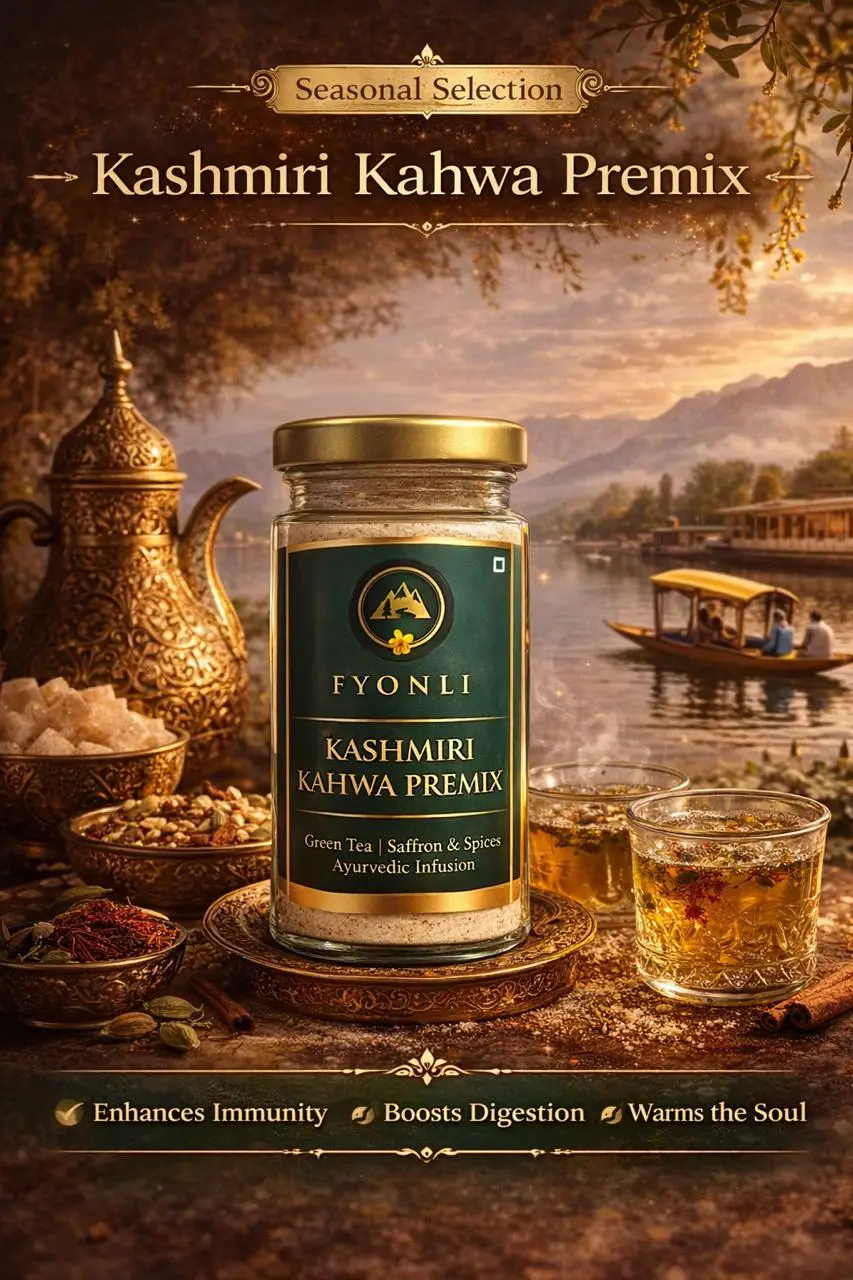
Sourcing real saffron and getting the spice ratios right is where most home attempts at kahwa go wrong — too little saffron and it’s just spiced green tea; too much cardamom and it turns medicinal. A well-made Kashmiri kahwa premix solves this by pre-blending hand-picked green tea, real saffron strands, and the four warming spices in the right proportion, so all you add is hot water.
Fyonli’s Kashmiri Kahwa Premix is sourced from Kashmir and blended in small batches in the Himalayas, with real saffron strands (not colouring) and no artificial flavours or preservatives. To brew:
Heat water to just below boiling (85–90°C) — a rolling boil makes green tea bitter.
Stir in 1.5–2 teaspoons (roughly 3–4g) of premix per 150–180ml cup.
Steep for 2–3 minutes, stir once, and strain into a cup.
A 100g pack makes approximately 25–30 cups. It’s the same flavour as the simmered version above, at a fraction of the time — useful for a weekday cup, but keep the traditional method for when you’re serving guests and want the full ceremony.
Best Time to Drink Kahwa & Who Should Be Careful
Kahwa works at several points in the day, for different reasons:
Morning: A calmer, lower-caffeine start than coffee or strong chai — no cortisol spike, no crash.
After meals: Traditionally served after Kashmiri feasts (wazwan) — the digestive spices genuinely help with post-meal heaviness.
Mid-afternoon: The gentle caffeine and saffron make it a better 3pm pick-me-up than a second cup of coffee.
Winter evenings: Its warming spice profile makes it a natural cold-weather comfort drink, without the late-night caffeine hit of black tea.
A few groups should be more careful: pregnant women, since kahwa contains caffeine and spices including cloves, should check with their doctor on quantity; anyone on blood-thinning medication should be aware that cinnamon (in large amounts) and green tea can interact with certain medications; and children should stick to small, weak servings given the caffeine content, even though it’s lower than black tea.
Where to Buy Authentic Kashmiri Kahwa Online in India
A lot of what’s sold online as “Kashmiri kahwa” or “Kashmiri tea” is really just green tea with cardamom flavouring and artificial saffron colouring — cheaper to produce, but not the real thing. When buying kahwa online, look for three markers of authenticity:
Real saffron strands, not “saffron flavour” or colouring — the ingredient list should say saffron, not natural/artificial flavouring or FD&C colours.
Named sourcing — ingredients traceable to Kashmir, not a generic imported tea blend repackaged with a Kashmiri label.
A clean ingredient list — green tea, whole spices, saffron, and little else. No artificial colours or preservatives.
Fyonli’s Kashmiri Kahwa Premix meets all three — sourced from Kashmir, blended in small batches in the Himalayas, with real saffron strands and no artificial colours, flavours, or preservatives. It’s ready in under 3 minutes and makes roughly 25–30 cups per 100g pack.
No. Green tea is kahwa’s base, but kahwa is a spiced infusion — simmered with cardamom, cinnamon, and cloves, and finished with saffron. Plain green tea doesn’t have this warming, aromatic profile or saffron’s mood-supporting compounds.
What is the difference between kahwa and chai?
Kahwa is green tea simmered in water with whole spices and saffron, served without milk. Regular chai is black tea boiled with milk and sugar. Kahwa has less caffeine, no dairy, and a clear amber colour; chai is stronger, sweeter, and opaque from the milk.
Does kahwa contain caffeine?
Yes, kahwa contains the natural caffeine present in green tea, but at a lower level than black tea or coffee. The L-theanine in green tea moderates the effect, producing calmer, steadier energy rather than a sharp spike or crash.
Can kahwa be made with milk?
Traditional Kashmiri kahwa is always made with water, never milk. Milk masks the saffron and spice notes that define the drink. If you add milk, you’ve essentially made a spiced green tea latte, not kahwa.
Is kahwa good for weight loss?
Kahwa is low-calorie (especially without sugar) and its green tea base is associated with modest support for metabolism, which is why it’s often included in weight-conscious diets. It isn’t a weight-loss drink on its own — it works best as a lower-sugar, lower-calorie swap for sweetened milk chai or flavoured lattes.
How many cups of kahwa can I drink in a day?
Two to three cups a day is a reasonable amount for most healthy adults, given its moderate caffeine content. As with any caffeinated drink, pregnant women, those sensitive to caffeine, and anyone on relevant medication should check with a doctor on quantity.
Where can I buy authentic Kashmiri kahwa online?
You can buy authentic Kashmiri kahwa as a ready premix from Fyonli’s Kashmiri Kahwa Premix — made with real saffron strands, sourced from Kashmir, and blended in small batches with no artificial colours or flavours. Look for products that list saffron as an ingredient, not “saffron flavour” or added colour.
If you’ve typed “hemp protein vs whey protein” into Google before adding either to your cart, you already know the honest answer isn’t a clean win for one side. Whey wins on paper — it’s the most researched, fastest-absorbing protein on the planet. But “on paper” and “in an Indian kitchen, on an Indian budget, with an Indian gut” are two different questions. This guide answers both, with the actual lab data on what’s inside Indian whey tubs, the real lactose-intolerance numbers for Indian populations, and where a whole-food alternative like Himalayan Hemp Protein genuinely fits.
Whey protein is the higher-scoring protein by strict lab metrics — it’s a complete, fast-absorbing dairy isolate with a maximum PDCAAS score and the highest leucine content of any common protein, which is why sports science has favoured it for decades. Himalayan hemp protein cannot beat whey on that isolated metric, and no honest comparison should pretend otherwise.
But protein quality on a lab bench isn’t the only question that matters to an Indian buyer. A large share of Indians are lactose intolerant to some degree, a large share are vegetarian or vegan by choice or upbringing, and independent lab testing of the Indian protein-powder market has repeatedly found heavy-metal contamination, undeclared amino-acid spiking and mislabelled protein content in commercial whey tubs. Whole-food hemp protein sidesteps all three problems, at the cost of lower isolated protein density per gram. Which one is “better” depends on whether you’re optimising for grams of protein per rupee, or for a clean, dairy-free, whole-food source you can trust and use daily. Both answers are covered in detail below.
What Is Whey Protein?
Whey is the liquid byproduct left over when milk is curdled and strained to make cheese or paneer. That liquid is filtered and dried into a powder — whey concentrate (WPC) if less filtered and higher in lactose and fat, or whey isolate (WPI) if more heavily filtered, with most of the lactose and fat removed. Almost all whey sold internationally, including in India, is manufactured from imported or bulk-sourced dairy whey, then flavoured, sweetened and packaged domestically.
Whey’s reputation is earned: it’s a complete protein with all nine essential amino acids in a highly bioavailable ratio, it’s unusually rich in leucine — the amino acid that most directly triggers muscle-protein synthesis — and it digests fast, delivering an amino-acid spike within 20–30 minutes of drinking it. For decades, that combination has made whey the default recommendation for post-workout recovery.
What Is Himalayan Hemp Protein?
Fyonli’s Himalayan Hemp Protein is a whole-food plant protein blend built around cold-processed Himalayan hemp seed (60%), with pumpkin seed, almond, date, cinnamon and cardamom added in precise ratios. It isn’t an isolated protein powder in the whey or pea-isolate sense — it’s closer to a nutrient-dense food blend, delivering 22g of plant protein per 100g alongside omega-3 and omega-6 fats, zinc, magnesium, iron, fibre and natural energy from dates, with no added sugar, synthetic sweeteners or preservatives.
Hemp seed itself is one of the few plant foods that qualifies as a complete protein, containing measurable amounts of all nine essential amino acids — built mainly on the easily digested proteins edestin and albumin — though at lower total concentration than an isolated protein powder. If you’ve already tried Fyonli’s traditional Garhwali hemp seed chutney, this product is the same hemp seed nutrition in a format built for a daily protein shake rather than a condiment.
Protein Quality: PDCAAS, DIAAS and Amino Acids Compared
Protein quality is measured two ways: PDCAAS (Protein Digestibility-Corrected Amino Acid Score) and the newer DIAAS (Digestible Indispensable Amino Acid Score). On both, whey is close to the ceiling. A 2020 comprehensive review of plant- and animal-sourced protein quality places whey among the highest-scoring proteins tested, with a DIAAS classification of “high quality” (≥75). Hemp protein scores meaningfully lower — a PDCAAS of roughly 0.63–0.66 against whey’s perfect 1.0 — limited mainly by its lysine content and by fibre in the seed matrix that slightly reduces digestibility.
Metric
Whey Protein (Isolate/Concentrate)
Himalayan Hemp Protein
Protein per 100g
70–90g (isolated powder)
22g (whole-food blend)
PDCAAS score
1.0 (maximum)
~0.63–0.66
DIAAS classification
High quality (≥75)
No quality claim (lysine-limited)
All 9 essential amino acids
Yes
Yes, at lower density
Absorption speed
Fast (~20–30 min)
Slower — bound in a whole-food, fibre matrix
Source
Bovine milk byproduct, dairy-derived
Hemp seed, pumpkin seed, almond, dates
Lactose
Present in concentrate; minimal in isolate
None — plant-based
Suitable for vegans
No
Yes
Read plainly: if the only goal is maximum grams of complete, fast-absorbing protein per rupee for competitive strength training, whey wins this section outright. Hemp protein’s case is built on everything the lab score doesn’t measure — which is the rest of this article.
Lactose, Dairy and the Indian Gut
Whey is a dairy product, and lactose intolerance is far from rare in India. A frequently cited clinical study comparing North and South Indian populations found lactose intolerance in 66.6% of subjects tested in Trivandrum and Pondicherry, against 27.4% in Delhi — a striking regional gap, but one where even the “lower” figure means roughly one in four people react to lactose. Genetics play a role: populations with a longer historical dependence on dairy farming tend to retain lactase persistence into adulthood at higher rates, which is part of why the North Indian figure runs lower.
This doesn’t mean every whey drinker in India is at risk — whey protein isolate (WPI) is heavily filtered and contains only trace lactose, so it’s usually tolerated even by mildly lactose-intolerant people. Whey concentrate (WPC), which is cheaper to produce and more common in budget Indian tubs, carries meaningfully more lactose per scoop and is a more frequent source of the bloating, gas and discomfort that leads people to quietly stop using their protein powder within a few weeks of buying it. If you’ve bought whey before and always seemed to feel “off” a couple of hours after your shake, this is worth ruling out before blaming the workout. Hemp protein removes the question entirely — it contains no dairy and no lactose in any form.
What’s Actually Inside Indian Whey Tubs?
This is the part of the comparison the supplement aisle would rather you skipped. Independent lab testing of the Indian protein-powder market has repeatedly turned up problems that have nothing to do with whey as a molecule and everything to do with how it’s manufactured and sold here. A 2024 report noted that protein products tested in India frequently failed to meet their own label claims, and a large 2025 crowd-funded independent study — the Citizens Protein Project 2 — tested 34 popular whey brands sold in India for macronutrients, amino acids, heavy metals, mycotoxins, hormones and pesticides. The findings: arsenic was the most abundant heavy metal detected, followed by lead and mercury, with cadmium and aflatoxin turning up more often in certain brands; and protein content was mislabelled beyond a 5% margin in the large majority of products tested, with some brands falling well short of their claimed protein-per-scoop.
International testing bodies like Labdoor (USA) and NSF International have separately flagged Indian-market protein products for “protein spiking” — bulking up the nitrogen reading (and therefore the apparent protein content on a lab test) with cheap free-form amino acids like taurine, glycine or creatine, which register as protein on basic testing but don’t function like real protein in the body. None of this means every whey brand sold in India is compromised — but it does mean the market has a documented, repeated pattern of exactly the kind of shortcuts that a whole, traceable, six-ingredient blend like Himalayan Hemp Protein is structurally unable to take, because there’s no isolate to spike and no nitrogen reading to game.
Nutrition Beyond Protein: Omega-3s, Fibre and Minerals
Whey is, by design, a protein-delivery vehicle. Strip out the lactose and fat during filtration, and what’s left is protein and not much else. That’s exactly what a competitive lifter chasing a specific daily protein target wants. It’s a narrower fit for someone using a protein powder as a general nutritional top-up to an otherwise varied diet.
Himalayan Hemp Protein carries a wider nutritional load in every scoop: naturally occurring omega-3 and omega-6 fatty acids from hemp seed in a favourable ratio, zinc, magnesium and iron from pumpkin seed, vitamin E and monounsaturated fats from almond, complex carbohydrates from date for sustained energy, and warming Ayurvedic spices — cinnamon for blood sugar support, cardamom for digestion — instead of artificial flavouring. None of this replaces a varied diet, but it means the same scoop that adds protein to your morning is also doing several other jobs a stripped dairy isolate simply can’t.
Cost, Serving Size and Real Daily Use
Whey wins on raw cost-per-gram-of-protein, and there’s no point pretending otherwise. Whey is sold in bulk 1–2kg tubs at 70–90g protein per 100g, and manufacturing it at that scale and density is simply cheaper per gram of protein delivered than any whole-food blend can be. If your only metric is rupees spent per gram of isolated protein, whey is the more economical choice — provided the tub you bought actually contains what the label says, which, per the previous section, is not something you can take for granted in the Indian market.
Himalayan Hemp Protein isn’t priced or portioned to compete on that metric, because it isn’t trying to be a bulk isolate — it’s a daily whole-food addition. At ₹399 for a 150g pack, used at the recommended 15g serving, that’s roughly ₹40 per serving, taken once or twice a day mixed into milk, a smoothie, or overnight oats. The honest comparison isn’t “which gives more protein per rupee” — it’s “which one are you actually going to keep using in six months, and what else is it giving you besides protein.”
Who Should Choose Whey, and Who Should Choose Hemp Protein
Choose whey protein isolate if you’re a competitive or serious strength athlete with a specific daily protein target to hit, you tolerate dairy well, and you buy from a brand that publishes independent, batch-level lab testing rather than just a label claim. For pure post-workout muscle-protein synthesis on a tight budget, whey isolate remains the evidence-backed default.
Choose Himalayan Hemp Protein if you’re vegetarian or vegan, lactose-sensitive or simply tired of feeling bloated after a shake, wary of what’s actually in a mass-market whey tub, or looking for a food-first daily protein top-up rather than a competition-lifter’s isolate. It’s also the better fit if you want a single scoop to deliver more than protein — omega-3s, minerals and steady energy alongside it.
Can You Use Both Together?
Yes, and for many people this is the most practical answer of all. There’s no metabolic conflict between whey and hemp protein — plenty of people use whey isolate around training sessions for the fast-absorbing amino-acid hit, and Himalayan Hemp Protein on rest days, in breakfast bowls, or blended with warm milk in the evening for its wider nutritional profile. If you already eat bhatt (black soybean) or gahat dal regularly, you’re already stacking Himalayan whole-food protein sources across your day — hemp protein simply makes that easier to hit consistently in a single scoop. For the broader philosophy behind building a diet on real, whole-food ingredients rather than isolates and additives, see our guide to clean eating for Indian kitchens.
Where to Buy Himalayan Hemp Protein Online in India
Fyonli’s Himalayan Hemp Protein is available directly at ₹399 for a 150g pack — six whole-food ingredients, cold-processed, blended in Devprayag, Uttarakhand, with no artificial flavours, refined sugar or preservatives. It ships pan-India and works straight out of the pack in milk, water, smoothies or overnight oats.
Frequently Asked Questions
Is hemp protein as good as whey protein for building muscle?
Not by the strict lab metrics — whey has a higher PDCAAS/DIAAS score, more leucine, and absorbs faster, all of which matter for maximising muscle-protein synthesis around a workout. Hemp protein is a lower-density, whole-food protein source better suited to daily, general nutrition than to hitting a precise competitive-lifter protein target.
Does hemp protein cause any side effects?
Hemp protein is generally very well tolerated. Because it retains fibre from the whole seed, introducing a large serving too quickly can cause mild digestive adjustment in some people — the usual fix is to start with a smaller serving (10g) and increase gradually.
Can I replace my whey protein with hemp protein completely?
You can, but if you’re training seriously and relying on your protein powder to hit a specific daily gram target, you’ll likely need a larger serving or an additional whole-food protein source (dal, paneer, eggs, tofu) to make up the difference, since hemp protein is far less protein-dense per gram than an isolate.
Is Himalayan Hemp Protein suitable for vegetarians and vegans?
Yes. It contains no dairy, whey or any animal-derived ingredient, making it fully vegan and lactose-free.
Does hemp protein contain THC? Is it legal in India?
No. Hemp seed is sourced from food-grade industrial hemp and does not contain the psychoactive compound found in cannabis flowers and resin. India’s FSSAI standard for hemp seed and seed products, notified in November 2021, permits hemp seed, hemp seed oil and hemp seed flour to be sold as food, which is why hemp protein is legally available from food retailers across India.
Which is cheaper — whey protein or hemp protein?
Per gram of isolated protein, whey is cheaper — it’s manufactured at higher protein density and larger scale. Himalayan Hemp Protein is priced and portioned as a whole-food daily addition (roughly ₹40 per 15g serving) rather than a bulk protein isolate, so the two aren’t a direct rupee-for-rupee comparison.
Is whey protein bad for lactose-intolerant Indians?
It can cause bloating, gas or discomfort in lactose-intolerant individuals, particularly with whey concentrate (WPC), which retains more lactose than whey isolate (WPI). Given that lactose intolerance affects a substantial share of the Indian population — with documented rates as high as 66.6% in some South Indian populations tested — this is worth checking before assuming a protein powder simply doesn’t agree with you for unrelated reasons.
How much Himalayan Hemp Protein should I take daily?
Mix 10–15g (1–2 tablespoons) in milk or plant-based milk once or twice a day for general use, or 15–20g post-workout blended with a frozen banana and chilled water or coconut milk for recovery.
If you have searched “mandua vs ragi” or “is mandua the same as ragi,” you are asking the right question — and the confusion is completely understandable. These two names appear constantly across Indian food writing, nutrition articles, and product labels, often in a way that implies they are different grains. They are not.
Mandua and ragi are the same grain. Both are regional names for finger millet — Eleusine coracana — a single cereal species that goes by different names depending on where in India you are standing. The name “mandua” is used across the Himalayan belt of Uttarakhand and Himachal Pradesh. The name “ragi” is used across Karnataka, Tamil Nadu, and Andhra Pradesh. Same grain, different geography, different vocabulary.
That said, there are some real, meaningful differences between Uttarakhand mandua and South Indian ragi — not in species, but in terroir: altitude, soil, growing cycle, flavour, and nutritional density. This article explains exactly what those differences are, why the naming confusion exists, and what you should look for if you want the highest-quality finger millet available in India.
The Short Answer: Mandua and Ragi Are the Same Grain
Mandua and ragi are two regional names for the same cereal grain: finger millet, scientifically classified as Eleusine coracana. There is no botanical distinction between them. A bag labelled “mandua flour” and a bag labelled “ragi flour” contain flour ground from the same species of grain — provided both are whole, unadulterated finger millet.
The confusion arises because India is a linguistically diverse country with dozens of distinct regional food vocabularies, and finger millet has accumulated a different name in almost every language it has been part of for centuries. When a South Indian health article says “ragi” and a Pahadi food brand says “mandua,” they are talking about the same thing. The disconnect is purely geographical and linguistic, not botanical.
Where genuine differences do exist — and they are worth understanding — they relate to growing conditions, not species. Finger millet grown at altitude in the Himalayas and finger millet grown on flatlands in Karnataka are the same plant in different environments. That environment produces measurable differences in the grain’s density, flavour, colour, and mineral content. These are terroir differences, exactly as you might find between wine grapes grown in two different regions.
What Is Finger Millet (Eleusine coracana)?
Finger millet is a cereal grain in the grass family (Poaceae), domesticated in the highlands of East Africa — likely in the Ethiopian and Ugandan region — approximately 5,000 years ago. From Africa, it travelled along ancient trade routes into South Asia, reaching the Indian subcontinent at least 3,000 years ago, possibly earlier.
The name “finger millet” comes from the shape of its mature seed head. The grain head branches into five to six long, curved spikes radiating outward from a central point — resembling the outstretched fingers of a hand. Each spike is dense with tiny seeds, typically 1–2mm in diameter, ranging in colour from pale cream through reddish-brown to nearly black-purple depending on the variety and growing conditions.
Nutritionally, finger millet is one of the most exceptional cereal grains in existence. It contains more calcium than any other cereal grain — approximately 344mg per 100g, compared to milk’s 120mg per 100ml. It has significant iron content (3.9mg per 100g), a low glycaemic index (approximately 54), and a good dietary fibre profile. In Uttarakhand, it has been the nutritional backbone of mountain communities for millennia — given to children for bone development, to pregnant women for iron and calcium, and to elders for sustained energy.
Today, finger millet is grown across Africa, South Asia, and parts of Southeast Asia. In India, the two primary cultivation zones are the Himalayan hill belt (producing mandua) and the Deccan plateau and southern states (producing ragi). Same species, different latitudes, different altitudes, different terroir.
Where Does the Name Mandua Come From?
Mandua (sometimes spelled mandwa, madua, or marua) is the name for finger millet used across the Himalayan hill states of Uttarakhand and Himachal Pradesh. The word is rooted in Garhwali and Kumaoni — the two major dialect groups of Uttarakhand — and is one of the oldest food vocabulary words in the mountain region. Similar forms of the name appear in Nepali (where the grain is called kodo or marwa) and in certain eastern Himalayan dialects.
In Uttarakhand, mandua is one of the three foundational crops of the traditional Pahadi farming system, alongside jhangora (barnyard millet) and gahat (horse gram). It grows on rain-fed terraced fields at altitudes between 1,000 and 2,500 metres, sown in June after the first monsoon rains break and harvested between October and November. The grain has been central to Uttarakhand’s food culture for as long as the region has been farmed — appearing as mandua roti, mandua kheer, and mandua sattu across generations of Pahadi cooking.
Uttarakhand mandua is typically darker in colour than flatland ragi — a deep reddish-brown to near-purple — which reflects both the variety grown and the higher mineral absorption possible in mountain soils. The flavour is earthier and slightly more complex than commercially grown South Indian ragi, a difference most people who have cooked with both notice immediately.
Where Does the Name Ragi Come From?
Ragi is the name for finger millet dominant across Karnataka, Tamil Nadu, Andhra Pradesh, and Telangana. It comes from the Kannada word ರಾಗಿ (rāgi), which has become the grain’s default name in South Indian cooking and, increasingly, in pan-India health food marketing.
South India is India’s largest finger millet producing zone. Karnataka alone accounts for approximately 58% of the country’s total finger millet production, with Tamil Nadu and Andhra Pradesh contributing significant additional volumes. The grain is grown on the Deccan plateau at elevations generally below 800 metres — a fundamentally different growing environment from the Himalayan belt.
In South Indian cooking, ragi appears as ragi mudde (steamed balls eaten with sambar), ragi dosa, ragi porridge (kanji), ragi malt, and ragi idli. The grain is so deeply embedded in South Indian food culture that “ragi” has become the default term used in most national health food brands, nutritional databases, and English-language nutrition content produced in India — which is part of why northern consumers searching for mandua encounter ragi terminology and vice versa.
Because South Indian production volumes are so much larger than Himalayan production, most “ragi flour” sold in Indian supermarkets and online marketplaces comes from Karnataka or Tamil Nadu flatland cultivation — not from mountain-grown sources.
Finger Millet Names Across India — A Complete Regional Map
Finger millet has been cultivated across the subcontinent for long enough to accumulate a different name in almost every regional language. Here is a complete reference:
Region / Language
Local Name for Finger Millet
Uttarakhand (Garhwali / Kumaoni)
Mandua, Madua, Mandwa, Marua
Himachal Pradesh
Mandua, Marua
Karnataka (Kannada)
Ragi, Raagi
Tamil Nadu (Tamil)
Kezhvaragu, Keppai
Andhra Pradesh / Telangana (Telugu)
Ragi, Ragulu
Maharashtra (Marathi)
Nachni, Nagali
Gujarat (Gujarati)
Nagli, Bavto
Odisha (Odia)
Mandia, Mandal
Bihar / Jharkhand
Marua, Manduwa
West Bengal (Bengali)
Marua
Nepal (Nepali)
Kodo, Marwa
Hindi (general)
Ragi, Mandua
English
Finger Millet
Scientific name
Eleusine coracana
The diversity of names reflects how widely — and independently — this grain was integrated into regional food cultures across the subcontinent. Each region named it in its own language; no single name became dominant nationally the way “wheat” or “rice” did in English. The result is a grain with one identity and many names, creating confusion for anyone who encounters it across regional contexts.
Mandua in English: What Is the Correct Translation?
The correct English term for mandua is finger millet. This is the standard scientific and commercial English name used internationally, and it applies equally to mandua, ragi, nachni, and every other regional name for Eleusine coracana.
Some sources use the term “African millet” — which reflects the grain’s East African origin — but this term is not standard and is rarely used in Indian nutritional or food contexts. “Finger millet” is the correct, widely understood English translation for mandua.
If you search “mandua in English” and reach a result that says “finger millet,” that is accurate. If you then search “ragi in English” and get the same answer, that is also accurate — because mandua and ragi are the same grain.
A note on common alternate spellings: mandua appears in health food writing as mandwa, mandua, madua, and marua. All refer to the same grain. The variation reflects the transliteration of Garhwali and Kumaoni into the Roman alphabet, where no single standardised spelling exists.
Are Mandua and Ragi Actually Different? The Terroir Argument
This is the most important nuance in the mandua vs ragi question — and the part most food writing gets wrong by treating it as binary.
Mandua and ragi are botanically identical. They are the same species, Eleusine coracana. You cannot look at a plant and determine whether it is “mandua” or “ragi” — the distinction is entirely in where it was grown.
But where it was grown matters in ways that are real, measurable, and significant for the quality of what you eat. This is the same principle that makes Darjeeling tea different from Assam tea, or Coorg coffee different from Chikmagalur coffee. Same species, different terroir — and terroir produces genuinely different products.
Altitude and Growing Cycle
Uttarakhand mandua grows between 1,000 and 2,500 metres above sea level on rain-fed terraced fields. At this altitude, temperatures are cooler, growing seasons are shorter, and the grain matures more slowly than in lowland cultivation. South Indian ragi grows primarily at elevations below 800 metres on the Deccan plateau, where warmer temperatures allow faster crop cycles.
Slower maturation at altitude means the grain spends more time absorbing minerals from the soil. This extended mineral uptake period — combined with the higher mineral concentration in Himalayan soils, which receive glacial mineral input — produces a denser, more mineral-rich grain than fast-cycle flatland cultivation.
Colour and Flavour
Uttarakhand mandua is typically darker in colour — a deep reddish-brown to near-purple — compared to commercially grown South Indian ragi, which tends toward a lighter reddish-tan. The darker colour in Himalayan mandua is associated with higher polyphenol content in the seed coat, which contributes to both the colour and the grain’s antioxidant properties.
The flavour difference is noticeable to anyone who cooks with both. Uttarakhand mandua has a distinctly earthier, slightly more robust flavour compared to standard commercial ragi flour, which tends to be milder and more neutral. Pahadi cooks describe mandua as having a natural depth that doesn’t require additional seasoning to carry a flatbread.
Nutritional Density
The nutritional difference between mountain-grown mandua and flatland ragi is not dramatic, but it is consistent with what the altitude and soil research on mountain-grown crops generally shows: higher mineral density, slightly higher polyphenol concentration, and more complex micronutrient profiles in mountain-grown grain compared to commercially produced flatland equivalents.
This is not a vendor claim — it reflects the well-documented relationship between altitude, mineral bioavailability in soil, and crop nutritional density that applies across mountain-grown cereals globally. Uttarakhand mandua is nutritionally superior to generic supermarket ragi flour for the same reason that mountain-grown produce is generally more nutritious than commercially farmed equivalents: the growing environment genuinely produces a better product.
What This Means Practically
If you buy generic “ragi flour” from a large Indian FMCG brand, you are almost certainly getting flatland-grown South Indian finger millet. If you buy mandua flour from a Uttarakhand-specific food brand sourcing directly from hill farmers, you are getting mountain-grown finger millet with meaningful terroir differences in colour, flavour, and nutritional density.
The grain is the same species. But the quality difference is real, and it matters if you care about what you are eating.
Can You Use Mandua Flour and Ragi Flour Interchangeably?
Yes — for all cooking purposes, mandua flour and ragi flour are completely interchangeable. Any recipe that calls for ragi flour will work identically with mandua flour, and vice versa. The same proportions, the same preparation methods, the same cooking times.
The flavour difference between high-quality Uttarakhand mandua flour and generic commercial ragi flour is real but subtle — more noticeable in simple preparations (a plain mandua roti, a thin porridge) than in complex recipes where other ingredients dominate. If you switch to mountain-grown mandua flour in your ragi dosa, ragi porridge, or ragi ladoo recipes, the recipes will work exactly as written. You will likely notice a slightly earthier, fuller flavour and a darker colour in the finished product.
The only adjustment sometimes worth making is in water ratio: stone-ground mandua flour from whole grain tends to absorb slightly more water than industrially processed ragi flour. Start with the amount your recipe specifies and add small amounts as needed.
Where to Buy Authentic Uttarakhand Mandua Flour
If the distinction between mountain-grown mandua and generic flatland ragi matters to you — for flavour, nutritional density, or supporting Himalayan farming communities — source matters significantly. Most “ragi flour” available in Indian supermarkets and major e-commerce platforms comes from bulk South Indian production, not from Himalayan hill farmers.
Fyonli’s Mandua Flour is sourced directly from small-holder farmers in the hill districts of Uttarakhand — grown at altitude on rain-fed terraced fields, harvested by hand, and stone-ground to preserve the full nutrition of the whole grain. It is darker than commercial ragi flour, earthier in flavour, and grown in a way that supports the farming communities who have maintained this grain for over three thousand years.
If you want to explore the broader range of traditional Himalayan grains, Devprayag Jhangora — barnyard millet from the Devprayag region — is one of the natural companions to mandua in Uttarakhand’s traditional grain system. The two are often eaten together across seasons and pair well in modern mixed-grain cooking.
Frequently Asked Questions
Is mandua and ragi the same thing?
Yes. Mandua and ragi are two regional names for the same grain — finger millet (Eleusine coracana). Mandua is the name used in Uttarakhand and Himachal Pradesh; ragi is the name used in Karnataka, Tamil Nadu, and Andhra Pradesh. They are botanically identical.
What is mandua called in English?
Mandua is called finger millet in English. The scientific name is Eleusine coracana. “Ragi” is also widely understood in Indian English contexts, though it is technically a regional name rather than an English translation.
Is Uttarakhand mandua better than South Indian ragi?
They are the same species, but Uttarakhand mandua grown at altitude on mineral-rich mountain soil — and slow-matured over a full growing season — produces a measurably denser, more flavourful grain compared to commercially farmed flatland ragi. The difference is terroir, not taxonomy. For raw nutritional density and flavour quality, mountain-grown mandua from reputable Himalayan sources is generally superior to generic commercial ragi flour.
Can I use mandua flour instead of ragi flour in recipes?
Yes, completely interchangeably. Mandua flour and ragi flour are the same product from the same grain. Any recipe using one will work identically with the other. You may notice slightly more flavour depth and a darker colour with high-quality mountain-grown mandua flour compared to generic commercial ragi flour.
What are the other names for finger millet in India?
Finger millet is known as mandua or madua (Uttarakhand), ragi or raagi (Karnataka, Andhra Pradesh, Telangana), nachni or nagali (Maharashtra), kezhvaragu or keppai (Tamil Nadu), nagli or bavto (Gujarat), mandia (Odisha), and marua (Bihar, West Bengal, Nepal). All names refer to Eleusine coracana — the same grain.
Is mandua gluten-free?
Yes. Finger millet — whether called mandua, ragi, or nachni — is naturally gluten-free. It is one of the most nutritious gluten-free grain options available in India, with significantly higher calcium and iron content than most gluten-free alternatives such as rice flour or tapioca starch.
Is mandua good for diabetes?
Yes. Finger millet has a glycaemic index of approximately 54, classifying it as a low-GI food. It releases glucose slowly into the bloodstream, helping to avoid sharp post-meal blood sugar spikes. Multiple studies have confirmed finger millet’s benefit for blood sugar management in people with Type 2 diabetes and pre-diabetes. The polyphenols naturally present in the grain’s seed coat are believed to contribute additional anti-diabetic effects. See the full mandua millet benefits guide for more detail on the evidence behind this.
Curious about this same naming pattern in pulses? See Toor Dal vs Arhar Dal vs Pahadi Toor Dal for how the same regional-name confusion plays out with pigeon pea — and why unpolished, hill-grown toor dal is a genuinely different product from what most Indian kitchens buy.
Hemp seed chutney — known in the Garhwal hills as bhang ki chutney — is a traditional Uttarakhandi condiment made from stone-roasted hemp seeds (bhang ke beej) ground with garlic, green chilli, lemon, and rock salt into a coarse, nutty, faintly spicy paste. It has been eaten in Garhwali and Kumaoni kitchens for generations, long before anyone called hemp a superfood. This guide gives you the authentic from-scratch recipe exactly as mountain households make it, a 5-minute shortcut using a ready premix, the legal and nutrition facts most people get wrong, and where to buy genuine Pahadi hemp seed chutney online in India.
Key Takeaways
Hemp seed chutney (bhang ki chutney) is a traditional Garhwali condiment of stone-roasted hemp seeds ground with garlic, chilli, lemon, and rock salt.
It is fully legal in India — FSSAI approved hemp seeds as food on 15 November 2021 — and will not make you high, as the seeds carry only trace THC.
It is genuinely nutrient-dense: hemp seed is a complete plant protein with all nine essential amino acids, at roughly 25–30% protein by weight.
Make it from scratch in about 15 minutes, or use a ready stone-roasted premix and just add water.
Authentic Pahadi hemp chutney is not sold on Blinkit or Amazon — the reliable way to buy it online is as a Devprayag-made premix.
Hemp seed chutney is a coarse-ground condiment built around roasted hemp seeds — the small, soft-shelled seeds of the hemp plant (Cannabis sativa). In Garhwal it is called bhang ki chutney; in Kumaon you will hear bhangeera or simply bhang ke beej ki chutney. It is one of the oldest everyday foods in the Uttarakhand hills, where hemp has been cultivated for its seed and fibre for centuries.
The flavour is distinctive: earthy and deeply nutty from the roasted seeds, sharp from raw garlic and green chilli, brightened by lemon or local nimbu, and grounded by rock salt. Traditionally it is pounded on a sil-batta (stone grinder), which crushes the seeds just enough to release their oils without turning them to butter — giving the chutney its signature grainy body.
A quick but important clarification: hemp seeds (bhang ke beej) are not the same as bhangjeera. Bhangjeera is perilla seed (Perilla frutescens), a separate Himalayan oilseed whose name confuses almost everyone. The two are often used together in Garhwali chutneys because their flavours complement each other — you can read the full story of perilla in our guide to bhangjeera (perilla seeds). A well-made hemp chutney premix usually contains both.
Is Hemp Seed Chutney Legal — and Will It Make You High?
Yes, it is completely legal, and no, it will not make you high. This is the single most common worry, so let us settle it clearly.
India’s NDPS Act regulates the flowering and fruiting tops and the resin of the cannabis plant — not the seeds. Hemp seeds contain only trace, non-psychoactive amounts of THC. On 15 November 2021, the Food Safety and Standards Authority of India notified official standards permitting hemp seed, hemp seed oil, and hemp seed flour to be sold as food — see the FSSAI standard for hemp seeds and seed products (Chapter 2.16). That standard caps CBD at 75 mg/kg and requires the source crop to comply with the NDPS Act — which is exactly why you can buy hemp seeds, hemp protein, and hemp seed chutney openly from food retailers today.
The intoxicating compound (THC) is concentrated in the resin of mature flowers, not in the seed. Roasted hemp seeds deliver protein, fibre, and omega fatty acids — not a high. Traditional Pahadi families have eaten bhang ki chutney with daily meals for generations precisely because it is a nutritious food, not an intoxicant.
Hemp Seed Chutney Nutrition — Quick Reference
What makes hemp seed chutney unusual among Indian condiments is that it is genuinely nutrient-dense rather than just flavourful. Hemp seeds are one of the few plant foods that provide a complete protein — all nine essential amino acids, built mainly on the highly digestible proteins edestin and albumin — alongside a naturally balanced ratio of omega-3 and omega-6 fats. Peer-reviewed analysis puts whole hemp seed at roughly 25–30% protein by weight.
Per 100g of hemp seed chutney blend
Approximate value
Protein
~18g (complete protein)
Healthy fats (omega-3 & omega-6)
High, naturally balanced ratio
Dietary fibre
Moderate to high
Key minerals
Magnesium, calcium (from sesame), iron
Additives / preservatives
None
A typical serving of 2–3 tablespoons (about 30g) adds roughly 5–6g of clean plant protein to a meal. For vegetarians, gym-goers, and anyone trying to eat closer to the source, that is a meaningful upgrade over factory chutneys built on flavour enhancers and stabilisers. If protein is your main goal, hemp goes even further as Himalayan hemp protein; for the wider philosophy behind eating like this, see our guide to clean eating for Indian kitchens.
Traditional Garhwali Hemp Seed Chutney Recipe (From Scratch)
This is the authentic bhang ki chutney as it is made in village kitchens across Tehri and Pauri Garhwal — fresh, raw, and ready in about fifteen minutes. The only technique that matters is roasting the seeds correctly: low heat, just until they turn fragrant and start to pop, never browned.
Ingredients (serves 4)
4 tablespoons hemp seeds (bhang ke beej)
1 tablespoon perilla seeds (bhangjeera) — optional but traditional
1 tablespoon sesame seeds (til) — optional, for body and calcium
2–3 cloves garlic
1–2 green chillies (or 1 dry red chilli)
A small handful of fresh coriander or mint (pudina)
Juice of ½ lemon (or a little amchur / raw mango)
¼ teaspoon cumin seeds (jeera)
Rock salt (sendha namak) to taste
3–4 tablespoons water, as needed
Method
Dry-roast the seeds. Heat a heavy pan on low. Add the hemp seeds and roast for 3–4 minutes, stirring constantly, until they smell nutty and begin to pop. Add the sesame and perilla seeds for the last minute. Do not let them brown — burnt seeds turn the chutney bitter.
Toast the cumin. In the same pan, toast the cumin seeds for 20–30 seconds until aromatic. Tip everything onto a plate and let it cool completely.
Grind the base. On a sil-batta or in a mixer, coarsely crush the cooled seeds with the garlic, green chilli, cumin, and salt. Aim for a grainy paste, not a smooth one.
Add the fresh notes. Add the coriander or mint and the lemon juice. Pulse or pound briefly to combine.
Loosen and serve. Add water a spoon at a time until the chutney reaches a thick, dollop-able consistency. Taste, adjust salt and lemon, and serve fresh.
Total time: ~15 minutes (10 minutes prep, 5 minutes roasting). Hemp chutney is best eaten the day it is made; refrigerate any leftovers in a sealed jar and use within 2 days.
The 5-Minute Shortcut: Chutney from a Hemp Seed Premix
Sourcing and correctly roasting hemp, perilla, and sesame seeds is the part most people get wrong — under-roast and the chutney tastes raw, over-roast and it turns bitter. A ready hemp seed chutney premix solves this: the seeds are already stone-roasted and blended in the right proportions, so you only add water.
Fyonli’s Hemp Seed Chutney Premix is a 150g blend of seven ingredients — hemp seeds, sesame seeds, perilla seeds (bhangjeera), dry red chilli, cumin, mustard, and rock salt — made by women’s self-help groups in Devprayag using the same slow-roasting method described above. To prepare:
Quick chutney: Mix 2–3 tablespoons of premix with 3–4 tablespoons of warm water. Stir, rest 2 minutes, serve.
Richer version: Grind the premix with a clove of garlic, a squeeze of lemon, and a little water into a thick paste.
Dry sprinkle: Dust it straight over curd, dal, salad, or rice as a protein-rich seasoning — no water needed.
Variations & How to Serve It
In the hills, hemp chutney is served with almost everything — but a few pairings are classic:
With Pahadi meals: alongside jhangora (barnyard millet) rice and a simple dal — the nutty chutney lifts plain mountain grains beautifully.
With parathas and roti: a spoonful turns a plain flatbread into a quick protein-rich meal.
As a dip or spread: thicker grind for crudités, crackers, or sandwiches.
Tomato-hemp variation: grind in one roasted tomato for a tangier, redder chutney popular in Kumaon.
Curd-hemp dip: fold a tablespoon of the dry premix into thick curd for an instant raita-style dip.
For more Himalayan ingredients that work the same way — nutrient-dense, traditional, and easy to fold into everyday meals — browse our roundup of Himalayan superfoods you can buy online in India.
Where to Buy Hemp Seed Chutney Online in India
Genuine Garhwali hemp seed chutney is not something you will find on Blinkit or in a supermarket aisle. Unlike mass-market condiments, it depends on hill-grown hemp, perilla, and sesame and on the slow-roasting method that gives it flavour — which is why it is made in small batches rather than at factory scale.
When buying hemp seed chutney or chutney powder online, look for three things:
A clean, readable ingredient list — just seeds, spices, and rock salt. No flavour enhancers, stabilisers, or added oils.
Named Himalayan origin — the best chutney comes from hemp grown at elevation in Uttarakhand, not generic commercial seed.
Stone-roasted, small-batch preparation — the marker of the traditional method rather than industrial blending.
Fyonli’s Hemp Seed Chutney Premix (150g) meets all three. It is stone-roasted and hand-blended by women’s self-help groups in Devprayag, Tehri Garhwal, from seven clean ingredients with no additives, and sourced from small-holder mountain farmers growing between 1,200 and 2,400 metres. You get the authentic bhang ki chutney taste in five minutes, with about 18g of plant protein per 100g.
Yes. Hemp seeds are legal as food in India. FSSAI notified official standards permitting hemp seed and seed products to be sold as food on 15 November 2021, with CBD capped at 75 mg/kg. The NDPS Act regulates cannabis flowers and resin, not the seeds, so hemp seed chutney is completely legal to buy, sell, and eat.
Will hemp seed chutney make me high?
No. Hemp seeds contain only trace, non-psychoactive amounts of THC. The intoxicating compound is found in the resin of cannabis flowers, not in the seeds. Hemp seed chutney is a protein- and omega-rich food, not an intoxicant, and has been a daily condiment in Uttarakhand for generations.
What is bhang ki chutney made of?
Traditional bhang ki chutney is made of roasted hemp seeds ground with garlic, green chilli, lemon or amchur, cumin, and rock salt. Many Garhwali versions also add perilla seeds (bhangjeera) and sesame for extra nuttiness and minerals. It is a fresh, coarse-ground condiment, not a cooked or preserved one.
Is hemp seed chutney the same as bhangjeera chutney?
Not exactly. Hemp seeds (bhang ke beej) and bhangjeera (perilla seeds) are two different plants whose names are easily confused. Hemp chutney is built on hemp seeds; bhangjeera chutney is built on perilla. In practice many Garhwali chutneys use both together, which is why a good hemp chutney premix often contains perilla as well.
How do you eat hemp seed chutney?
Serve it as a side with rice and dal, spread it on roti or paratha, use it as a dip for crackers and vegetables, or sprinkle the dry premix over curd, salad, or cooked grains. A 2–3 tablespoon serving adds roughly 5–6g of plant protein to the meal.
How long does hemp seed chutney last?
Freshly made hemp chutney is best eaten the same day; refrigerated in a sealed jar it keeps for about 2 days before the fresh herbs and lemon dull. A dry premix is far more stable — the low-moisture roasted-seed blend keeps for months on the shelf without preservatives, and you make only as much chutney as you need at a time.
Where can I buy authentic Pahadi hemp seed chutney online?
You can buy authentic Garhwali hemp seed chutney as a ready premix directly from Fyonli’s Hemp Seed Chutney Premix — stone-roasted, additive-free, made by women’s self-help groups in Devprayag, and shipped across India. It is not commonly available on Blinkit or Amazon, which makes a direct mountain-sourced product the most reliable way to get the real thing.