
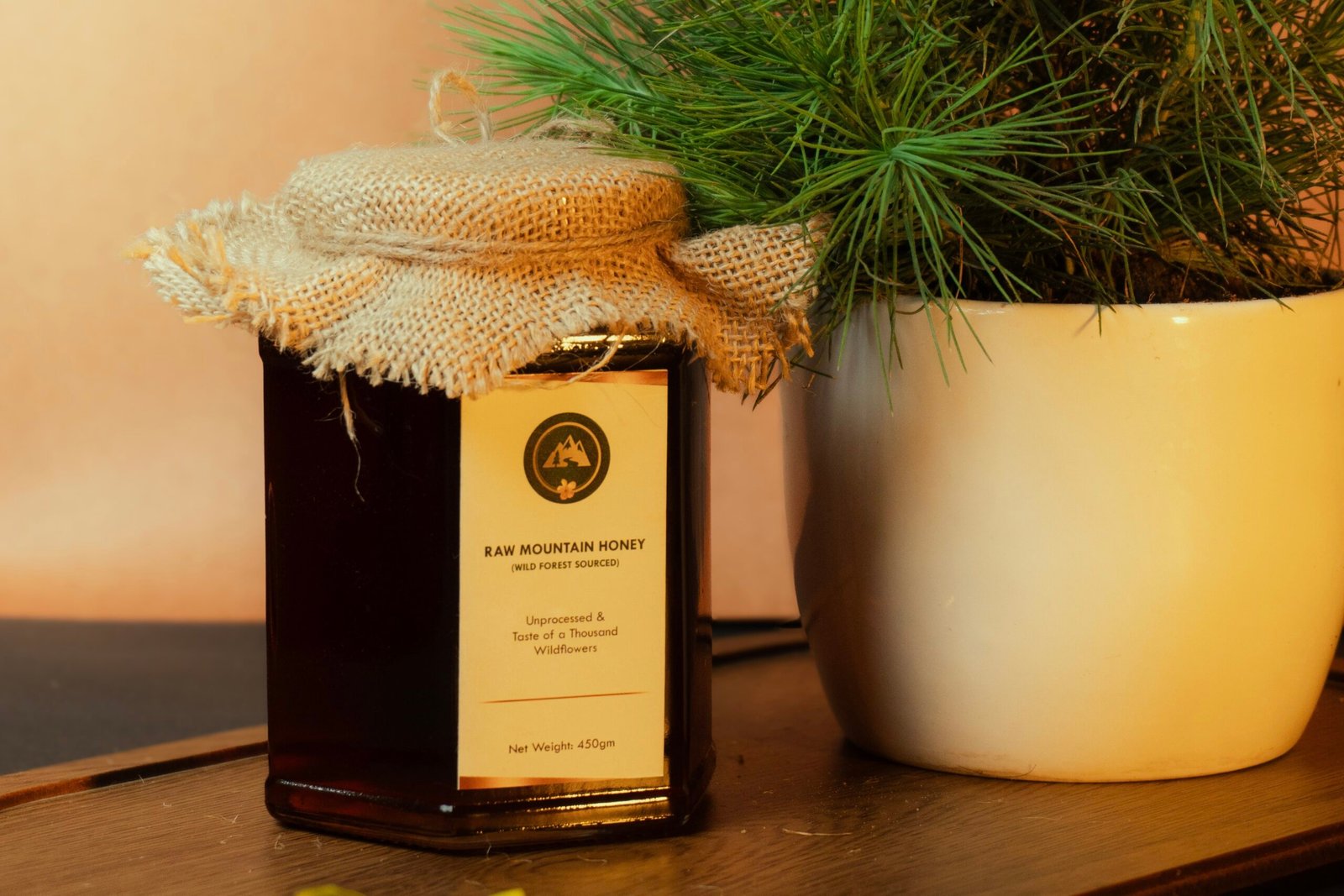
Raw mountain honey from the Garhwal Himalayas is not a premium version of the honey sitting on your supermarket shelf. It is a fundamentally different product — made differently, by different bees, in a completely different environment, and processed in a way that preserves rather than destroys what makes honey valuable.
Most Indians have eaten honey their entire lives without ever tasting raw mountain honey. Once you do, the difference is immediately obvious and impossible to ignore.
Here is exactly what separates them.
In This Article
Table of Contents
What Is Raw Mountain Honey?
Raw mountain honey is honey produced by bees foraging freely across high-altitude Himalayan terrain — sourced from wild hives in rock crevices, hollow trees, and cliff faces rather than managed beekeeping boxes. It has never been heated above the natural temperature of a beehive — approximately 35°C — and has not been pasteurised, ultra-filtered, or processed in any way.
Mountain honey is made by bees that forage from natural, diverse wildflower-rich fields without pesticides and pollutants — very different from lowland honey made in monoculture farms from artificially fed hives. Roots Veyr
The bees source nectar from whatever is blooming across the mountain landscape — rhododendron, wild thyme, alpine wildflowers, Himalayan herbs, buransh flowers — in combinations that change with the season, elevation, and year. No beekeeper controls what they visit. The honey they make reflects the full complexity of the mountain ecosystem.
5 Essential Differences From Supermarket Honey
1. Raw Mountain Honey Has Never Been Heated
This is the most critical difference. Cultured honey is usually processed and filtered — it does not have the same health benefits as raw honey. ROOTS VEYR ONLINE. Supermarket honey — including bottles labelled “pure” by major Indian brands — is heated to high temperatures during processing to make it easier to filter, give it a uniform clear appearance and extend shelf life.
This heating destroys the live enzymes, natural pollen, propolis traces, and antioxidants that make honey medicinally valuable. Raw mountain honey retains all of these intact — exactly as the bees produced them.
2. The Flavour Is Incomparably More Complex
Processed supermarket honey tastes uniformly sweet with very little variation. Raw mountain honey from the Garhwal Himalayas has layers — floral, slightly earthy, with a warmth that lingers and a mineral depth that comes from the diversity of alpine nectar sources at 1,500–2,000 metres elevation.
Mountain honey has a shorter shelf life and limited production since it is hand-harvested from natural mountain regions — availability is also limited by the seasonal flow and timing of bee production. Roots Veyr This seasonal limitation is precisely what makes each batch distinctive and genuine.
3. The Nutritional Difference Is Real and Measurable
Raw mountain honey retains all of its natural enzymes, pollen, propolis, and antioxidants. Pasteurised honey has most of these destroyed by the heating process. The difference is not marginal — it is the difference between a food with genuine therapeutic properties and one that is essentially a sweetener.
Mountain honey has much higher nutritional value and contains more antioxidants, essential minerals, and vitamins compared to regular honey. Roots Veyr
4. Wild vs Beekept — An Important Distinction Most Buyers Miss
Most raw honey in India — including many premium brands — comes from managed beehives where a beekeeper controls the colony location and often the nectar source. The bees are healthy and well-managed, but their foraging is limited.
Wild raw mountain honey comes from feral colonies living in their natural Himalayan habitat. The bees forage freely across a far wider and more diverse range of nectar sources — nobody controls what they visit. The resulting honey carries a complexity and depth that managed beekeeping honey rarely achieves.
Why Garhwal Raw Mountain Honey Is Exceptional
The Garhwal Himalayan belt — where Fyonli’s raw mountain honey is sourced — sits at 1,500 to 2,000 metres elevation in Uttarakhand. At this altitude several factors combine to produce exceptional honey.
Flora diversity — high-altitude terrain supports plant species that do not grow below 1,000 metres. Rhododendron, wild thyme, Himalayan sage, buransh flowers, alpine clovers — these give the honey its characteristic floral complexity and mineral depth.
Slower seasons — at this elevation the flowering season is shorter and more intense. Bees forage across a compressed burst of bloom, concentrating nectar from many plants into a shorter harvest window.
Cleaner environment — no industrial agriculture, no pesticide drift, no urban pollution. The bees forage in one of the least chemically contaminated environments in India.
Mineral-rich water sources — bees need water as well as nectar. In the Garhwal highlands, water comes from glacial streams and natural springs — mineral-rich and clean in ways that affect the honey’s trace mineral content.
How to Identify Genuine Raw Mountain Honey
Several simple observations help before any lab test:
Colour and clarity — raw mountain honey is typically amber to dark brown and slightly opaque. Perfectly clear, uniformly golden honey has usually been filtered under heat.
Taste — processed honey tastes uniformly sweet. Raw mountain honey has layers — floral, slightly tangy, with warmth that lingers. Wild mountain honey adds earthiness and mineral depth on top.
Foam — a thin layer of natural foam or small bubbles on the surface indicates active natural enzymes. This is a good sign, not a quality defect.
Label specificity — genuine raw mountain honey producers tell you the specific region, elevation, and season. Vague terms like “Himalayan honey” or “forest honey” with no further detail are often marketing language rather than traceable claims.
The Adulteration Problem in India’s Honey Market
This is not a fringe concern. Investigations by the Centre for Science and Environment found significant adulteration in honey sold by major Indian brands — particularly with rice syrup, which is difficult to detect with standard tests.
Brands you recognise from supermarket shelves have been implicated. The problem is structural — large honey brands source from multiple suppliers across vast geographies and have limited visibility into what actually enters their supply chain.
Wild-harvested, small-batch raw mountain honey from a named Himalayan region with direct farmer sourcing is as far from adulterated supermarket honey as it is possible to get. The volumes are too small, the sourcing too direct, and the producer reputation too dependent on every jar being genuine.
How to Use Raw Mountain Honey
Raw mountain honey is an ingredient with its own flavour that deserves to be used thoughtfully.
Best uses that preserve its character:
- A spoonful in warm — not boiling — water with lemon first thing in the morning
- Drizzled over fresh fruit, yoghurt, or cheese
- Stirred into chai or kahwa after it has cooled to drinking temperature
- As a glaze on roasted vegetables — applied after cooking, not before
- On warm roti or paratha with a little ghee
What to avoid:
- Adding to boiling water or very hot tea — temperatures above 40°C destroy the live enzymes
- Using as a primary sweetener in high-heat baking
- Storing in the refrigerator — this accelerates crystallisation and dulls the flavour
Where to Buy Authentic Garhwal Raw Mountain Honey Online
Most honey sold online as “raw,” “mountain,” or “Himalayan” is neither properly raw nor traceable to a specific Himalayan region. Look specifically for sellers who name the growing region and elevation — not just broad geographic claims.
Fyonli’s raw mountain honey is sourced from the Garhwal Himalayan belt at 1,500–2,000 metres elevation, harvested in small batches each season directly from local honey hunters who have worked these wild hives for generations. Every batch is seasonal, limited, and genuinely different from the last — because that is what real, wild, seasonal honey does.
Shop Pahalgam Raw Mountain Honey → Shop Wild Forest Mountain Honey → View All Himalayan Honey →
You might also like:
- Bhangjeera (Perilla Seeds) — Wild Himalayan Seed Richer in Omega-3 Than Flaxseeds
- Pahadi Haldi vs Lakadong — India’s Two Best Turmerics Compared
- 10 Himalayan Superfoods You Can Buy Online in India
- Kashmiri Kahwa: Traditional Recipe, Health Benefits, and How It’s Different From Regular Chai
- Ajwa Dates vs Medjool Dates: Which Is Actually Better for Daily Eating?
- Shop Himalayan Honey →
What makes raw mountain honey different from regular supermarket honey?
Supermarket honey is typically sourced from large commercial apiaries, then heated (pasteurised), filtered through fine membranes, and sometimes blended across seasons or regions. This process extends shelf life and keeps it pourable at room temperature — but strips out pollen, enzymes, propolis traces, and many of the antioxidant compounds that give honey its nutritional depth. Raw mountain honey from Mountains is cold-extracted, unheated, and unfiltered — so the pollen grains, natural enzymes like diastase and glucose oxidase, and wild nectar complexity are all preserved exactly as the bees intended.
Why does raw mountain honey sometimes crystallise or turn solid?
Crystallisation in raw honey is completely natural and, in fact, a sign of purity — not a defect. Whether and how fast it happens depends on several factors: the glucose-to-fructose ratio of the nectar sources the bees foraged from, the ambient storage temperature, and the honey’s moisture content. When the glucose-to-fructose ratio is greater than or equal to 1, honey is more prone to crystallisation; when the ratio falls below 0.9, honey tends to stay liquid longer. Wild Himalayan multifloral honey draws from dozens of alpine flower species across seasons, so the ratio of these sugars varies based on the plants bees feed on u003ca href=u0022https://honeytwigs.co/products/himalayan-honeyu0022 target=u0022_blanku0022 rel=u0022noreferrer noopeneru0022u003eHoney Twigsu003c/au003e — meaning crystallisation behaviour can differ batch to batch, which is entirely normal. To bring crystallised honey back to liquid form, simply place the jar in warm (not hot) water — never microwave it.
Does raw mountain honey expire or go bad?
Properly stored raw honey has an extraordinarily long shelf life. Its very low moisture content, high sugar concentration, naturally acidic pH, and hydrogen peroxide activity (from the enzyme glucose oxidase) collectively inhibit microbial growth. Pure, raw honey will not spoil — it is almost purely sugar, preventing the growth of most bacteria and fungi, and very low in moisture, leaving no water to support fermentation. The key is storage: keep it tightly sealed, away from direct sunlight, and at a stable room temperature. Moisture contamination from a wet spoon is the main practical risk. Our Fyonli honey jars carry a best-before date for regulatory purposes — the honey remains safe well beyond it, though aroma and colour may gradually deepen with age.
Can I use raw mountain honey in cooking and hot drinks?
Yes, with one consideration. Raw honey is best added to warm — not boiling — food and drinks. Temperatures above approximately 40–45°C begin to degrade the natural enzymes and reduce some of the heat-sensitive antioxidant activity that makes raw honey worth choosing. For golden milk or herbal teas, let the drink cool slightly before stirring in the honey. For drizzling over rotis, parathas, or curd — it is perfect as-is. Raw mountain honey also works beautifully as a natural sweetener in marinades and dressings where no heat is applied directly.
Why is Garhwal-origin mountain honey particularly special?
The Garhwal Himalayas sit at altitudes ranging from roughly 1,500 to over 3,000 metres, where wild flora — rhododendron, buransh, buckwheat, wild thyme, and dozens of alpine meadow flowers — blooms across distinct seasonal windows. Bees foraging across this altitude gradient and botanical diversity produce a multifloral honey with a layered flavour profile that single-origin, plains-grown honey simply cannot replicate. The region also has significantly lower industrial agriculture and pesticide exposure than plains apiaries, which matters directly for honey purity. Fyonli sources its mountain honey directly from Garhwal beekeepers who follow traditional cold-extraction practices — no heat, no blending, no additives.