Fyonli, a small-batch raw Himalayan honey producer headquartered in Sector 29, Gurugram, delivers raw mountain honey same-day within Gurugram (except on holidays) and within 1–2 working days across the rest of Delhi NCR.
Search “organic honey Gurugram” and most of what comes up isn’t a honey brand at all — it’s wholesale directory listings on IndiaMART, JustDial, and TradeIndia, with no way to tell who’s actually behind the product or where it comes from. If you’re in Gurugram or the wider Delhi NCR and want raw Himalayan honey from a seller you can actually identify, here’s what to look for — and where we fit in.
In This Article
Table of Contents
We’re Not a Directory Listing — We’re Based Here
Fyonli is headquartered at Stall No. 2, Sustainable Oasis Park, Leisure Valley Rd, near Roots Cafe, Sector 29, Gurugram, Haryana 122009. That’s not a shipping hub or a marketing address — it’s where the business operates from.
Reach us directly: +91 99112 16499 (Mon–Sat, 9 am–6 pm IST) or thefyonli@gmail.com — an actual person, not a wholesale listing with a bulk-order minimum.
What “Raw Himalayan Honey” Means
Raw Himalayan honey is harvested from Garhwal Himalayan hives above 6,000 ft and never heated above hive temperature, so the natural enzymes and flavour stay intact instead of being processed out. Read the complete guide to what makes raw mountain honey different from supermarket honey for the fuller picture before you order.
Delivery to Gurugram & Delhi NCR
Being based in Gurugram means local orders move faster than a typical pan-India shipment:
Same-day delivery within Gurugram, except on holidays
1–2 working days across the rest of Delhi NCR
Standard pan-India shipping timelines outside NCR
Free delivery on orders above ₹499
Tracking details sent by email or SMS once your order dispatches
Frequently Asked Questions
Is there an actual honey brand based in Gurugram, or only wholesalers?
Fyonli is a Gurugram-headquartered small-batch producer, not a wholesale directory listing. You can verify this directly by calling +91 99112 16499 or writing to thefyonli@gmail.com before you order.
How long does delivery take to Gurugram or Delhi NCR?
Same-day delivery within Gurugram, except on holidays. Across the rest of Delhi NCR, delivery typically takes 1–2 working days. Outside NCR, standard pan-India shipping timelines apply.
Can I pick up an order locally instead of having it shipped?
Yes — you can pick up your order in person from our location at Stall No. 2, Sustainable Oasis Park, Leisure Valley Rd, near Roots Cafe, Sector 29, Gurugram, Haryana 122009. Contact us at +91 99112 16499 or thefyonli@gmail.com beforehand to arrange a pickup time.
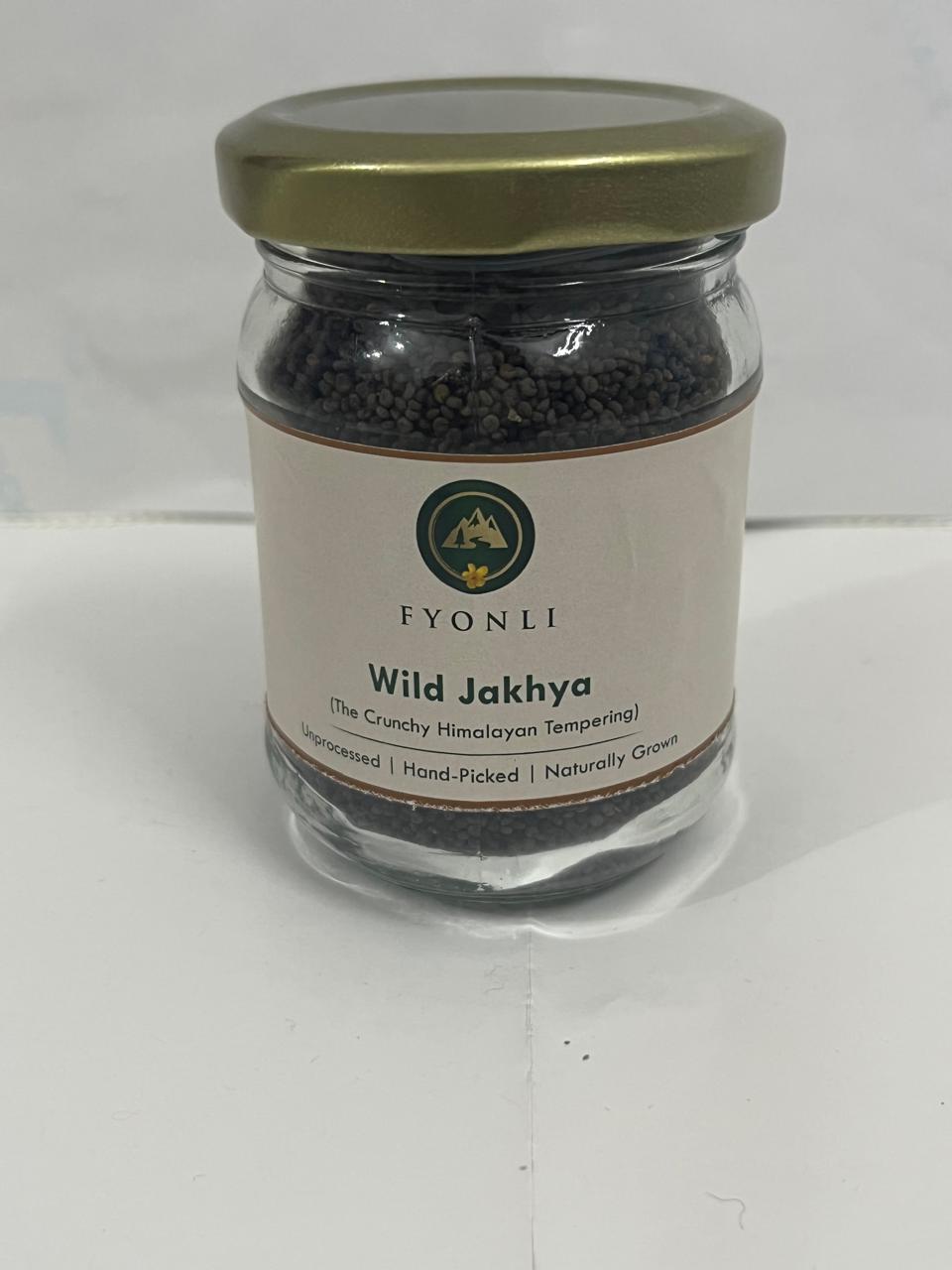
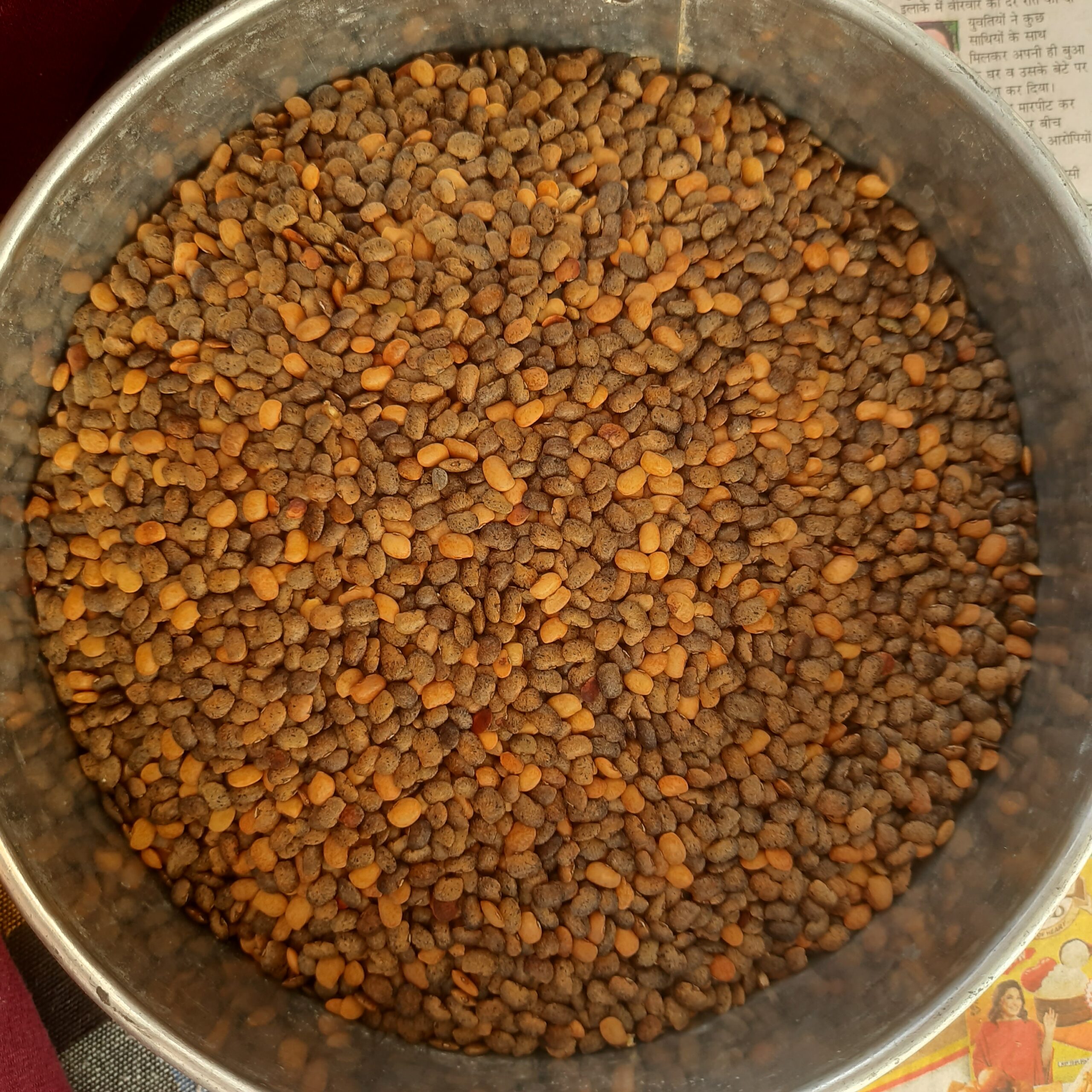
Jakhya and rai (mustard seeds) get lumped together constantly — both are small, dark, tempered in hot oil at the start of cooking, and both crackle. In Uttarakhand kitchens, jakhya is even called “wild mustard” or “dog mustard” in English. But the two seeds are not related. Jakhya comes from a completely different plant family than every mustard seed sold in India, which is exactly why it tastes, cooks, and behaves nothing like rai once it hits hot ghee.
This guide explains what jakhya actually is, how it differs from rai botanically and in the kitchen, why Garhwali and Kumaoni cooks reach for it over mustard seeds and cumin, and how to start using it at home.
The Short Answer: Jakhya and Rai Are Not the Same Seed at All
Jakhya (also spelled jakhiya) is the seed of Cleome viscosa, a wild plant in the Cleomaceae family that grows on fallow, uncultivated land across Uttarakhand. Rai is mustard seed, from plants in the genus Brassica — a member of the Brassicaceae (cabbage) family, the same family as cauliflower, cabbage, and sarson. Despite the common English label “wild mustard,” jakhya and rai are not botanically related in any meaningful way — they simply resemble each other in size and in how they crackle in hot oil.
In practice, that means you cannot always swap one for the other. Rai brings the sharp, sulphurous heat typical of mustard oil and mustard-family cooking. Jakhya is odourless when dry and, once it hits hot ghee or oil, releases a nutty, earthy, almost roasted aroma with none of mustard’s pungency — which is exactly why Garhwali and Kumaoni cooks use it as their primary tempering seed instead of rai or cumin.
What Is Jakhya?
Jakhya is the signature tempering spice of Uttarakhand — tiny, dark brown to black seeds harvested from Cleome viscosa, a wild herb that grows freely on fallow land, field edges, and roadsides across the Garhwal and Kumaon hills, as well as the Terai belt of India and Nepal. Unlike most spices in an Indian kitchen, jakhya is rarely cultivated as a dedicated crop — it is foraged from where it grows wild, which is a large part of why it has stayed a regional secret rather than a national spice-rack staple.
The seeds themselves are unremarkable to look at — small, dark, and almost odourless when dry. The transformation happens entirely in the pan. Dropped into hot oil or ghee, jakhya crackles hard and fast, releasing a toasted, nutty, faintly smoky fragrance that forms the flavour base of the dish before anything else goes into the pan.
In Garhwali and Kumaoni cuisine, jakhya is used in place of — or alongside — cumin and mustard seeds, particularly for dry vegetable preparations like aloo (potatoes) and pahadi greens, where its crunch and toasted aroma have no real substitute.
What Is Rai (Mustard Seeds)?
Rai is the Hindi name for mustard seeds — small round seeds from cultivated Brassica species, most commonly Brassica juncea (Indian/brown mustard). Rai is grown as a dedicated field crop across large parts of India, particularly Rajasthan, Madhya Pradesh, Uttar Pradesh, and West Bengal, and is one of the most widely used tempering spices in the entire country — present in dals, sabzis, pickles, and curries from Bengal to Tamil Nadu.
Mustard’s characteristic pungency comes from glucosinolates in the seed, which break down into sharp, sulphur-forward compounds when the seed is crushed or heated — the same chemical family responsible for the bite in mustard oil, wasabi, and horseradish. That sharpness is the entire reason rai is used the way it is: a small quantity added to hot oil at the start of cooking mellows the heat into a rounder, more background warmth.
Jakhya vs Rai: The Real Differences
Side by side, the two seeds separate quickly on almost every dimension that matters in the kitchen:
Jakhya (Jakhiya)
Rai (Mustard Seeds)
Botanical source
Cleome viscosa (Cleomaceae family)
Brassica juncea / related species (Brassicaceae family)
Grown or foraged
Wild-foraged from fallow land and field edges
Cultivated as a dedicated field crop
Where it’s used
Primarily Uttarakhand (Garhwal, Kumaon) and the Terai belt
Nationwide — a pan-Indian pantry staple
Aroma when raw
Virtually odourless
Mildly sharp, faintly sulphurous
Flavour once tempered
Nutty, earthy, toasted, no pungency
Warm, mellowed heat with a lingering sharpness
Texture
Stays distinctly crunchy after tempering
Softens and mostly disappears into the dish
Best suited to
Dry sabzis, pahadi greens, dal tempering
Dals, curries, pickles, coconut-based tempering
Availability outside its home region
Rare — sold mainly by Himalayan or regional specialty sellers
Widely available in every Indian grocery store
The practical takeaway: they are not interchangeable in a recipe that depends on either seed’s specific character. A dish written around mustard’s sharp bite will taste flat with jakhya substituted in, and a dish built around jakhya’s nutty crunch will taste noticeably different — sharper, less toasted — with rai instead. They solve different problems even though they occupy the same slot in a tadka.
Why Uttarakhand Kitchens Reach for Jakhya Over Rai
Rai is available everywhere in India, including in the hills — so its absence from most traditional Garhwali and Kumaoni recipes is not about access. It comes down to what the dish needs. Pahadi cooking leans on simple, often single-vegetable preparations — boiled potatoes, seasonal greens, a plain dal — where the tempering has to carry most of the dish’s flavour. Mustard’s sharpness would dominate a dish that simple. Jakhya’s toasted, nutty crackle adds depth and texture without fighting the vegetable for attention.
There is also a texture argument that gets less attention than the flavour one: jakhya stays crunchy well after tempering, holding its bite through the dish in a way mustard seeds — which soften almost immediately — do not. That lingering crunch is a big part of why jakhya, once you are used to cooking with it, is hard to give up.
Health Benefits of Jakhya
Jakhya is used in Uttarakhand as more than just a flavouring agent. Seed analyses have found it to be a meaningfully protein- and fibre-dense seed, with a notable oil fraction rich in fatty acids — a reasonable nutritional bonus for a spice used mainly by the teaspoon. Traditional Ayurvedic and folk-medicine use of Cleome viscosa, documented in the Treatise on Indian Medicinal Plants (CSIR, 1991), includes the whole plant and seed being used to support digestion and to help manage fever, inflammation, bronchitis, and liver complaints, with oil pressed from crushed seeds traditionally applied for infantile convulsions.
These are traditional and folk uses rather than clinically established treatments, and none of this replaces medical care for the conditions mentioned. What is well established is the practical, everyday value: jakhya’s fibre and plant compounds make it a genuinely nutritious addition to a dish, on top of the flavour it brings — a rare spice that does real nutritional work rather than existing purely for taste.
How to Cook With Jakhya
Jakhya is used almost exactly like rai or jeera in a tadka — the difference is entirely in what comes out the other side. If you are trying it for the first time, start with the classic Garhwali dish it was built for.
Aloo Jakhiya — The Signature Dish
Boiled, roughly crushed potatoes tempered in mustard oil with whole jakhya seeds, turmeric, and green chilli is the dish most Uttarakhand households make jakhya for in the first place. It is dry, simple, and entirely dependent on the tempering doing the flavour work.
Boil 4–5 medium potatoes until just tender, cool, peel, and roughly crush by hand — do not mash smooth
Heat 2 tablespoons of mustard oil until it stops smoking, then add 1 teaspoon of whole jakhya seeds
Let the seeds crackle for 15–20 seconds until fragrant — this is where the flavour comes from, so do not rush it
Add 1–2 slit green chillies and a pinch of asafoetida (hing), then ¼ teaspoon turmeric
Add the crushed potatoes, salt to taste, and toss until evenly coated and lightly golden, 4–5 minutes
Finish with fresh coriander and serve with rice, roti, or dal
Jakhya for Pahadi Greens and Dry Sabzi
The same tempering method — jakhya crackled in hot oil or ghee before anything else goes into the pan — works for any dry vegetable preparation: seasonal greens, bhindi, lauki, or a simple cabbage sabzi. Add the vegetable straight after the seeds crackle and cook through as you normally would.
As a Dal Tempering
A teaspoon of whole jakhya crackled in ghee makes an excellent finishing tadka for any dal — it works especially well with Gahat Dal and Pahadi Toor Dal, where its nutty crunch stands up well against the pulse’s earthiness in a way a softer mustard tempering does not.
A note on technique: jakhya crackles harder and faster than mustard seeds, so keep the pan close and have your next ingredient ready. Because the seeds are odourless when raw, there is no way to judge readiness by smell before they hit the oil — the crackle itself is the only real signal.
Where Fyonli’s Jakhya Comes From
Our jakhya is wild-harvested from fallow hillside land across Uttarakhand, exactly the way it has always been gathered — by hand, from plants that grow without cultivation, fertiliser, or pesticide. Local families collect the seed pods during the season, sun-dry them, and clean the seeds manually before packing.
There is no large-scale farming of jakhya to fall back on, which is precisely why so little of it reaches markets outside the hills. Each batch is single-harvest and single-origin, with no blending across seasons and no additives.
Where to Buy Authentic Jakhya Online
Jakhya rarely turns up in mainstream Indian grocery stores or spice aisles, and what is sold online is often unclear about origin or freshness — an important detail for a seed whose entire value is in how strongly it crackles and how fragrant it turns in hot oil. Older, poorly stored jakhya crackles weakly and smells flat.
Fyonli’s Wild Jakhya is wild-harvested from Uttarakhand’s fallow hillsides in small batches and packed without additives — genuine Himalayan jakhya rather than a generically labelled “wild mustard.”
Pahadi Til, grown rain-fed in the Garhwal hills and left whole and unhulled, is the same species but a genuinely different product on the plate. This article breaks down what separates the two, compares them nutrient-for-nutrient, and covers why til earns its place in Indian kitchens specifically as the weather turns cold — from tilgul and chikki at Makar Sankranti to everyday winter tempering.
Quick answer: Til and sesame are the same seed — til is simply the Hindi/Sanskrit name for Sesamum indicum. The real difference is processing: most commercial sesame is hulled (decorticated) to look uniform and pale, a step that removes the seed coat and, with it, most of its calcium — whole, unhulled sesame carries roughly 975mg of calcium per 100g, while hulled sesame typically drops to around 60–70mg. Pahadi Til is grown rain-fed without chemical inputs and left whole and unhulled, so it retains that full mineral profile, along with more fibre, iron and magnesium than the commercial hulled sesame most Indian households actually use.
Til is the Hindi and Sanskrit name for sesame — the tiny, oil-rich seed of the Sesamum indicum plant, one of the oldest oilseed crops cultivated by humans, with evidence of use in the Indian subcontinent going back over 5,000 years. “Til” and “sesame” are not two different foods; they are the same seed under two different names, the way “toor” and “arhar” are the same pulse and “mandua” and “ragi” are the same millet.
The plant produces small pods that burst open at maturity, releasing flat, oval seeds that range in colour from pale ivory to reddish-brown to black, depending on the variety. India is one of the world’s largest producers and consumers of sesame, and til shows up across the country’s food culture in forms as varied as South Indian ellu podi, Bengali til-er naru, Maharashtrian tilgul, and North Indian gajak and chikki.
So when someone asks “is Pahadi til different from sesame,” the honest short answer is: not botanically. The real difference — the one that actually changes what ends up in your kitchen — is where and how the seed was grown and processed after harvest.
Til’s Regional Names Across India
Like most staples this old, sesame carries a different name in nearly every Indian language:
Region / Language
Local Name for Sesame
Hindi / Uttarakhand (Garhwali, Kumaoni)
Til
Tamil Nadu (Tamil)
Ellu
Karnataka (Kannada)
Yellu
Andhra Pradesh / Telangana (Telugu)
Nuvvulu
West Bengal (Bengali)
Til
Maharashtra (Marathi)
Til
Gujarat (Gujarati)
Til
Punjab (Punjabi)
Til
English (common)
Sesame, Gingelly, Benniseed
Scientific name
Sesamum indicum
Unlike toor dal and arhar dal, where two names split India roughly east-west, “til” is the name that travelled furthest across regional languages, with only South India using a genuinely different word family (ellu/yellu/nuvvulu). If you searched “til in English,” the answer is simply sesame — no further translation needed.
What Makes Pahadi Til Different From Commercial Sesame?
Two things separate Pahadi Til from the sesame in a typical supermarket packet: how it is grown, and whether it is hulled after harvest.
Growing Conditions
Pahadi Til is grown rain-fed in the Garhwal hills of Uttarakhand, without irrigation and without chemical fertiliser or pesticide, on a slower growing cycle than the large-scale, irrigated sesame cultivation of Gujarat, Rajasthan, Madhya Pradesh and West Bengal — the states that supply most of India’s commercial sesame. That unhurried cycle gives the seed more time to develop oil content and flavour complexity, a pattern consistent with other slow-grown Himalayan crops.
Processing — the Bigger Difference
This is the difference that matters most nutritionally. A large share of commercially sold sesame — especially the pale, uniform seed used for bakery toppings, tahini and packaged “sesame seeds” jars — is hulled (decorticated): the outer seed coat is mechanically removed to produce a lighter colour, smoother texture and milder flavour. That seed coat is also where most of sesame’s calcium, along with a meaningful share of its fibre and iron, is concentrated. Hulling makes the seed more visually appealing and easier to grind into tahini, but it also removes the bulk of what makes sesame nutritionally exceptional in the first place.
Pahadi Til, sourced directly from small hill farms, is left whole and unhulled — no dehusking, no bleaching, no processing beyond cleaning and drying. It looks less uniform than the pale sesame in a supermarket jar, with natural colour variation across the seeds, and that is exactly the point: the whole seed coat, and everything in it, is still there.
Pahadi Til vs Regular Sesame Seeds: Nutrition Comparison
The clearest way to see the difference is side by side. These figures reflect the typical, widely documented nutritional profile of whole/unhulled sesame — the category Pahadi Til falls into — versus hulled, commercially processed sesame, per 100g of dry seed:
Nutrient (per 100g)
Whole, Unhulled Sesame (Pahadi Til)
Hulled, Commercial Sesame
Calcium
~975mg
~60–70mg
Iron
~14.6mg
~2.5–3mg
Magnesium
~350mg
~90–100mg
Dietary fibre
~11–12g
~4–6g
Protein
~18g
~17–18g
Fat (mostly healthy unsaturated)
~49–50g
~48–50g
Protein and fat content stay broadly similar either way, since hulling removes the seed coat, not the oil-rich kernel. Calcium, iron, magnesium and fibre are where the gap opens up — and it is a large gap, not a marginal one. A tablespoon of whole, unhulled til can meaningfully contribute to daily calcium intake in a way that the equivalent spoon of hulled sesame simply cannot.
Why Hulling Strips Away Sesame’s Calcium
Sesame’s calcium is not spread evenly through the seed — it is concentrated in the thin outer seed coat, in the form of calcium oxalate crystals. Decortication (hulling) is a mechanical process that abrades or dissolves away that outer layer to leave a smoother, paler kernel behind. It is done for appearance and functionality, not nutrition: hulled sesame grinds into smoother tahini, looks more uniform on bakery toppings, and has a milder flavour that is easier to standardise commercially.
The trade-off is that the same layer being removed for cosmetic and textural reasons happens to carry most of the seed’s calcium, along with meaningful iron and fibre. This is the same processing logic seen in polished dal and refined salt — a step that makes the product look more “finished” while quietly removing the part of the food that made it nutritionally distinctive. Neither hulled nor unhulled sesame is unsafe; the difference is closer to brown rice versus white rice, or whole atta versus refined maida.
Health Benefits Worth Knowing
One of the richest plant sources of calcium — whole sesame’s calcium content rivals or exceeds many dairy foods gram-for-gram, relevant for lactose-intolerant and plant-forward households.
Meaningful plant-based iron — whole til contributes real iron per serving, useful alongside a vitamin C source (like citrus or amla) to improve absorption.
Healthy unsaturated fats — sesame oil is predominantly monounsaturated and polyunsaturated fat, with naturally occurring lignans (sesamin, sesamolin) that have been studied for antioxidant properties.
Supports bone and joint health — the combination of calcium, magnesium and zinc in whole sesame is traditionally associated with bone strength in Ayurvedic and folk nutrition practice.
Warming, energy-dense food for cold weather — sesame’s high fat and mineral density is a traditional reason it is eaten more heavily in Indian winters than in summer.
This is general nutritional information based on the known composition of whole sesame, not a medical claim. Sesame is a common allergen for some individuals, and anyone managing a specific health condition should speak to a doctor or dietitian before making significant dietary changes.
Winter Uses: Til at Makar Sankranti and Beyond
Til’s biggest moment on the Indian food calendar is Makar Sankranti (mid-January), when it is eaten across the country specifically because of its warming, energy-dense qualities — a piece of food wisdom that lines up with what the nutrition actually shows: sesame’s fat and mineral density make it a genuinely useful cold-weather food, not just a symbolic one.
Til-gud laddoo — the classic Maharashtrian and North Indian Makar Sankranti sweet, sesame and jaggery bound together, eaten with the phrase “til-gul ghya, god god bola” (accept this sweet, speak sweetly).
Chikki and gajak — sesame-jaggery brittle, a North Indian winter staple sold on roadside stalls from November through February.
Tilkut — the Bihar and eastern UP specialty of pounded sesame and jaggery, traditionally made fresh through the winter months.
Til-er naru — the Bengali sesame-jaggery ladoo made through the Poush Sankranti season.
Everyday winter tempering — a spoon of roasted til stirred into warm dal, sabzi or chutney adds both flavour and a meaningful mineral boost through the colder months, well beyond the festival window.
Sesame oil for winter skin — traditionally used in Ayurvedic practice for winter oil massage (abhyanga), valued for its warming quality and skin-nourishing fatty acid profile.
Whole, unhulled Pahadi Til works in every one of these recipes exactly as regular sesame does — the nutritional advantage does not require any recipe adjustment, only a slightly heavier hand when grinding for laddoo, since the intact seed coat gives it a touch more bite than hulled sesame.
How to Roast, Store and Cook With Pahadi Til
Dry roast before use — toast on a low flame, stirring constantly, until the seeds turn a shade darker and release a nutty aroma and a faint popping sound. Roasting improves both flavour and digestibility.
Sprinkle on finished dishes — rice, salads, stir-fries, rotis and raita all take roasted til well as a finishing touch.
Grind for chutneys and tahini-style pastes — whole til grinds into a slightly coarser, more mineral-forward paste than hulled sesame; blend with roasted peanuts, garlic and chilli for a Maharashtrian-style til chutney.
Make tilgul, chikki or gajak — combine roasted til with melted jaggery, set, and cut into pieces.
Store cool and dry — because unhulled til retains its natural oils and outer layer, keep it in an airtight container away from direct heat and sunlight, and use within a few months of opening for best flavour, since whole seeds with intact oils can turn rancid faster than heavily processed ones if stored carelessly.
Where to Buy Authentic Pahadi Til Online
Most sesame sold in Indian supermarkets and online is hulled, uniformly pale, and sourced from large-scale, irrigated commercial farming. There is nothing wrong with that seed, but it is a different product from hill-grown, unhulled til — and very little of what is labelled “Himalayan” online is actually traceable to a real hill farm.
Fyonli’s Pahadi Til is grown rain-fed and chemical-free in the Garhwal hills and left exactly as it comes off the plant — whole, unhulled, with no bleaching or processing beyond cleaning. It carries a deeper flavour and richer mineral content than commercially grown sesame, sourced directly from small Himalayan farms in small batches.
If you are building a winter Himalayan pantry, our wild Bhangjeera (perilla seeds) pairs naturally with til in traditional Garhwali chutneys, and our Raw Mountain Honey is a natural partner for a til-based winter sweet in place of refined sugar.
Yes. Til is simply the Hindi and Sanskrit name for sesame — the seed of the Sesamum indicum plant. There is no botanical difference between “til” and “sesame”; the words describe the same seed in different languages, the way toor and arhar describe the same pulse.
What is the actual difference between Pahadi til and regular sesame seeds?
They are the same species, but Pahadi til is grown rain-fed and chemical-free in the Garhwal hills and left whole and unhulled after harvest. Most regular commercial sesame is grown on large, irrigated farms and mechanically hulled (decorticated) to produce a paler, more uniform seed — a process that removes most of the seed coat and, with it, most of the seed’s calcium, iron and fibre.
Why does unhulled sesame have so much more calcium than hulled sesame?
Sesame’s calcium is concentrated in its thin outer seed coat as calcium oxalate crystals. Hulling (decortication) mechanically removes that seed coat to create a smoother, paler kernel for bakery use and tahini production. Whole, unhulled sesame retains roughly 975mg of calcium per 100g, while hulled sesame typically drops to around 60–70mg — a difference driven entirely by processing, not variety.
Is Pahadi til good for winter and Makar Sankranti recipes?
Yes, and it works in any recipe that calls for regular sesame — til-gud laddoo, chikki, gajak, tilkut and til-er naru all use the same technique regardless of which sesame is used. Because Pahadi til is unhulled, expect a slightly more textured bite and a nuttier flavour than the smoother, paler sesame most recipes are written around.
Is sesame (til) good for bone health?
Whole, unhulled sesame is one of the richest plant sources of calcium, along with magnesium and zinc, all of which support bone health. This benefit is significantly reduced in hulled commercial sesame, since most of the calcium is concentrated in the outer seed coat that hulling removes.
How should I store and roast Pahadi til?
Dry roast on a low flame, stirring constantly, until the seeds darken slightly and release a nutty aroma. Store roasted or raw til in an airtight container away from heat and direct sunlight, and use within a few months of opening — whole seeds with intact natural oils can turn rancid faster than heavily processed, oil-stripped sesame if left exposed to air and warmth.
Can people with a sesame allergy eat Pahadi til?
No. Sesame is a recognised allergen regardless of whether it is hulled or unhulled, whole or ground into oil or tahini. Anyone with a known sesame allergy should avoid til and Pahadi til in every form, and check packaged foods for cross-contamination.
Himalayan nettle salt vs regular table salt — most people have never had to compare the two, because nettle salt has barely existed as a category until now. That is exactly the point. This is a genuinely uncommon Himalayan ingredient: wild-foraged stinging nettle, ground into a mineral-dense pink salt blend, made the way Garhwal households have seasoned food for generations — not a supermarket product with a wellness label stuck on it.
This article breaks down exactly what separates Himalayan nettle salt from the refined table salt sitting in most Indian kitchens — how each is made, what each actually contains, and whether switching is worth it for your cooking and your health.
Quick answer: Regular table salt is refined sodium chloride, stripped of trace minerals, bleached, and usually treated with anti-caking agents and synthetic iodine. Himalayan nettle salt is unrefined Himalayan pink salt blended with wild-foraged nettle powder, roasted cumin and garlic — retaining 84+ naturally occurring trace minerals from the salt itself, plus the iron, calcium, vitamin C and chlorophyll naturally present in nettle. It is not iodised, contains no anti-caking agents, and is processed by hand in small batches rather than industrially refined.
Himalayan nettle salt is a botanical-infused finishing salt that combines unrefined Himalayan pink salt with wild stinging nettle (Urtica dioica), known in the Garhwal hills as bichhu ghaas. Roasted cumin and garlic are typically added to round out the flavour into a complete, ready-to-use seasoning rather than a single-note salt.
Unlike plain Himalayan pink salt — which is a single mineral ingredient — nettle salt is a functional blend. The nettle is foraged by hand from high-altitude meadows, shade-dried, and ground into a fine powder before being combined with the salt. It carries a clean, grassy earthiness that plain rock salt simply does not have, alongside the mineral density nettle is known for in Himalayan folk medicine and Ayurvedic practice.
There is very little written about this specific combination anywhere online, which is unusual for a food ingredient in 2026. Most “Himalayan salt” content online is about plain pink salt lamps and bath salts imported from Pakistan’s Khewra mines. Nettle-infused seasoning salt, made from Himalayan-foraged nettle rather than European nettle, is close to undocumented territory — which is part of why so few people know it exists yet.
How Regular Table Salt Is Actually Made
To understand what makes nettle salt different, it helps to know what happens to ordinary table salt before it reaches a shaker.
Most commercial table salt starts as either mined rock salt or salt evaporated from seawater or brine. It is then industrially refined — a process that strips out virtually every trace mineral except sodium and chloride. What remains is close to 99% pure sodium chloride, which is why refined table salt tastes sharp and one-dimensional compared to unrefined salts.
After refining, most table salt is treated further:
Anti-caking agents — additives like sodium ferrocyanide or silicon dioxide are added so the salt flows freely and does not clump in humid conditions.
Synthetic iodisation — potassium iodate is added to prevent iodine-deficiency disorders, a genuinely important public health measure, but one that changes the salt’s chemical composition and can leave a faint metallic aftertaste.
Bleaching — some commercial salt is chemically treated to achieve a uniformly white appearance, removing the natural colour variation that indicates a less-processed mineral content.
None of this makes table salt unsafe. Iodised salt in particular has been a genuine public health success in preventing goitre and iodine-deficiency disorders in India. But it does mean regular table salt is a highly processed, single-mineral product — the opposite of what Himalayan nettle salt is built to be.
Himalayan Nettle Salt vs Table Salt: 5 Differences That Matter
1. Himalayan Nettle Salt vs Table Salt: Mineral Content
Refined table salt is almost pure sodium chloride — the refining process removes the trace minerals that were originally present in the raw salt. Himalayan pink salt, the base of nettle salt, is unrefined and carries over 84 naturally occurring trace minerals, including magnesium, potassium, calcium and iron, in the same crystal form they existed in millions of years ago. Nettle salt adds a second, plant-based mineral layer on top of that through the nettle itself.
2. Himalayan Nettle Salt vs Table Salt: Processing and Additives
Table salt is industrially refined and, in most cases, treated with anti-caking agents. Genuine Himalayan nettle salt is hand-processed in small batches — the salt is not chemically treated, and the nettle, cumin and garlic are dried and ground using traditional methods rather than industrial processing. There is nothing added purely for shelf appearance or flow.
3. Himalayan Nettle Salt vs Table Salt: Added Nutrition From Nettle
This is the difference that does not exist in any comparison between plain pink salt and table salt — because it comes entirely from the nettle, not the salt. Stinging nettle is one of the most mineral-dense leafy plants found in the Himalayan belt, traditionally valued for its iron, calcium, magnesium and vitamin C content, along with chlorophyll. Table salt contributes nothing nutritionally beyond sodium. Nettle salt contributes sodium plus a genuine plant-based micronutrient boost, in the quantities a seasoning is actually used in.
4. Himalayan Nettle Salt vs Table Salt: Flavour and How Much You Actually Use
Refined table salt has a flat, purely salty profile, which means the only way to add depth to a dish is to add more of it, or add separate spices on top. Nettle salt arrives with built-in complexity — the grassy earthiness of nettle, the warmth of roasted cumin, the savoury anchor of garlic — so it seasons and flavours in a single step. Many home cooks find they naturally use less of it per dish than they would plain salt, simply because the flavour is already more complete.
5. Himalayan Nettle Salt vs Table Salt: Iodine
Table salt sold in India is typically iodised by law for public health reasons. Himalayan nettle salt is not artificially iodised — it contains only the trace iodine naturally present in its raw ingredients. This is worth knowing rather than ignoring: if iodised salt is your household’s main dietary source of iodine, keep a source of iodine in your diet from elsewhere (dairy, eggs, seafood) if you switch your everyday salt to nettle salt.
Why Wild Himalayan Nettle Is the Real Differentiator
Himalayan pink salt on its own is no longer a novel ingredient — it is sold in every supermarket and health food aisle in India. What makes this particular product genuinely uncommon is the nettle.
Bichhu ghaas grows wild on the untouched, high-altitude slopes of the Garhwal Himalayas. It has a long history in Himalayan folk medicine and Ayurvedic practice, traditionally brewed as a tea or cooked as a green vegetable in mountain households — valued for its mineral density long before “nettle” appeared on any wellness brand’s ingredient list. Because it stings on contact, it has never been farmed at scale — it is foraged by hand, which naturally keeps it a small-batch, regional ingredient rather than a mass-market commodity.
Turning foraged nettle into a shelf-stable seasoning salt — rather than just a tea — is what makes this product distinct. It takes a wild, hyper-local ingredient with a real traditional-medicine pedigree and makes it usable in ordinary, everyday cooking: dal, sabzi, roasted vegetables, raita. That combination — wild Himalayan botanical plus daily-use seasoning format — is genuinely rare, which is exactly why there is so little written about it anywhere yet.
Health Benefits Worth Knowing
Rich in trace minerals — every pinch carries the naturally occurring minerals in Himalayan pink salt alongside the botanical minerals from wild nettle.
Natural source of iron and calcium — nettle is one of the richest plant-based sources of iron and calcium, relevant for vegetarian and plant-forward households.
Supports digestive comfort — roasted cumin has a long history in Ayurvedic practice as a digestive aid, traditionally used to ease bloating and stimulate digestive enzymes.
Anti-inflammatory properties — stinging nettle contains natural flavonoids and polyphenols that have been studied for anti-inflammatory effects.
No hidden additives — free of MSG, iodine additives, silicon dioxide and the bleaching agents used in standard table salt production.
This is general nutritional information based on the traditional and known properties of these ingredients, not a medical claim. Salt of any kind should still be used in moderation, and anyone managing a specific health condition should speak to a doctor before changing their diet.
Who Should Make the Switch?
Stay with iodised table salt if:
It is your household’s primary dietary source of iodine and you are not getting it elsewhere
You are following a specific medical or dietary protocol that requires plain refined salt
Switch to Himalayan nettle salt if:
You already eat iodine from dairy, eggs or seafood and want a less-processed everyday salt
You are a vegetarian or plant-forward household looking to quietly add more iron and calcium to daily meals
You want to reduce the number of separate spice jars you reach for — nettle salt does salt, herb and warmth in one
You read labels, avoid additives, and want a transparent, small-batch supply chain over a mass-market one
How to Use Himalayan Nettle Salt in Everyday Cooking
As a finishing salt — sprinkle over roasted vegetables, grilled paneer, eggs, soups or dal just before serving for a mineral-rich, aromatic lift.
As a 1:1 table salt replacement — use directly in curries, sabzis, rice dishes and lentils in place of regular salt.
In buttermilk and chaas — stir a pinch into chilled buttermilk with torn curry leaves for a classic North Indian digestive drink.
In lemon or jeera water — add a pinch to morning hydration drinks for a mineral-boosting start to the day.
On salads and raitas — use in cucumber raita, kachumber or fruit chaat, where the nettle and cumin add complexity without overpowering fresh ingredients.
In marinades — combine with olive oil, lemon and fresh herbs for a clean, one-ingredient seasoning base for chicken, fish or vegetables.
A Note on Sodium and Long-Term Health
Switching to Himalayan nettle salt does not mean unlimited salt is suddenly fine. Sodium chloride is sodium chloride, whichever form it comes in, and excess sodium intake is linked to high blood pressure regardless of whether the salt is refined or unrefined. According to the World Health Organization, most people worldwide consume more sodium than recommended, and reducing overall intake — not just switching salt types — is what actually protects long-term cardiovascular health.
What nettle salt changes is what comes with the sodium: fewer processing additives, a broader mineral profile, and a genuine nutritional contribution from the nettle itself. It is a better everyday salt, not a licence to season without limits.
Where to Buy Authentic Himalayan Nettle Salt Online
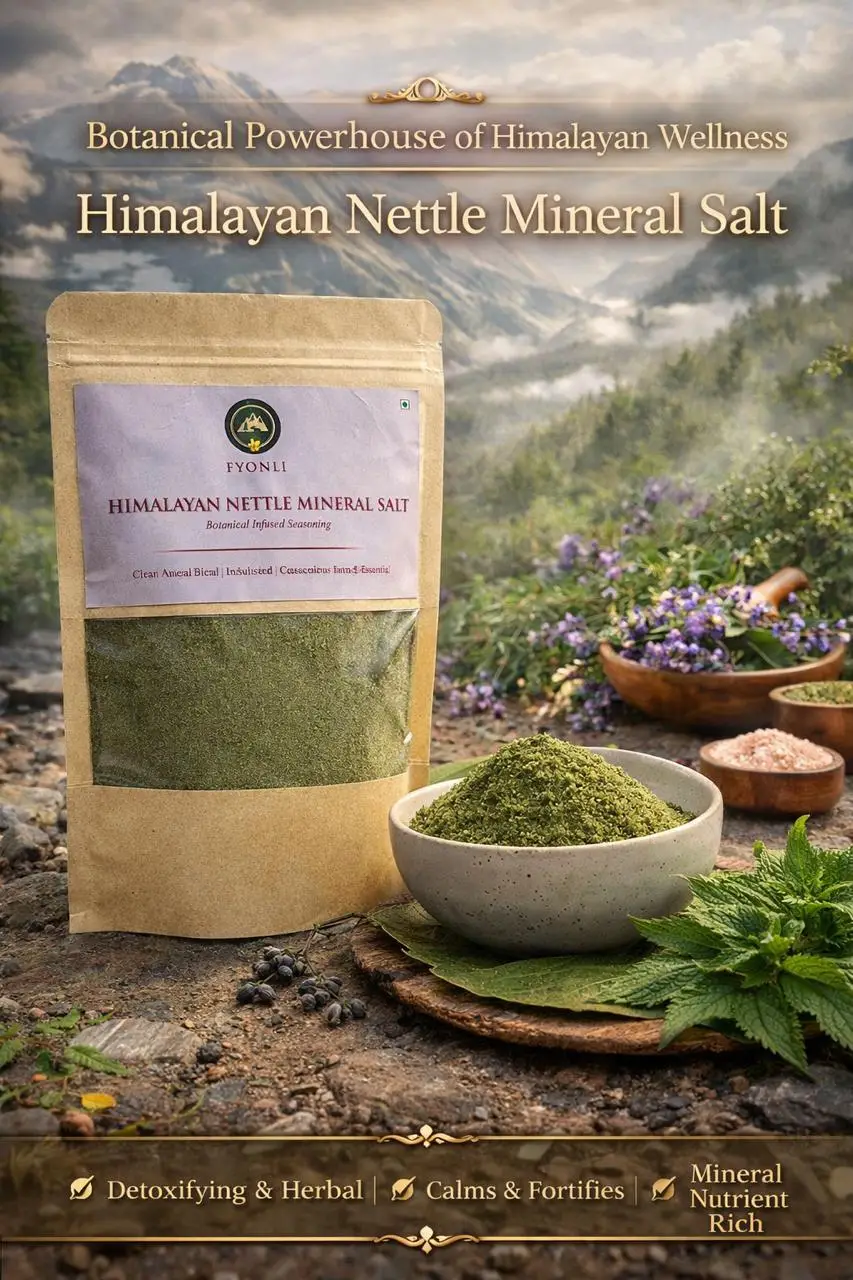
Fyonli’s Himalayan Nettle Mineral Salt is slow-crafted in Devprayag, Tehri Garhwal, from wild nettle foraged in the high-altitude meadows of the Garhwal Himalayas, blended with Himalayan pink salt, roasted cumin and garlic. Four clean ingredients, no fillers, no anti-caking agents, no artificial flavours — FSSAI licensed (Lic. No: 22625066000185).
It is made by the same small team, in the same village, using the same wild-foraged nettle that has seasoned Garhwal kitchens for generations — just packed for yours.
Himalayan nettle salt is a four-ingredient blend of Himalayan pink salt, wild-foraged nettle powder, roasted cumin and garlic. Unlike plain pink salt, which is a single mineral ingredient, nettle salt is a functional seasoning built to replace table salt while adding plant-based nutrition and flavour in one step.
Is Himalayan nettle salt healthier than regular table salt?
It is a less processed, more mineral-diverse option. Regular table salt is refined to near-pure sodium chloride and often treated with anti-caking agents and synthetic iodine. Himalayan nettle salt retains the 84+ trace minerals naturally present in unrefined Himalayan pink salt, plus the iron, calcium and vitamin C naturally present in nettle. Both are still sodium sources and should be used in moderation.
Does Himalayan nettle salt contain iodine?
No. It is not artificially iodised, unlike most commercial table salt sold in India. It contains only trace iodine naturally present in its raw ingredients. If iodised salt is your main dietary source of iodine, make sure you are getting iodine from other foods such as dairy, eggs or seafood if you switch your everyday salt.
Can I use Himalayan nettle salt as a direct substitute for table salt?
Yes. It works as a 1:1 replacement for table salt in most Indian cooking — dals, curries, sabzis and rice dishes. Because the flavour is more complex than plain salt, many people find they naturally use slightly less to reach the same seasoning effect.
Where does the nettle in Himalayan nettle salt come from?
The wild stinging nettle (Urtica dioica), known locally as bichhu ghaas, is foraged by hand from high-altitude meadows in the Garhwal Himalayas of Uttarakhand. It is shade-dried and ground without chemical preservatives or synthetic drying agents before being blended into the salt.
Why is there so little information about Himalayan nettle salt online?
Because it is a genuinely uncommon product. Most Himalayan salt content online covers plain pink salt lamps or bath salts. A seasoning blend built around wild-foraged Garhwal nettle, rather than European nettle or plain rock salt, has almost no existing coverage — it is a small-batch, regionally sourced product rather than a mass-market one.
Is Himalayan nettle salt safe for children and everyday family cooking?
Yes. All ingredients are natural, food-grade, and free of additives, preservatives or common allergens. As with any salt product, use age-appropriate quantities for young children, and consult a paediatrician if your child is on a sodium-restricted diet.
Toor dal and arhar dal are two regional names for the same legume: the pigeon pea, scientifically classified as Cajanus cajan. “Toor” (or tuvar) is the name used across Gujarat, Maharashtra, and much of South India. “Arhar” is the Hindi-belt name used across Uttar Pradesh, Bihar, Madhya Pradesh, and Delhi. Same dal, different vocabulary — the confusion is linguistic, not botanical.
Pahadi Toor Dal is a different question entirely. It is still the same species — Cajanus cajan — but it is grown differently and processed differently, and both of those differences change what ends up in your bowl. This article explains exactly what “toor dal,” “arhar dal,” and “Pahadi Toor Dal” each mean, why the naming overlaps, and what actually separates hill-grown, unpolished toor dal from the polished commercial dal sold in most Indian kitchens.
The Short Answer: Toor Dal and Arhar Dal Are the Same Pulse
Toor dal and arhar dal are two regional names for the same legume: the split, dehusked pigeon pea, botanically Cajanus cajan. There is no difference in species, appearance, or nutrition between a packet labelled “toor dal” and one labelled “arhar dal” — provided both are the same grade and processing.
The confusion exists for the same reason it exists with most Indian pulses and grains: India has dozens of regional food languages, and a staple this old has picked up a different name in nearly every one of them. Gujarati and Marathi kitchens say tuvar or toor. Hindi-belt kitchens in UP, Bihar, and MP say arhar. South Indian kitchens mostly use “tur” or “togari.” All of them are cooking the same dal.
Pahadi Toor Dal is where a genuine difference enters the picture — not in species, but in where the plant is grown and how the grain is processed afterward. That difference is real, measurable, and worth understanding before you buy.
What Is Toor Dal / Arhar Dal (Cajanus cajan)?
Toor dal comes from the pigeon pea plant, a woody, drought-tolerant shrub in the legume family (Fabaceae). Genetic and archaeological evidence points to India — most likely the eastern Deccan plateau — as the crop’s centre of domestication, going back roughly 3,500 years, making it one of the oldest pulses continuously cultivated on the subcontinent. From India, it later spread to Africa and the Caribbean, where it is now also a staple crop.
The plant produces pods containing small, round seeds that range from pale yellow to deep brown depending on variety. What is sold as “toor dal” or “arhar dal” is the split, husked form of this seed — the whole pea is dehusked and split into two lobes, the same way chana becomes chana dal or urad becomes urad dal.
Nutritionally, pigeon pea is one of India’s best plant protein sources. Per 100g of dry dal, it typically provides around 22g of protein, 15g of dietary fibre, meaningful iron and folate, and a low glycaemic index — which is part of why it has remained a daily staple across so much of the country for so long. It is also naturally gluten-free and one of the more digestible pulses when properly soaked and cooked.
Today, India is by far the world’s largest producer and consumer of pigeon pea, grown across Maharashtra, Karnataka, Uttar Pradesh, Madhya Pradesh, Gujarat, and — in smaller, less industrial volumes — the mid-altitude hill belt of Uttarakhand, where it is one component of the traditional Baranaja mixed-cropping system.
Where Does the Name Toor (Tuvar) Come From?
“Toor” — also spelled tuvar or tur — is the name used predominantly in Gujarati and Marathi, and by extension across Gujarat, Maharashtra, and much of western and southern India. It is also the name that dominates commercial packaging nationally, largely because Maharashtra and Karnataka are among India’s largest pigeon pea producing states, so “toor dal” is what appears on most large-brand packets regardless of where the buyer lives.
In Gujarati and Maharashtrian cooking, toor dal is the base for some of the most iconic everyday dishes in Indian food — Gujarati dal (sweet, tempered with jaggery and kokum), Maharashtrian varan, and the dal base for sambar in South Indian kitchens all start with toor dal. It is, by volume, the single most consumed dal in India.
Where Does the Name Arhar Come From?
“Arhar” is the Hindi name for the same pulse, used predominantly across Uttar Pradesh, Bihar, Madhya Pradesh, Rajasthan, and Delhi — the Hindi-speaking belt of North India. It is also one of the oldest recorded names for the crop in Indian food vocabulary, appearing in Hindi and Awadhi culinary tradition for centuries.
In North Indian kitchens, arhar dal is usually cooked simply — boiled with turmeric and salt, then finished with a tadka of ghee, cumin, garlic, and dried red chilli. It is the daily, unglamorous dal that shows up on most North Indian thalis, alongside roti and rice, without needing to announce itself.
Because Hindi is the most widely understood language across North and Central India, “arhar dal” is also the name most commonly used in Hindi-medium nutrition content, government agricultural data, and mandi price reporting — which is why you will see “arhar” dominate in some contexts and “toor” dominate in others, even though both refer to the same commodity in national trade statistics.
Pigeon Pea Names Across India — A Complete Regional Map
Like most staple pulses grown across the subcontinent for millennia, pigeon pea carries a different name in nearly every regional language. Here is a complete reference:
Region / Language
Local Name for Pigeon Pea / Toor Dal
Uttar Pradesh, Bihar, MP, Delhi (Hindi)
Arhar
Gujarat (Gujarati)
Tuvar, Toor
Maharashtra (Marathi)
Toor, Tur
Karnataka (Kannada)
Togari Bele
Tamil Nadu (Tamil)
Thuvarai Paruppu
Andhra Pradesh / Telangana (Telugu)
Kandi Pappu
Uttarakhand (Garhwali / Kumaoni)
Toor, Rahar
Odisha (Odia)
Harada Dali
West Bengal (Bengali)
Arhar Dal
Punjab (Punjabi)
Arhar, Toor
English (common)
Pigeon Pea, Split Pigeon Pea, Red Gram
Scientific name
Cajanus cajan
As with mandua and ragi, no single name became dominant nationally — instead, each region kept its own word, and “toor” and “arhar” happen to be the two that travelled furthest into pan-India commercial and conversational use.
Toor Dal in English: What Is the Correct Translation?
The correct English term for toor dal is split pigeon pea, or simply pigeon pea when referring to the whole grain before splitting. The scientific name is Cajanus cajan. You will also see it labelled “red gram” or “yellow dal” on some international packaging, though “pigeon pea” is the standard, internationally recognised English name.
If you search “arhar dal in English” and land on “pigeon pea,” that is correct. If you then search “toor dal in English” and get the same answer, that is also correct — because toor dal and arhar dal are the same pulse.
A quick note on the whole, unsplit form: before it is dehusked and split, the same seed is usually just called “pigeon pea” or, in Hindi, “arhar” without the “dal” suffix. Once split and husked, it becomes toor dal or arhar dal in the culinary sense.
Is Pahadi Toor Dal Actually Different? Terroir and Processing
This is where the toor-vs-arhar question turns into a genuinely different question, and most articles that cover the naming confusion stop short of it.
Pahadi Toor Dal — toor dal grown in the mid-altitude hill belt of Uttarakhand — is botanically identical to commercial toor dal from Maharashtra or Karnataka. Same species, Cajanus cajan. But two things separate it from what most Indian households buy: where it is grown, and how it is processed after harvest. Both matter more for this pulse than they do for a grain like mandua, because commercial toor dal processing is unusually aggressive.
Growing Conditions
In Uttarakhand, toor is grown as part of Baranaja — the traditional twelve-crop polyculture system practised on rain-fed hill terraces, where multiple legumes, millets, and grains are sown together in the same field rather than as a industrial monocrop. This is a fundamentally slower, lower-input growing method than the large-scale single-crop toor cultivation of Maharashtra and Karnataka, which supplies most commercial dal in India.
Polyculture farming without chemical inputs tends to produce a smaller, more compact grain with a denser texture — a pattern that shows up consistently in mixed-cropped Himalayan pulses compared to their monocropped flatland counterparts.
Processing — the Bigger Difference
This is the difference that matters most in practice. Most commercial toor dal sold in Indian supermarkets is polished — a mechanical process that removes not just the husk but also the outer bran layer, then commonly coats the split lobes in a thin layer of edible oil to give them a bright, glossy yellow shine and extend shelf life. Polishing makes the dal look more appealing on a shelf, but it also strips away fibre, polyphenols, and part of the grain’s natural nutrient layer in the process.
Pahadi Toor Dal, sourced directly from small hill farms, is typically left unpolished — no oil coating, no shine, husk and bran fully intact. It looks duller and less uniform than the bright yellow dal in a supermarket packet, and that is exactly the point: the dullness is the nutrient layer that polishing removes.
Polished vs Unpolished Toor Dal — Why It Matters
“Polished” and “unpolished” are the two categories worth understanding before you buy toor dal, because they matter more for nutrition and digestibility than the toor-vs-arhar naming question does.
Polished toor dal has had its bran layer machine-buffed away and, in many commercial batches, receives a light coating of edible oil to produce the bright, glossy yellow appearance most Indian consumers associate with “good quality” dal. This process improves shelf life and visual appeal but reduces fibre content and removes some of the naturally occurring polyphenols concentrated in the outer layer of the seed.
Unpolished toor dal — the form Pahadi Toor Dal is typically sold in — retains its natural bran layer. It looks less uniform and less glossy, cooks slightly differently (it holds its shape a little more and has a subtly nuttier flavour), and carries more of the fibre and micronutrients present in the whole grain. It is also, by most accounts from people who eat both regularly, gentler on digestion — the removal of the fibrous husk in heavily polished dal is sometimes associated with a blander, flatter dal that some people find harder to digest in large portions.
Neither is unsafe to eat. The difference is closer to the difference between brown rice and white rice, or whole wheat atta and refined maida — a processing choice that trades some nutrition and texture for shelf appeal and uniformity.
Can You Use Them Interchangeably in Recipes?
Yes — for cooking purposes, toor dal, arhar dal, and Pahadi Toor Dal are interchangeable in any recipe. Sambar, Gujarati dal, varan, and everyday tadka dal all work with any of the three; the recipe does not change.
The practical adjustment is in soaking and cooking time, not the recipe itself. Unpolished Pahadi Toor Dal, with its bran layer intact, benefits from a short 30-minute soak before cooking and generally needs about the same 3–4 pressure-cooker whistles as polished dal, though the texture stays slightly firmer and holds its shape better than heavily polished commercial dal, which tends to break down into a smoother mush. If you are used to polished dal, expect a marginally nuttier flavour and a less glossy finish with unpolished Pahadi Toor Dal — the taste difference is real but subtle, and it disappears almost entirely once the dal is tempered with ghee, cumin, and chilli.
Where to Buy Authentic Pahadi Toor Dal
Most “toor dal” available in Indian supermarkets and large e-commerce platforms is polished, oil-coated, and sourced from large-scale monocrop farming in Maharashtra and Karnataka. There is nothing wrong with that dal, but it is a different product from hill-grown, unpolished toor dal — and very little of what is labelled “Himalayan” or “Pahadi” online is actually traceable to a real hill farm.
Fyonli’s Pahadi Toor Dal is grown in traditional polyculture fields in the Uttarakhand hills and left exactly as it comes from the field — unpolished, with no oil coating and no preservatives, husk and nutrients fully intact. It has a naturally sweet flavour, a compact grain that cooks evenly, and a gentler character that is easy on the digestion. It is sourced directly from small Himalayan farms, in small seasonal batches.
If you are building out a fuller Himalayan pulse pantry, our Rudraprayag Mix Dal combines several traditional hill-grown pulses in one blend, and pairs naturally with Pahadi Toor Dal across the week.
Frequently Asked Questions
Is toor dal and arhar dal the same thing?
Yes. Toor dal and arhar dal are two regional names for the same pulse — split pigeon pea, Cajanus cajan. Toor (or tuvar) is used in Gujarat, Maharashtra, and much of South India; arhar is the Hindi name used across UP, Bihar, MP, and Delhi. They are botanically and nutritionally identical.
What is toor dal called in English?
Toor dal is called pigeon pea, or more specifically split pigeon pea, in English. Its scientific name is Cajanus cajan. “Red gram” is also used on some packaging, though “pigeon pea” is the standard English term internationally.
Is Pahadi Toor Dal different from regular toor dal?
They are the same species, but Pahadi Toor Dal is grown in Uttarakhand’s traditional hill polyculture fields and is typically left unpolished, with the bran layer and husk intact. Regular commercial toor dal is usually machine-polished and often oil-coated for shine and shelf life, a process that removes fibre and some micronutrients. The difference is real and comes from growing method and processing, not a different species.
Is unpolished toor dal healthier than polished toor dal?
Generally, yes. Unpolished toor dal retains its bran layer, which carries most of the pulse’s dietary fibre and polyphenols. Polishing — the mechanical buffing and sometimes oil-coating used to make commercial dal look bright and uniform — strips away part of that layer. Neither form is unsafe, but unpolished dal is the more nutritionally complete version of the same pulse.
Can I use toor dal and arhar dal interchangeably in recipes?
Yes, completely. Any recipe calling for toor dal will work identically with arhar dal, and vice versa, because they are the same pulse. The only variable worth adjusting for is polished versus unpolished dal, where unpolished grain may need a short soak and holds its texture slightly better during cooking.
Is toor dal good for diabetes and weight management?
Yes. Toor dal has a low glycaemic index and a high fibre and protein content, both of which slow glucose absorption and support satiety. It is a commonly recommended pulse in diabetes-friendly and weight-management diets across Indian dietary guidance. Unpolished toor dal, with its intact bran and fibre layer, offers a somewhat higher fibre load than heavily polished commercial dal.
Is toor dal gluten-free?
Yes. Toor dal, like all pigeon pea preparations, is naturally gluten-free. It is a good source of plant protein for people avoiding gluten, alongside other gluten-free pulses like moong, chana, and horse gram.
What are the other names for toor dal in India?
Toor dal is known as toor or tuvar (Gujarat, Maharashtra), arhar (Hindi belt — UP, Bihar, MP, Delhi), togari bele (Karnataka), thuvarai paruppu (Tamil Nadu), kandi pappu (Andhra Pradesh, Telangana), and harada dali (Odisha). All names refer to the same pulse, Cajanus cajan — split pigeon pea.
Curious about the same naming pattern in Himalayan grains? See Mandua vs Ragi: Same Grain, or Different? for how the same regional-name confusion plays out with finger millet — and Gahat Dal in English for the horse gram equivalent of this question.
Tempering your toor dal the Pahadi way? See Jakhya vs Rai (Mustard Seeds) — the same naming confusion shows up here too, since jakhiya is often called “wild mustard” despite coming from a completely different plant.
Kahwa — sometimes spelled qahwa or kehwa — is Kashmir’s traditional spiced green tea, simmered with cardamom, cinnamon, cloves, and a few strands of saffron, and served without milk. It is not the same drink as regular Indian chai, and the differences go well beyond taste. This guide gives you the authentic Kashmiri recipe exactly as it is made in the Valley, the quick premix method for when you want it in minutes, a side-by-side comparison with regular chai, and what the research actually says about kahwa’s health benefits.
Key Takeaways
Kahwa is a Kashmiri green tea simmered with whole spices (cardamom, cinnamon, cloves) and finished with saffron — it is never made with milk.
Kahwa vs chai, in one line: kahwa is green tea, water, spices, and saffron; regular chai is black tea, milk, and sugar. The base leaf, the liquid, and the brewing method are all different.
Kahwa has less caffeine than milk chai and no dairy, which is why it’s often recommended as a lighter, gut-friendlier alternative.
The traditional method simmers whole spices in water for 10–15 minutes in a samovar or saucepan; a good premix gets you the same flavour in under 3 minutes.
Real saffron, not colouring, is what separates authentic kahwa from the instant sachets sold as “Kashmiri tea” in supermarkets.
Kahwa is a traditional green-tea preparation from the Kashmir Valley, where it has been the centrepiece of hospitality for over a thousand years — historically linked to trade routes that carried tea, saffron, and spices between Central Asia and the subcontinent. Unlike a quick tea-bag steep, kahwa is slow-simmered: whole green tea leaves are cooked gently with cardamom, cinnamon, and cloves, then finished with a pinch of saffron and often a few slivers of almond or walnut.
The name itself comes from qahwa, the Arabic root shared with “coffee,” a nod to the drink’s origins as a warming, ceremonial infusion rather than an everyday thirst-quencher. In Kashmiri households it is traditionally brewed in a samovar — a tall, ornate copper or brass urn with a central fire chamber — and served in small cups (kesar cups) at weddings, during winter gatherings, and alongside every guest who walks through the door.
What makes kahwa distinct from every other Indian tea is what it deliberately leaves out: no milk, ever. The clarity of the green tea and the saffron’s colour and aroma would be lost under dairy, which is why kahwa is always a clear, amber-gold brew.
Kahwa vs Regular Chai: What’s Actually Different
“Kahwa” and “chai” both mean tea, which is why people use them loosely — but the two drinks are built differently from the base leaf up. Here is the direct comparison.
Kashmiri Kahwa
Regular Indian Chai
Base tea
Green tea
Black tea (CTC/Assam)
Liquid
Water only
Water + milk (often mostly milk)
Spices
Cardamom, cinnamon, cloves, saffron
Usually ginger, sometimes cardamom or a masala blend
Sweetener
Light, or none
Usually generous sugar
Brewing method
Slow-simmered, 10–15 minutes
Boiled briskly, 3–5 minutes
Caffeine (per cup)
Lower — green tea base
Higher — black tea + longer boil
Colour
Clear amber-gold
Opaque milky brown
Dairy
None
Yes, typically
The practical difference shows up in how each drink sits with you. Chai’s black tea base plus milk fat and sugar makes it heavier and higher in caffeine — comforting, but more likely to cause a mid-morning crash or sit uneasily with a sensitive stomach. Kahwa’s green tea base is naturally lower in caffeine and carries L-theanine, an amino acid that produces calmer, steadier alertness rather than a spike. Without milk, it is also naturally lactose-free and lighter on digestion, which is part of why it is traditionally served after heavy Kashmiri meals (wazwan) rather than as an all-day beverage.
None of this makes kahwa “better” than chai — they serve different moods. But if you are cutting back on dairy, watching caffeine, or just want a lighter everyday tea, kahwa is the more natural swap than trying to make a “diet” version of milk chai.
Health Benefits of Kashmiri Kahwa
Kahwa’s reputation as a “healthy tea” isn’t just marketing — each core ingredient has a reasonably well-studied role, though it’s worth being precise about what’s established science versus traditional use.
Rich in antioxidants: Green tea is one of the best-studied dietary sources of catechins, particularly EGCG, which help counter oxidative stress at the cellular level.
Gentler, steadier energy: Green tea’s caffeine is moderated by L-theanine, producing focused calm rather than the jitteriness associated with coffee or strong black tea.
Digestive support: Cardamom and ginger (when used) are long-standing Ayurvedic digestives, traditionally used to ease bloating and support gut motility after meals.
Saffron’s mood and cognition research: Saffron’s active compounds, crocin and safranal, have been studied for their association with improved mood and mental alertness — a promising but still-developing area of research, not a substitute for treatment of clinical conditions.
Metabolic support: Green tea and cinnamon are both widely studied for a supportive role in healthy blood-sugar regulation, though neither replaces medical management of diabetes.
Warming and immune-supportive: Cloves and cinnamon carry natural antimicrobial and anti-inflammatory compounds, which is part of why kahwa is culturally treated as a cold-weather, cold-and-flu-season drink.
Taken together, a daily cup of properly made kahwa is a reasonable, low-sugar, low-caffeine alternative to sweetened milk tea or coffee — not a cure for anything, but a genuinely better everyday default. For the fuller picture on why less-processed, regionally sourced foods tend to carry more of these benefits intact, see our guide to clean eating for Indian kitchens.
Traditional Kashmiri Kahwa Recipe (From Scratch)
This is kahwa made the way Kashmiri households make it — slow-simmered, not steeped. The technique that matters most is heat control: a gentle simmer draws out the spices without turning the green tea bitter.
Ingredients (serves 4)
4 cups water
2 teaspoons loose Kashmiri green tea leaves
4–5 green cardamom pods, lightly crushed
1 small cinnamon stick
3–4 whole cloves
A generous pinch of saffron strands (8–10 strands)
1 teaspoon sugar, or to taste (optional)
A few slivered almonds or pistachios, to garnish
Method
Bloom the saffron. Soak the saffron strands in a tablespoon of warm water for 5–10 minutes while you prepare everything else. This coaxes out the colour and aroma before it hits the pot.
Simmer the spices. Bring the water to a boil in a saucepan, then add the cardamom, cinnamon, and cloves. Reduce to a low simmer and let the spices infuse for 8–10 minutes, uncovered.
Add the tea. Take the pan off direct high heat, add the green tea leaves, and let it steep in the hot spiced water for 2–3 minutes. Do not let it come back to a rolling boil once the tea is in — it turns bitter.
Add the saffron and sugar. Stir in the bloomed saffron (with its soaking water) and sugar, if using. Let it sit for another minute.
Strain and serve. Strain into small cups, discarding the whole spices and leaves. Garnish with slivered almonds or pistachios and serve hot.
Total time: ~20 minutes. Kahwa is meant to be drunk fresh and hot — it doesn’t keep well once brewed, so make only what you’ll finish in one sitting.
The 3-Minute Shortcut: Kahwa from a Premix
Sourcing real saffron and getting the spice ratios right is where most home attempts at kahwa go wrong — too little saffron and it’s just spiced green tea; too much cardamom and it turns medicinal. A well-made Kashmiri kahwa premix solves this by pre-blending hand-picked green tea, real saffron strands, and the four warming spices in the right proportion, so all you add is hot water.
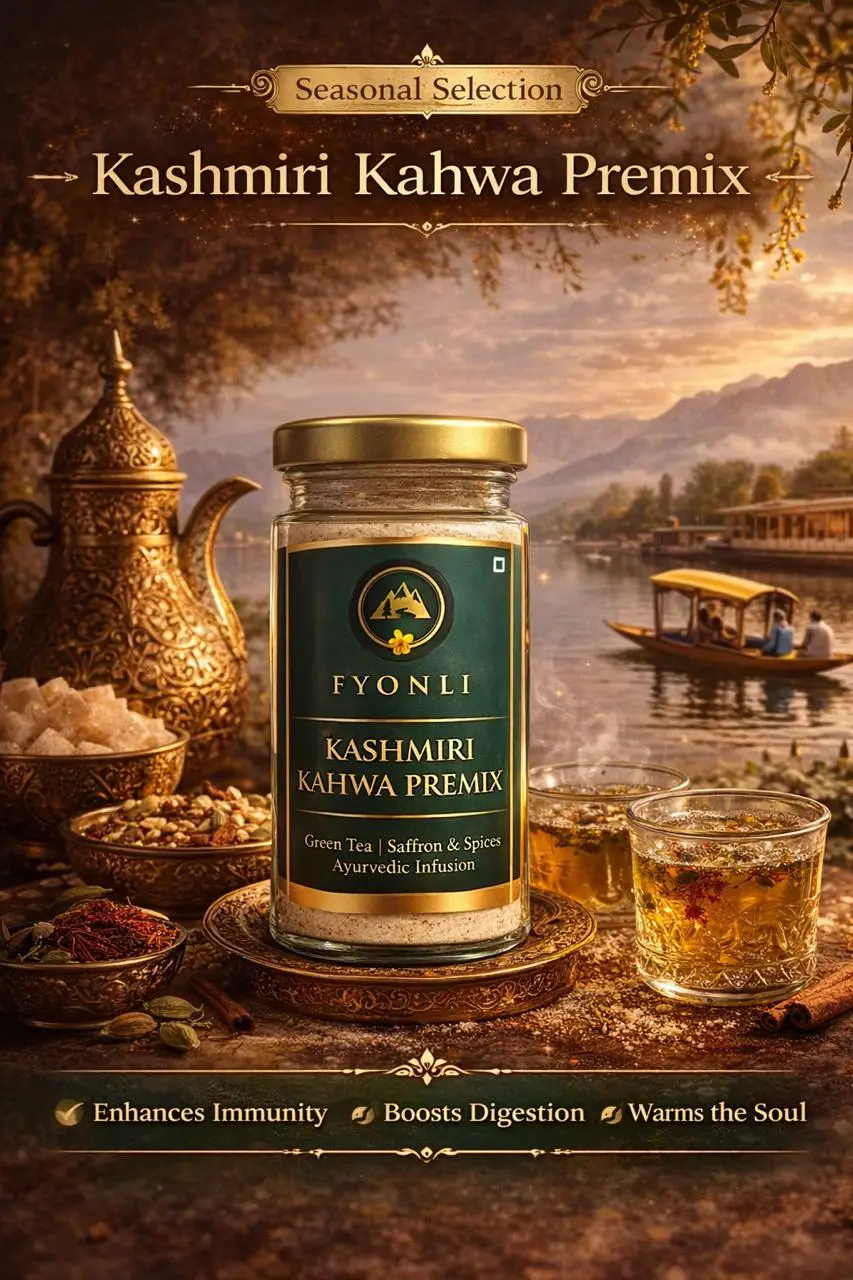
Fyonli’s Kashmiri Kahwa Premix is sourced from Kashmir and blended in small batches in the Himalayas, with real saffron strands (not colouring) and no artificial flavours or preservatives. To brew:
Heat water to just below boiling (85–90°C) — a rolling boil makes green tea bitter.
Stir in 1.5–2 teaspoons (roughly 3–4g) of premix per 150–180ml cup.
Steep for 2–3 minutes, stir once, and strain into a cup.
A 100g pack makes approximately 25–30 cups. It’s the same flavour as the simmered version above, at a fraction of the time — useful for a weekday cup, but keep the traditional method for when you’re serving guests and want the full ceremony.
Best Time to Drink Kahwa & Who Should Be Careful
Kahwa works at several points in the day, for different reasons:
Morning: A calmer, lower-caffeine start than coffee or strong chai — no cortisol spike, no crash.
After meals: Traditionally served after Kashmiri feasts (wazwan) — the digestive spices genuinely help with post-meal heaviness.
Mid-afternoon: The gentle caffeine and saffron make it a better 3pm pick-me-up than a second cup of coffee.
Winter evenings: Its warming spice profile makes it a natural cold-weather comfort drink, without the late-night caffeine hit of black tea.
A few groups should be more careful: pregnant women, since kahwa contains caffeine and spices including cloves, should check with their doctor on quantity; anyone on blood-thinning medication should be aware that cinnamon (in large amounts) and green tea can interact with certain medications; and children should stick to small, weak servings given the caffeine content, even though it’s lower than black tea.
Where to Buy Authentic Kashmiri Kahwa Online in India
A lot of what’s sold online as “Kashmiri kahwa” or “Kashmiri tea” is really just green tea with cardamom flavouring and artificial saffron colouring — cheaper to produce, but not the real thing. When buying kahwa online, look for three markers of authenticity:
Real saffron strands, not “saffron flavour” or colouring — the ingredient list should say saffron, not natural/artificial flavouring or FD&C colours.
Named sourcing — ingredients traceable to Kashmir, not a generic imported tea blend repackaged with a Kashmiri label.
A clean ingredient list — green tea, whole spices, saffron, and little else. No artificial colours or preservatives.
Fyonli’s Kashmiri Kahwa Premix meets all three — sourced from Kashmir, blended in small batches in the Himalayas, with real saffron strands and no artificial colours, flavours, or preservatives. It’s ready in under 3 minutes and makes roughly 25–30 cups per 100g pack.
No. Green tea is kahwa’s base, but kahwa is a spiced infusion — simmered with cardamom, cinnamon, and cloves, and finished with saffron. Plain green tea doesn’t have this warming, aromatic profile or saffron’s mood-supporting compounds.
What is the difference between kahwa and chai?
Kahwa is green tea simmered in water with whole spices and saffron, served without milk. Regular chai is black tea boiled with milk and sugar. Kahwa has less caffeine, no dairy, and a clear amber colour; chai is stronger, sweeter, and opaque from the milk.
Does kahwa contain caffeine?
Yes, kahwa contains the natural caffeine present in green tea, but at a lower level than black tea or coffee. The L-theanine in green tea moderates the effect, producing calmer, steadier energy rather than a sharp spike or crash.
Can kahwa be made with milk?
Traditional Kashmiri kahwa is always made with water, never milk. Milk masks the saffron and spice notes that define the drink. If you add milk, you’ve essentially made a spiced green tea latte, not kahwa.
Is kahwa good for weight loss?
Kahwa is low-calorie (especially without sugar) and its green tea base is associated with modest support for metabolism, which is why it’s often included in weight-conscious diets. It isn’t a weight-loss drink on its own — it works best as a lower-sugar, lower-calorie swap for sweetened milk chai or flavoured lattes.
How many cups of kahwa can I drink in a day?
Two to three cups a day is a reasonable amount for most healthy adults, given its moderate caffeine content. As with any caffeinated drink, pregnant women, those sensitive to caffeine, and anyone on relevant medication should check with a doctor on quantity.
Where can I buy authentic Kashmiri kahwa online?
You can buy authentic Kashmiri kahwa as a ready premix from Fyonli’s Kashmiri Kahwa Premix — made with real saffron strands, sourced from Kashmir, and blended in small batches with no artificial colours or flavours. Look for products that list saffron as an ingredient, not “saffron flavour” or added colour.
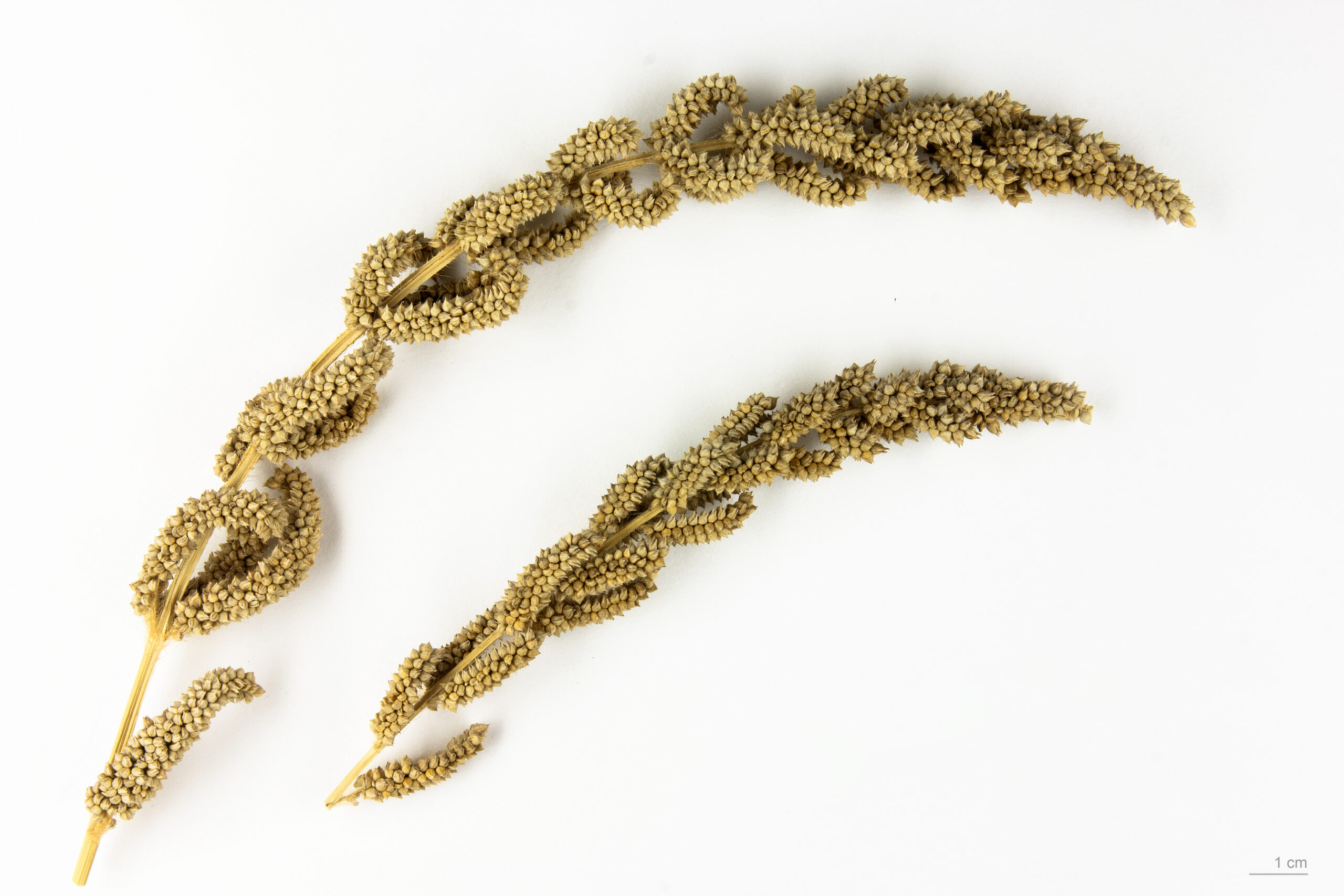
Jhangora is barnyard millet — the local Garhwali name for Echinochloa frumentacea, a small, white, gluten-free grain grown on the terraced hillside farms of Uttarakhand for over 2,000 years. Also called Sanwa in Hindi and Sama in fasting traditions, jhangora is one of the most nutritionally complete millets available in India — with the highest dietary fibre of any commonly eaten millet, a low glycaemic index, and a Himalayan origin that makes its variety genuinely distinct.
If you are new to millets, or specifically trying to understand where jhangora sits in the millet category and how it compares to ragi, bajra, jowar, and foxtail millet — this guide covers exactly that.
Jhangora is the Uttarakhand name for barnyard millet, one of the eight millets recognised and promoted by the Indian government under its Millet Mission. Its scientific name is Echinochloa frumentacea. It is called Sanwa or Samak in Hindi, Kuthiraivalli in Tamil, and Oodalu in Kannada — the same grain, known by different names across India’s regional food traditions.
In Uttarakhand’s Garhwal and Kumaon hills, jhangora has been a daily staple grain for thousands of years — eaten as a rice substitute, cooked into kheer, made into khichdi, and used as a fasting-approved grain during Navratri and Ekadashi. It grows naturally at altitudes between 400 and 2,100 metres on rain-fed terraced farms with no irrigation and no synthetic fertiliser.
Uttarakhand jhangora has a pending Geographical Indication (GI) tag — a formal recognition that this specific Himalayan variety, grown in this specific terrain, is distinct from barnyard millet grown in the plains.
Where Jhangora Fits in the Millet Family
India grows and eats eight major millets. Understanding where jhangora sits in that family helps clarify what makes it different and who should prioritise it.
Ragi (Finger Millet) — the calcium king; best for bone health and growing children
Bajra (Pearl Millet) — highest protein and iron; widely eaten across Rajasthan and Gujarat
Jowar (Sorghum) — mild, versatile; good for chapatis and rotis
Foxtail Millet (Kangni) — high protein, high fibre; popular in South India
Little Millet (Kutki) — high iron; used extensively in tribal food traditions
Kodo Millet — antidiabetic properties; used in Chhattisgarh and Madhya Pradesh
Jhangora / Barnyard Millet — highest fibre of any millet; lowest glycaemic index; fasting-approved; Himalayan origin
Each millet has a specific nutritional strength. Jhangora’s position is clear: it is the fibre champion of the millet family, and the grain best suited to blood sugar management, weight control, and fasting traditions.
Jhangora vs Other Millets — Head-to-Head
This is where the numbers tell the story. All values are per 100g raw grain (source: ICMR-NIN National Food Composition Tables).
Millet
Calories
Protein
Dietary Fibre
Iron
GI
Gluten-Free
Jhangora (Barnyard)
307 kcal
6.2g
9.8g
2.9mg
~50 (Low)
Yes
Ragi (Finger Millet)
336 kcal
7.3g
3.6g
3.9mg
~65
Yes
Bajra (Pearl Millet)
361 kcal
11.6g
1.2g
16.9mg
~55
Yes
Jowar (Sorghum)
349 kcal
10.4g
1.8g
4.1mg
~55
Yes
Foxtail Millet
351 kcal
12.3g
8.0g
2.8mg
~50
Yes
Little Millet
341 kcal
7.7g
7.6g
9.3mg
~50
Yes
What the table shows: Jhangora has the highest dietary fibre (9.8g) of any millet in the comparison — more than double the fibre of ragi, jowar, and bajra. Its glycaemic index (~50) is among the lowest. The trade-off: its protein (6.2g) is lower than bajra, jowar, or foxtail millet. If your priority is fibre and blood sugar stability, jhangora is the clear choice. If your priority is maximum protein, foxtail millet or bajra serves better.
One thing the table cannot show: origin and growing conditions. Jhangora from Uttarakhand’s Himalayan farms is a genuinely different product from commercially grown barnyard millet. Altitude, soil mineralogy, and traditional seed varieties all affect the final grain — a difference you taste and feel.
5 Key Health Benefits of Jhangora
1. The Highest Fibre of Any Commonly Eaten Millet
At 9.8g of dietary fibre per 100g, jhangora delivers more fibre than ragi, bajra, jowar, and most other millets. This matters for three reasons: gut health and regular digestion; sustained fullness after meals (meaning you eat less overall); and cholesterol management, as dietary fibre binds to bile acids and reduces LDL reabsorption. A single serving of jhangora provides a substantial contribution to the 25–30g daily fibre target that most Indians do not reach.
2. Low Glycaemic Index — Stable Energy Throughout the Day
Jhangora’s glycaemic index of approximately 50 puts it in the low-GI category. This means it releases glucose slowly into the bloodstream rather than causing a sharp spike and subsequent energy crash. For anyone managing blood sugar — or simply wanting to avoid the 3pm energy slump after lunch — switching from white rice or wheat rotis to jhangora at one meal a day is a straightforward, evidence-backed choice. Our deeper guide on Jhangora Barnyard Millet covers the diabetes angle in full.
3. Genuine Support for Weight Management
The combination of high fibre, low GI, and moderate calories (307 kcal per 100g — lower than ragi, bajra, jowar, or foxtail millet) makes jhangora one of the most weight-management-appropriate grains available. Fibre creates satiety; low GI prevents hunger-triggering blood sugar crashes; and the slightly lower caloric density means you can eat a satisfying portion without overconsumption. Replacing white rice with jhangora at one meal per day is a single dietary change with a measurable calorie and fibre impact.
4. Antioxidants and Phenolic Compounds Not Found in Refined Grains
Jhangora barnyard millet contains phenolic acids and flavonoids — plant antioxidants that reduce oxidative stress, support cellular health, and help manage chronic low-grade inflammation. These compounds are present in the outer bran layer of the grain, which is retained in minimally processed jhangora. They do not appear on a nutrition label but form a significant part of the grain’s traditional health reputation across Himalayan food medicine.
5. Naturally Gluten-Free and Easy to Digest
Like all millets, jhangora is naturally gluten-free — not processed to remove gluten but genuinely free of it by nature. For those with gluten sensitivity, coeliac disease, or wheat intolerance, jhangora is a safe, filling, and nutritionally complete alternative. It is also generally well-tolerated by people with sensitive digestion — lighter on the stomach than wheat and with none of the digestive heaviness that refined grains often cause.
Jhangora for Navratri and Ekadashi Fasting
One of the most important traditional uses of jhangora — and one that explains its enduring place in North Indian kitchens — is as a fasting grain.
During Navratri, Ekadashi, and Maha Shivratri, Hindu fasting traditions prohibit the consumption of cereals — wheat, rice, barley, oats, and regular corn. Millets, however, are not classified as cereals under these fasting rules. Jhangora (barnyard millet) is specifically listed as an acceptable fasting grain in most North Indian fasting traditions, alongside Sama rice (which is actually a different millet — little millet / Proso millet), singhara atta, and kuttu (buckwheat).
This makes jhangora uniquely useful: it provides complex carbohydrates, sustained energy, and genuine fullness during fasting periods — without the blood sugar crash that comes from sugar-based fasting snacks like fruits, dairy sweets, or sabudana prepared with lots of ghee and potato.
Common jhangora fasting preparations:
Jhangora khichdi — cooked with sendha namak (rock salt), ghee, and cumin; no onion, no garlic
Jhangore ki kheer — cooked in full-fat milk with sugar and cardamom; a Pahadi festival dessert
Jhangora upma — tempered with ghee, green chilli, and mild spices permitted during fasting
Pahadi families in Uttarakhand have eaten jhangora through every fast and festival for centuries — long before “fasting superfoods” became a marketing category.
Jhangora in Ayurveda
Ayurvedic texts classify jhangora (referred to as Shyamaka in Sanskrit) as a light, easy-to-digest grain with cooling, balancing properties. It is recommended in Ayurveda for:
Digestive disorders — its lightness makes it suitable for people with sluggish digestion, bloating, or IBS
Fever and convalescence — jhangora gruel (kanji) was traditionally prescribed during illness for its easy digestibility and hydrating properties
Pitta and Kapha imbalance — its cooling nature helps pacify excess heat (Pitta) and its fibre content helps clear Kapha accumulation
Weight management — Ayurveda classifies it as Laghu (light) and Grahi (absorbent), properties associated with healthy weight maintenance
The Ayurvedic view of jhangora aligns closely with what modern nutritional science confirms: a grain that is easy on the digestive system, slow to release energy, and supportive of healthy weight and stable metabolism.
The Uttarakhand Altitude Advantage
Not all jhangora is the same. The barnyard millet grown on the terraced hillside farms of Uttarakhand — in districts like Tehri Garhwal, Devprayag, Chamoli, and Pauri Garhwal — is a different product from commercially grown barnyard millet cultivated in flat, irrigated plains.
Three factors explain why altitude matters:
Slower Maturation = Denser Grain
At altitudes above 1,000 metres, cooler temperatures slow the growth cycle of the jhangora plant. A slower maturation allows more time for the grain to accumulate nutrients, develop flavour compounds, and build denser cellular structure. Plains-grown jhangora matures faster under warmer conditions — producing a larger but nutritionally thinner grain.
Himalayan Soil Mineralogy
Uttarakhand’s terraced farms sit on weathered Himalayan rock — rich in trace minerals including zinc, magnesium, and silica that are often depleted in intensively farmed plains soil. Crops absorb minerals from soil; mineral-rich soil produces mineral-rich grain. This is the biochemical basis for why mountain-grown grains and pulses have different nutritional profiles from their plains-grown equivalents.
No Synthetic Inputs
Pahadi mountain farming is inherently low-input — steep terrain, lack of irrigation infrastructure, and the traditional farming knowledge of Garhwali and Kumaoni communities means these farms have never relied on chemical fertilisers or pesticides. The jhangora grows in genuine organic conditions, not certified-but-converted organic conditions.
Where to Buy Authentic Jhangora Online
Most jhangora sold online is not identified by growing region, and much of it comes from intensively farmed plains sources rather than the Himalayan hill farms where the grain traditionally grows. Our jhangora comes directly from Devprayag farming communities in Tehri Garhwal, harvested by hand each autumn season and packed in small batches without industrial processing or blending.
Jhangora is called barnyard millet in English. Its scientific name is Echinochloa frumentacea. In Hindi it is known as Sanwa; in Tamil as Kuthiraivalli; in Kannada as Oodalu. It is one of the eight millets promoted under India’s national Millet Mission.
Is jhangora the same as Sama rice?
No. Jhangora (barnyard millet, Echinochloa frumentacea) and Sama (little millet / Proso millet, Panicum sumatrense) are different plants. Both are used as fasting grains and both are called “Sama ke chawal” or similar names in different regions — which creates confusion. In Uttarakhand, jhangora is the primary fasting millet. In Maharashtra and Gujarat, Sama (little millet) fills that role. They have similar uses but are nutritionally and botanically distinct.
Is jhangora better than ragi?
It depends on what you need. Ragi wins on calcium — at 344mg per 100g, it is the best plant source of calcium available in grain form. Jhangora wins on fibre — at 9.8g per 100g vs ragi’s 3.6g, nearly three times more. Jhangora also has a lower glycaemic index than ragi. If your priority is bone health and calcium: ragi. If your priority is fibre, blood sugar stability, and digestive health: jhangora. Ideally, eat both.
Can jhangora be eaten during Navratri fasting?
Yes. Jhangora is a traditionally accepted fasting grain for Navratri and Ekadashi in North Indian Hindu fasting practice. It is not classified as a cereal grain under fasting rules and can be eaten during both Navratri and Ekadashi. The most common fasting preparations are jhangora khichdi (made with rock salt and ghee) and jhangore ki kheer (milk-based dessert).
Is jhangora good for weight loss?
Yes — jhangora supports weight management through three mechanisms: its 9.8g of dietary fibre creates strong satiety; its low glycaemic index prevents hunger-triggering blood sugar crashes; and at 307 kcal per 100g it is lower in calories than most other millets. It does not “burn fat” — no food does — but as a grain replacement in your daily diet, it consistently produces better fullness and lower total calorie intake than white rice or wheat rotis.
This article is the complete guide to gahat dal in English — what the plant is, where it comes from, why it is nutritionally exceptional, how Ayurveda has used it for centuries, and how to cook it simply at home.
Gahat dal is called horse gram in English. The name “horse gram” comes from its historical use as livestock fodder across the Indian subcontinent — but do not let that mislead you. Horse gram is an exceptional human food with a nutritional profile that most widely consumed pulses cannot match.
Its full scientific name is Macrotyloma uniflorum. It belongs to the legume family (Fabaceae) and is one of the few pulses that grows reliably in poor, rocky, rain-fed soil — including the terraced hillside farms of the Himalayan belt where few other crops survive without irrigation.
It is known by different names across India:
Gahat — Garhwal and Kumaon, Uttarakhand
Kulthi — North India (general Hindi)
Kollu — Tamil Nadu
Ulavalu — Andhra Pradesh and Telangana
Hurali — Karnataka
Horse gram — English (the universal reference)
Same pulse, many names — but gahat from Uttarakhand carries a specific identity: grown at altitude, in Himalayan mineral-rich soil, by Pahadi farmers who have tended these hillside fields without synthetic inputs for generations.
How Gahat Dal Compares to Other Common Dals
Most Indian kitchens rotate through 4 or 5 dals — masoor, moong, arhar, chana, rajma. Gahat dal sits outside this rotation for most urban households. That is a nutritional gap worth closing. Here is how it compares:
Dal
Protein (per 100g)
Iron
Fibre
Glycaemic Index
Gahat Dal (Horse Gram)
22–24g
~7mg
~5g
Low
Masoor Dal
~25g
~7mg
~11g
Low–Med
Moong Dal
~24g
~6mg
~16g
Low
Arhar (Toor) Dal
~22g
~5mg
~15g
Medium
Chana Dal
~20g
~5mg
~17g
Low
Where gahat dal truly stands apart is not just in its numbers — it is in its specific therapeutic properties. No other common Indian dal has the same Ayurvedic and clinical evidence behind kidney health, blood sugar management, and diuretic function. That combination is unique to horse gram.
5 Reasons You Should Add Gahat Dal to Your Diet
1. It Is the Best Pulse for Kidney Stone Prevention
This is gahat dal’s most well-documented traditional use — and where modern science most directly supports traditional practice. Gahat contains polyphenols that inhibit the formation of calcium oxalate crystals (the most common kidney stone type) and exerts a strong diuretic effect that increases urine flow. The traditional Uttarakhand practice of drinking overnight soaking water from gahat on an empty stomach each morning is a folk remedy that Ayurveda formalised and research has since validated.
2. It Manages Blood Sugar Better Than Most Dals
Gahat dal has a genuinely low glycaemic index — it releases energy slowly, avoids blood sugar spikes, and keeps you full for longer after meals. The combination of high protein, dietary fibre, and complex carbohydrates makes the post-meal glucose response from gahat significantly more stable than from most other pulses. For people managing Type 2 diabetes or insulin resistance, it is one of the most suitable dals available.
3. It Delivers 22–24g of Protein Per 100g
At 22–24g of protein per 100g, gahat dal horse gram is among the highest-protein pulses available in India. For vegetarians relying on dal as their primary protein source, this is meaningful — you get more protein per gram from gahat than from many of the dals currently in your kitchen.
4. It Is One of the Richest Vegetarian Sources of Iron
Gahat dal contains approximately 7mg of iron per 100g — among the highest iron values of any commonly available Indian pulse. For women with high iron requirements, vegetarians managing low haemoglobin, or anyone experiencing fatigue linked to iron deficiency, gahat is a genuinely useful food rather than just an interesting regional ingredient.
5. It Supports Weight Management Through Sustained Fullness
The high fibre and protein in gahat dal creates prolonged satiety — you feel full for longer without eating more. Ayurvedic texts describe gahat as having Medohara properties — the ability to help reduce excess body fat. In practical terms, replacing a lighter dal with gahat in your weekly rotation is a simple way to reduce hunger between meals without any other dietary change.
Gahat Dal Nutrition — What 100g Actually Gives You
Per 100g of raw gahat dal (horse gram):
Calories: 321 kcal
Protein: 22–24g
Carbohydrates: 57g (complex, slow-release)
Dietary Fibre: ~5g
Fat: 0.5g
Iron: ~7mg (approximately 39% of daily requirement)
Calcium: ~287mg
Phosphorus: ~311mg
Vitamin C: present (rare for a dried pulse)
Glycaemic Index: Low
Three things stand out: protein is among the highest of any Indian dal; iron at ~7mg per 100g puts it above most other pulses; and calcium at ~287mg per 100g is exceptionally high for a dried legume. You get all three in one food — which is uncommon in the plant world.
Where Gahat Dal Comes From — The Uttarakhand Story
Gahat has been grown in Uttarakhand for over 2,000 years. In the hill districts of Tehri Garhwal, Chamoli, Pauri Garhwal, and across Kumaon, it grows on rain-fed terraced farms at altitudes between 600 and 2,000 metres — without irrigation, without synthetic fertiliser, and often without any external inputs at all.
This growing environment matters. Crops grown at altitude in cold, rocky Himalayan soil develop differently from the same crop grown on flat, irrigated plains. Lower temperatures, higher UV exposure, mineral-rich mountain soil, and slow maturation produce a denser grain with a more concentrated nutritional profile. The mountain conditions are not incidental to the nutrition — they are the reason for it.
In traditional Pahadi households, gahat dal was the winter pulse — cooked into thick, slow-simmered curries during the coldest months when warming, sustaining food was the priority. The thick gravy of gahat dal served with rice or roti was not a dish of poverty. It was Himalayan food intelligence: a pulse that thrives in the hardest conditions and rewards the people who eat it.
How to Cook Gahat Dal at Home (Simple and Digestible)
The most common thing people say about gahat dal the first time they cook it: it needs proper soaking. That is true. But done correctly, it produces one of the most flavourful, hearty dals you will make.
Step 1 — Soak Overnight (This Step Is Not Optional)
Soak gahat dal in plenty of cold water for 8–12 hours. The grains will absorb water and soften significantly. If you have been told gahat is difficult to cook, insufficient soaking is almost certainly the reason. A properly soaked gahat dal cooks as easily as rajma.
Step 2 — Pressure Cook
Drain and rinse the soaked dal. Add to a pressure cooker with fresh water (1:3 ratio). Cook on medium heat for 4–5 whistles. The dal is ready when the grains are fully soft and the liquid has thickened slightly.
Step 3 — Make the Tadka
Heat ghee in a heavy pan. Add cumin seeds, dried red chillies, crushed garlic, and thinly sliced onion. Fry until golden. Add a tomato and cook until it breaks down. Add turmeric, coriander powder, and a pinch of asafoetida (hing). Combine with the cooked dal, salt to taste, and simmer on low heat for 10–12 minutes. Finish with garam masala and fresh coriander.
The result is a thick, earthy, deeply satisfying dal — nothing like the mild, watery versions that come from lighter pulses. This is a dal with real character.
Traditional Uttarakhand variation: Pahadi cooking uses minimal water, generous ghee, and slow cooking over low heat. The tadka uses jakhiya seeds — often called wild Himalayan mustard seeds, though botanically unrelated to mustard — alongside or instead of cumin, giving the finished dish its distinctly Garhwali flavour and aroma.
Who Should Be Eating Gahat Dal?
Anyone with a history of kidney stones — the most evidence-backed dietary support from a pulse, used in Uttarakhand for this purpose for centuries
People managing Type 2 diabetes — low-glycaemic, high-protein, high-fibre; one of the most diabetes-appropriate dals in the Indian pantry
Vegetarians looking for high protein — 22–24g per 100g, among the highest of any Indian pulse
Women and anyone managing low iron — approximately 7mg iron per 100g, one of the richest plant sources available
Those managing weight — high fibre and protein sustain fullness; Ayurveda identifies Medohara (fat-reducing) properties
Anyone eating for long-term health — a 2,000-year-old food with an unbroken track record of nourishing Himalayan communities
Frequently Asked Questions About Gahat Dal
What is gahat dal called in English?
Gahat dal is called horse gram in English. Its scientific name is Macrotyloma uniflorum. It is the same pulse known as Kulthi in Hindi, Kollu in Tamil, Ulavalu in Telugu, and Hurali in Kannada.
Is gahat dal the same as kulthi?
Yes. Gahat and Kulthi are the same pulse — horse gram. Gahat is the name used in Uttarakhand’s Garhwali and Kumaoni dialects; Kulthi is the general Hindi name. The grain, its nutritional properties, and its Ayurvedic uses are identical.
Does gahat dal really help with kidney stones?
Yes — gahat dal has the strongest traditional and scientific evidence of any pulse for kidney stone support. Its diuretic properties increase urine flow; its polyphenols inhibit calcium oxalate crystal formation. The traditional practice of drinking overnight soaking water on an empty stomach is well-documented in Ayurvedic texts and supported by modern research. It is a dietary support, not a substitute for medical treatment.
How long should I soak gahat dal before cooking?
Soak gahat dal for 8–12 hours before cooking — overnight is the standard. It is a dense grain that does not soften adequately without sufficient soaking. After soaking, it cooks in a pressure cooker in 4–5 whistles. Do not try to cook it without soaking first.
Who should avoid gahat dal?
Gahat dal is safe for most people. It is relatively high in purines — a consideration for people with gout. It is iron-rich, so those with haemochromatosis (iron overload) should monitor intake. People with advanced chronic kidney disease (as distinct from kidney stones) should consult a doctor before significantly increasing their pulse intake.
Looking for the same guide on another Himalayan pulse? See Toor Dal vs Arhar Dal vs Pahadi Toor Dal for the naming confusion around pigeon pea, and what actually separates hill-grown, unpolished toor dal from standard commercial dal.
Curious about the tadka itself? See Jakhya vs Rai (Mustard Seeds) for why Garhwali kitchens temper their dal with jakhiya instead of mustard seeds — and why the two are not the same spice at all, despite the name.
Himalayan superfoods have been feeding mountain communities for thousands of years. While India spent the last decade importing quinoa, chia seeds, and kale from abroad, the Uttarakhand and Kashmir Himalayan belt has been quietly producing foods that outperform most imported superfoods on every nutritional measure.
The difference is that nobody marketed them. That is now changing — and you can buy all of these genuine Himalayan superfoods online in India today, delivered directly from mountain farming communities to your door. According to the National Institute of Nutrition, traditional Indian foods grown at altitude consistently show higher micronutrient density than commercially cultivated equivalents — a finding that validates what Himalayan communities have always known empirically.
Here are the ten most remarkable ones, what makes each exceptional, and exactly where to find them.
Himalayan superfoods don’t get more overlooked than bhangjeera. Wild-harvested perilla seeds from the slopes of Devprayag in Garhwal, bhangjeera is the same seed celebrated in Korean and Japanese cooking as egoma — except it has grown wild in Uttarakhand and fed Pahadi communities for centuries before anyone called it a superfood.
Why it is exceptional: Bhangjeera contains one of the highest concentrations of alpha-linolenic acid (ALA) omega-3 of any plant food — higher than flaxseeds. For vegetarians who cannot get omega-3 from fish, bhangjeera is one of the most potent and culturally rooted alternatives available in India. It also contains rosmarinic acid — a powerful natural anti-inflammatory compound.
How to use it: Dry roast and grind with green chilli and garlic for bhangjeera chutney — the signature Pahadi condiment. Add whole seeds to hot ghee as a tempering for any dal. Mix into yoghurt with salt for a simple raita.
Who should eat it: Anyone increasing plant-based omega-3 intake, anyone curious about traditional Pahadi cooking, anyone looking for a genuinely different and delicious chutney base.
Of all the Himalayan superfoods on this list, gahat dal horse gram has the most impressive traditional medicinal reputation — and the most modern scientific validation to back it up.
Why it is exceptional: Gahat dal — known in English as horse gram — contains compounds that inhibit the formation of calcium oxalate kidney stones and has diuretic properties that help flush existing stones. It also contains approximately 22–24g of protein per 100g, among the highest of any pulse in India, with a low glycaemic index that makes it valuable for diabetics. Traditional Uttarakhand communities have eaten it for centuries — both as daily nutrition and as a specific remedy for urinary health.
How to use it: Soak overnight, pressure cook for 5–6 whistles, temper generously with ghee and garlic. Drink the soaking water on an empty stomach in the morning for kidney health support — this costs nothing extra since you are soaking the dal anyway.
Who should eat it: Anyone managing kidney stones or at risk, diabetics, vegetarians needing high-protein pulses, anyone wanting deeply flavourful winter dal.
3. Pahadi Haldi — High Curcumin Himalayan Turmeric
Most Indian kitchens use commercial turmeric containing 1–2% curcumin — the active anti-inflammatory compound. Pahadi haldi from Uttarakhand — grown slowly at altitude for up to 3 years rather than the standard 6 months — consistently tests between 4–7% curcumin. The difference in both flavour and therapeutic effect is real and measurable.
Why it is exceptional: Curcumin is one of the most studied natural anti-inflammatory compounds in science — linked to joint health, cardiovascular support, cognitive protection, and immune function. The commercial turmeric in most Indian kitchens delivers too little of it to be meaningful. Pahadi haldi delivers enough to matter — with an aroma and flavour that is richer, warmer, and more complex than any supermarket alternative.
How to use it: Always cook briefly in ghee or oil before adding water — this activates the curcumin. Always add a pinch of black pepper — piperine increases curcumin absorption by up to 2,000%. These two steps turn good turmeric into genuinely effective turmeric.
Who should eat it: Everyone who uses turmeric daily and actually wants the health benefits they are expecting from it.
Jhangora is Uttarakhand’s name for barnyard millet — a small white grain grown on terraced Himalayan hillsides in Devprayag and surrounding Garhwal valleys for thousands of years. It has fed mountain communities through winters and fasts without ever being marketed to the rest of India. That is changing as the millet movement gains momentum.
Why it is exceptional: Jhangora barnyard millet has a glycaemic index of approximately 50 versus white rice at 72 — significantly lower blood sugar impact. It contains nearly 4 times more dietary fibre than white rice, more iron, more protein, and is naturally gluten-free. Uttarakhand Jhangora has even been applied for Geographical Indication status — a recognition that this specific Himalayan variety is genuinely distinct from barnyard millet grown elsewhere.
How to use it: Cook exactly like rice — 1 cup grain, 2 cups water, 15 minutes. Serve with any dal. Also makes exceptional Jhangore ki Kheer — the beloved Pahadi dessert cooked slowly in full-fat milk with cardamom and dry fruits.
Who should eat it: Diabetics, anyone managing weight, anyone wanting to reduce rice consumption without sacrificing satisfaction, anyone interested in ancient grains.
5. Raw Wild Mountain Honey — Nothing Like Supermarket Honey
Raw wild mountain honey from the Garhwal Himalayan belt is produced by bees foraging freely across alpine terrain at 1,500–2,000 metres elevation. It has never been heated, pasteurised, or processed. It is fundamentally different from every jar on a supermarket shelf — not a premium version of the same thing but a genuinely different product.
Why it is exceptional: Raw mountain honey retains all its live enzymes, natural pollen, propolis traces, and antioxidants — all destroyed by the pasteurisation process that commercial honey undergoes. The flavour is layered and complex — slightly floral, earthy, with mineral depth from the diversity of alpine nectar sources. Wild honey at altitude adds further complexity from flora that simply does not exist below 1,000 metres.
How to use it: A spoonful in warm water with lemon first thing in the morning. Drizzled over yoghurt or fresh fruit. Stirred into cooled chai. Never add to boiling water — above 40°C destroys the live enzymes that make raw honey valuable.
Who should eat it: Everyone — but particularly anyone who has been consuming commercial honey expecting health benefits and wondering why they are not noticing any.
6. Himalayan Black Soyabean Bhatt — Antioxidant Powerhouse
Bhatt is a rare black soyabean variety grown at altitude across Uttarakhand — smaller and darker than commercial soyabean, with a dense earthy flavour and a nutritional profile that makes most imported Himalayan superfoods look ordinary by comparison.
Why it is exceptional: Bhatt is extraordinarily rich in anthocyanins — the same dark pigment antioxidants found in blueberries and acai berries that health enthusiasts pay premium prices to import from abroad. It is also high in protein, iron, and isoflavones. It grows naturally in Himalayan villages and has been eaten for generations without ever being marketed as a superfood — which makes it one of the most genuinely undervalued foods on this list.
How to use it: Cook like any bean — soak overnight, pressure cook until soft, temper with cumin and garlic. The flavour is deeper and more complex than white soyabean. Works exceptionally well in simple dal preparations or mixed into rice dishes.
Who should eat it: Anyone interested in antioxidant-rich foods, anyone wanting the Indian equivalent of expensive imported superberries — grown in their own country, supporting Indian farmers.
Rajma is one of India’s most loved dishes — but most people have never tasted rajma grown at altitude in mineral-rich Himalayan soil, hand-picked at the right stage of ripeness, and traceable to a specific valley. Chakrata rajma from the Chakrata hills of Uttarakhand is that product.
Why it is exceptional: Altitude-grown rajma develops a deeper, earthier flavour and a creamy interior texture — holding its shape while melting when pressed — that plains-grown commercial rajma simply cannot replicate. The thin skin means it cooks faster too. Single-origin rajma from a named Himalayan region is to commercial supermarket rajma what estate coffee is to instant powder — genuinely the same category but a completely different experience.
How to use it: Soak for 4–6 hours, pressure cook for 3–4 whistles. Cook your masala separately and combine — the beans contribute enough flavour that the gravy needs far less work than with commercial rajma.
Who should eat it: Anyone who cooks rajma regularly and wants to understand what it can actually taste like.
Mandua is the Garhwali name for finger millet — a grain grown on Himalayan terraces for generations and now gaining recognition as one of the most calcium-rich plant foods available anywhere in India. Stone-ground Mandua flour from Uttarakhand retains all its nutritional value in a way that factory-processed ragi flour cannot.
Why it is exceptional: Mandua contains more calcium than most dairy products — making it exceptionally valuable for vegetarians, lactose-intolerant individuals, and anyone concerned about bone health. It is naturally gluten-free, has a low glycaemic index, and is rich in iron and essential amino acids. Stone-grinding at low temperature preserves these nutrients and the grain’s natural aroma in a way that industrial milling simply does not.
How to use it: Mix with wheat flour for rotis — start with 30% Mandua, 70% wheat and adjust to taste. Use for porridge, pancakes, or dosas. The flavour is slightly nutty and earthy — distinctly different from plain wheat flour in a way most people find immediately appealing.
Who should eat it: Anyone looking to increase calcium intake naturally, anyone avoiding gluten, anyone wanting to bring traditional mountain grains into daily cooking.
9. Snow White Akhrot — Rare Grade Kashmiri Walnuts
Most walnuts sold in India are bitter — dark, astringent kernels that most people eat reluctantly rather than enthusiastically. Snow White Akhrot from Anantnag in Kashmir is the premium exception — pale cream kernels, zero bitterness, and a mild buttery flavour that is in an entirely different category.
Why it is exceptional: The Snow White grade is the rarest walnut kernel grade from Kashmir — selected for its pale colour, which indicates lower tannin content and consequently zero bitterness. Walnuts are among the most nutritionally dense nuts available — rich in omega-3, antioxidants, and compounds that support brain and cardiovascular health. The Snow White variety delivers all of this without the bitterness that makes most people eat walnuts reluctantly.
How to use it: Eat straight from the pack — the flavour needs no accompaniment. Add to oatmeal, salads, or yoghurt. Use in baking where walnut flavour is wanted without bitterness.
Who should eat it: Anyone who has been put off walnuts by bitterness — which is most Indians who have only ever tried commercially available walnuts.
Jakhya is a wild seed foraged from Himalayan forests in Uttarakhand — used as a tempering spice the way mustard seeds or cumin are used across the rest of India. Outside of Uttarakhand, almost nobody knows what it is. Inside it, nobody cooks dal without it.
Why it is exceptional: Jakhya has a unique crunchy, slightly bitter, intensely aromatic quality when fried in hot ghee that no other tempering spice replicates. It is not a substitute for mustard or cumin — it is its own thing entirely. The flavour it gives to a simple dal or sabzi is immediately recognisable as Pahadi food — an entire regional cuisine captured in one small wild seed.
How to use it: Add a teaspoon to hot ghee at the beginning of any dal preparation. The seeds crackle and darken — the moment they smell nutty and fragrant, proceed with the recipe. One use is enough to understand why this spice has anchored Pahadi cooking for generations.
Who should eat it: Anyone cooking Indian food who wants to explore regional spice traditions beyond the standard pantry.
Why These Himalayan Superfoods Are Not in Most Indian Kitchens Yet
The honest answer is distribution and marketing — not quality. Every food on this list has been eaten in the mountains for generations, in some cases for thousands of years. The farming communities that grow them have always known their value.
What was missing was a supply chain that could bring these genuine Himalayan superfoods to urban India with their provenance and quality intact — without the blending, industrial processing, and traceability loss that comes with mass commercial distribution.
That is exactly what small-batch Himalayan food brands are building. The window to discover these foods before they go mainstream is now.
Note: These are traditional foods with well-known nutritional benefits. This is not medical advice. Please consult a healthcare professional for specific health conditions.
Is Himalayan food genuinely healthier or just marketing?
The nutritional difference is real and measurable. Altitude, mineral-rich glacial soil, slower growing seasons, and the absence of chemical inputs all contribute to higher micronutrient density in Himalayan-grown foods. Research from institutions including the Centre for Aromatic Plants, Uttarakhand confirms that crops grown at altitude in traditional farming systems show consistently higher nutritional profiles than commercially cultivated equivalents.
What is bhangjeera and where can I buy it online?
Bhangjeera is the Garhwali name for wild perilla seeds — one of India’s richest plant-based omega-3 sources, grown naturally in the Devprayag region of Uttarakhand. It is used in traditional Pahadi cooking as a chutney base and tempering spice. You can buy authentic Devprayag bhangjeera online from Fyonli with pan-India delivery.
Which Himalayan superfood is best for kidney stones?
Gahat dal — known in English as horse gram or kulthi — is the traditional Himalayan remedy for kidney stones. It has diuretic properties that increase urine flow and contains compounds that inhibit the formation of calcium oxalate crystals. Drinking the water in which gahat has been soaked overnight is the traditional Uttarakhand practice for kidney stone support.
Which Himalayan superfood is best for diabetes?
Jhangora (barnyard millet) and gahat dal (horse gram) are the most beneficial Himalayan superfoods for diabetics. Both have a low glycaemic index, meaning they release energy slowly without causing blood sugar spikes. Pahadi haldi with black pepper also supports blood sugar regulation through its high curcumin content.
Are Himalayan superfoods available for delivery across India?
Yes — all Fyonli Himalayan superfoods are delivered pan-India with free shipping on orders above ₹499. Products are sourced directly from Uttarakhand and Kashmir farming communities and packed in small batches for freshness.
What makes Himalayan superfoods different from regular foods?
Himalayan superfoods are grown at altitude — typically between 1,500 and 2,500 metres — in mineral-rich glacial soil without chemical inputs. The slower growing seasons, colder temperatures, and clean environment concentrate nutrients and flavour in ways that plains-grown
Pahadi haldi vs Lakadong turmeric — if you have been researching premium turmeric in India, you have encountered both. Lakadong from Meghalaya dominates the high-curcumin turmeric conversation right now. Pahadi haldi from Uttarakhand has been used in mountain kitchens and Ayurvedic practice for centuries without the marketing.
Both are genuinely superior to supermarket turmeric. But they are different products — in flavour, curcumin content, cooking use, and origin. This is an honest comparison to help you decide which belongs in your kitchen.
Before comparing pahadi haldi vs Lakadong turmeric directly, it is worth understanding why curcumin is the number everyone quotes.
Curcumin is the primary active compound in turmeric — responsible for its deep golden colour, anti-inflammatory properties, antioxidant effects, and most of its documented health benefits. It is one of the most studied natural compounds in nutritional science, linked to reduced inflammation, improved joint health, cardiovascular support, and cognitive protection.
The problem is that commercial supermarket turmeric contains very little of it. Commercial turmeric powders — often blended from multiple sources and processed under heat — typically contain 1–2% curcumin. High-curcumin varieties from specific growing regions consistently test significantly higher. That is the entire reason pahadi haldi and Lakadong command a premium over standard turmeric.
What Is Pahadi Haldi?
Pahadi haldi is turmeric grown across the mid-Himalayan belt of Uttarakhand — in districts like Chamoli, Tehri Garhwal, Pauri, and Pithoragarh. It has been a kitchen and medicinal staple in Pahadi households for as long as anyone can trace.
What makes pahadi haldi different from commercial turmeric is the growing cycle. Regular commercial turmeric is harvested after 6 months in the ground. Pahadi haldi grows for up to 3 years — this extended growing period in mineral-rich Himalayan soil at altitude produces significantly higher curcumin content and a distinctly richer, more complex flavour profile.
It is hand-harvested, traditionally stone-ground, and has never been processed industrially. The flavour is warm, deeply aromatic, and slightly earthy — integrating more naturally into Indian cooking than any alternative.
What Is Lakadong Turmeric?
Lakadong turmeric comes from the Jaintia Hills region of Meghalaya in Northeast India. It has a curcumin content that consistently tests between 7–10% — genuinely one of the highest of any turmeric variety in the world. Its colour is a deep reddish-orange, its flavour is bold and intensely pungent, and it has become the premium turmeric of choice for Indian health food brands over the last three to four years.
Farmers in Meghalaya have cultivated it traditionally for generations, and the Government of Meghalaya has actively promoted it as a regional agricultural identity. It is now widely available from most serious natural food brands in India.
Pahadi Haldi vs Lakadong — 3 Differences That Matter
1. Pahadi Haldi vs Lakadong: Curcumin Content
Lakadong leads on raw curcumin numbers — testing between 7–10% consistently. Pahadi haldi from quality Himalayan sources tests between 4–7% — meaningfully higher than commercial turmeric, though typically below peak Lakadong figures.
If maximum curcumin concentration per gram is your only metric, Lakadong wins on paper. But curcumin alone does not tell the full story — bioavailability and cooking integration matter equally for how much benefit you actually receive.
2. Pahadi Haldi vs Lakadong: Flavour in Cooking
This is where pahadi haldi holds its own decisively. Lakadong’s intensity can be overpowering — many cooks find they need to use significantly less to avoid the turmeric dominating the dish. Pahadi haldi integrates more naturally into Indian cooking — its warmth and aroma complement rather than compete with other spices.
For everyday dal, curry, and sabzi, most traditional Indian cooks find pahadi haldi more versatile. Lakadong is better suited for preparations where turmeric is the featured ingredient — golden milk, turmeric shots, health supplements.
3. Pahadi Haldi vs Lakadong: Aroma and Character
Pahadi haldi has a richer, more complex fragrance — deeper and more resinous, with a warmth that fills the kitchen when added to hot oil. Lakadong is more sharply pungent. Both are excellent — which you prefer is genuinely a matter of personal preference and cooking style.
Which Turmeric Should You Choose?
The honest answer depends entirely on what you are using it for.
Choose Lakadong if:
You are taking turmeric primarily as a health supplement and want maximum curcumin per gram
You are making golden milk or turmeric shots where turmeric is the featured ingredient
You are comfortable adjusting quantities downward significantly
Choose Pahadi Haldi if:
You cook with turmeric daily in Indian food and want something that integrates naturally
You value aroma and flavour complexity alongside curcumin content
You want to support Himalayan farming communities specifically
You prefer the flavour tradition that is part of North Indian and Pahadi cooking heritage
The case for having both: Several serious home cooks keep both — Lakadong for golden milk and supplements, pahadi haldi for everyday cooking. The flavour profiles are different enough that they genuinely serve different purposes.
How to Get Maximum Benefit From Either
High curcumin content is only useful if your body can absorb it. Curcumin on its own has very low bioavailability. Two things dramatically improve absorption:
Black pepper — piperine, the active compound in black pepper, increases curcumin absorption by up to 2,000%. Add even a small pinch of freshly ground black pepper to any turmeric preparation. Traditional Indian cooking — which almost always combines these spices — has always been correct here.
Fat — curcumin is fat-soluble, meaning it absorbs far better when consumed with a fat source. Cooking pahadi haldi or Lakadong briefly in ghee or oil before adding water-based ingredients dramatically improves absorption. This is why tempering turmeric in ghee first — standard in most Indian cooking — is nutritionally correct as well as culinarily correct.
A Note on Turmeric Adulteration in India
Turmeric is one of the most commonly adulterated spices in India. Studies have found commercially sold turmeric powder frequently mixed with starch, sawdust, chalk powder, or artificial colouring — including lead chromate, which is toxic.
This makes provenance and traceability particularly important for turmeric. Buying from a seller who names the specific growing region and how the turmeric was processed is not just about getting better flavour — it is a genuine food safety issue.
Both pahadi haldi and Lakadong from reputable small-batch sources bypass this problem. The supply chains are short, the producers are named, and the volumes are small enough that adulteration is neither economically attractive nor logistically possible.
According to FSSAI’s spice quality standards, curcumin content is now a regulated quality parameter for turmeric — a recognition that the difference between high and low curcumin turmeric is significant enough to matter for consumer protection.
Where to Buy Authentic Pahadi Haldi Online
Our pahadi haldi is sourced from Uttarakhand hill farmers who grow it using traditional methods — slow-grown at altitude for up to 3 years, hand-harvested, and stone-ground without industrial processing. It is packed in small batches without blending with commercial turmeric, additives, or artificial colour.
It is the turmeric that Pahadi kitchens have used for generations — and the one that belongs in yours.
What is the main difference between Pahadi Haldi and Lakadong turmeric?
Pahadi Haldi is a broad category of small-batch, mountain-grown turmeric from the Himalayan belt — including Uttarakhand — known for its earthy flavour, deep orange-yellow colour, and high essential oil content. Lakadong turmeric is a specific variety from the Jaintia Hills of Meghalaya and is widely recognised for its exceptional curcumin content, often between 6–9%. While Pahadi Haldi wins on aroma and culinary versatility, Lakadong is the benchmark for raw curcumin concentration.
Which turmeric has more curcumin — Pahadi Haldi or Lakadong?
Lakadong turmeric generally leads on curcumin content, with levels often cited between 6–9% — well above the commercial average of 2–3%. High-quality Pahadi Haldi from Uttarakhand typically contains 3–5% curcumin, which is still significantly higher than supermarket turmeric. For purely therapeutic, supplement-style use, Lakadong holds the edge. For everyday kitchen cooking with strong flavour and aroma, Pahadi Haldi is equally compelling.
Can I use Pahadi Haldi and Lakadong turmeric interchangeably in cooking?
Yes, but with an adjustment. Lakadong’s higher curcumin density means it can colour and lend bitterness more aggressively — use slightly less than you would with regular turmeric. Pahadi Haldi integrates more gently into dals, curries, and golden milk, delivering rich aroma without overpowering a dish. Both work beautifully in Indian cooking; the choice depends on whether you’re optimising for flavour depth or maximum curcumin intake.
Is Pahadi Haldi better than regular turmeric from the market?
Yes, in most meaningful ways. Regular commercial turmeric is often grown at scale in the plains, harvested early, and can lose volatile oils during prolonged storage or adulteration. Pahadi Haldi, sourced small-batch from Himalayan farms, retains higher essential oil content, stronger colour pigmentation, and a more complex earthy-woody aroma. It is also typically free of synthetic colourants and fillers — a real concern with mass-market haldi.
Where does Fyonli’s Pahadi Haldi come from?
Fyonli sources its Pahadi Haldi directly from small-holder farms in Uttarakhand — part of our Soil-to-Soul commitment to traceable, mountain-origin ingredients. The turmeric is harvested from high-altitude farms, sun-dried using traditional methods, and stone-milled in small batches to preserve its natural oils and pigmentation. No additives, no fillers, no artificial colour.
Is high-curcumin turmeric worth the extra cost?
For daily culinary use, a good Pahadi Haldi at a moderate price point gives you excellent value — strong aroma, natural colour, and meaningfully higher curcumin than plain market haldi. Lakadong, at a premium price, makes more sense if you are using turmeric therapeutically — in golden milk shots, health tonics, or supplements — where raw curcumin concentration matters most. For the Indian home cook, Pahadi Haldi is the everyday upgrade that actually makes sense.
u003cstrongu003eDoes turmeric curcumin content affect its colour and taste?u003c/strongu003e
Yes, directly. Curcumin is the compound responsible for turmeric’s signature golden-yellow colour — higher curcumin means deeper, more vibrant colour. It also contributes to turmeric’s characteristic mild bitterness. However, aroma in turmeric comes largely from its essential oils (turmerone, ar-turmerone), not curcumin. This is why Pahadi Haldi can smell more fragrant than some high-curcumin varieties, even if Lakadong wins on the curcumin number.
Wait! Want to taste the Himalayas?
Get 15% off your first order — just drop your WhatsApp number or email.