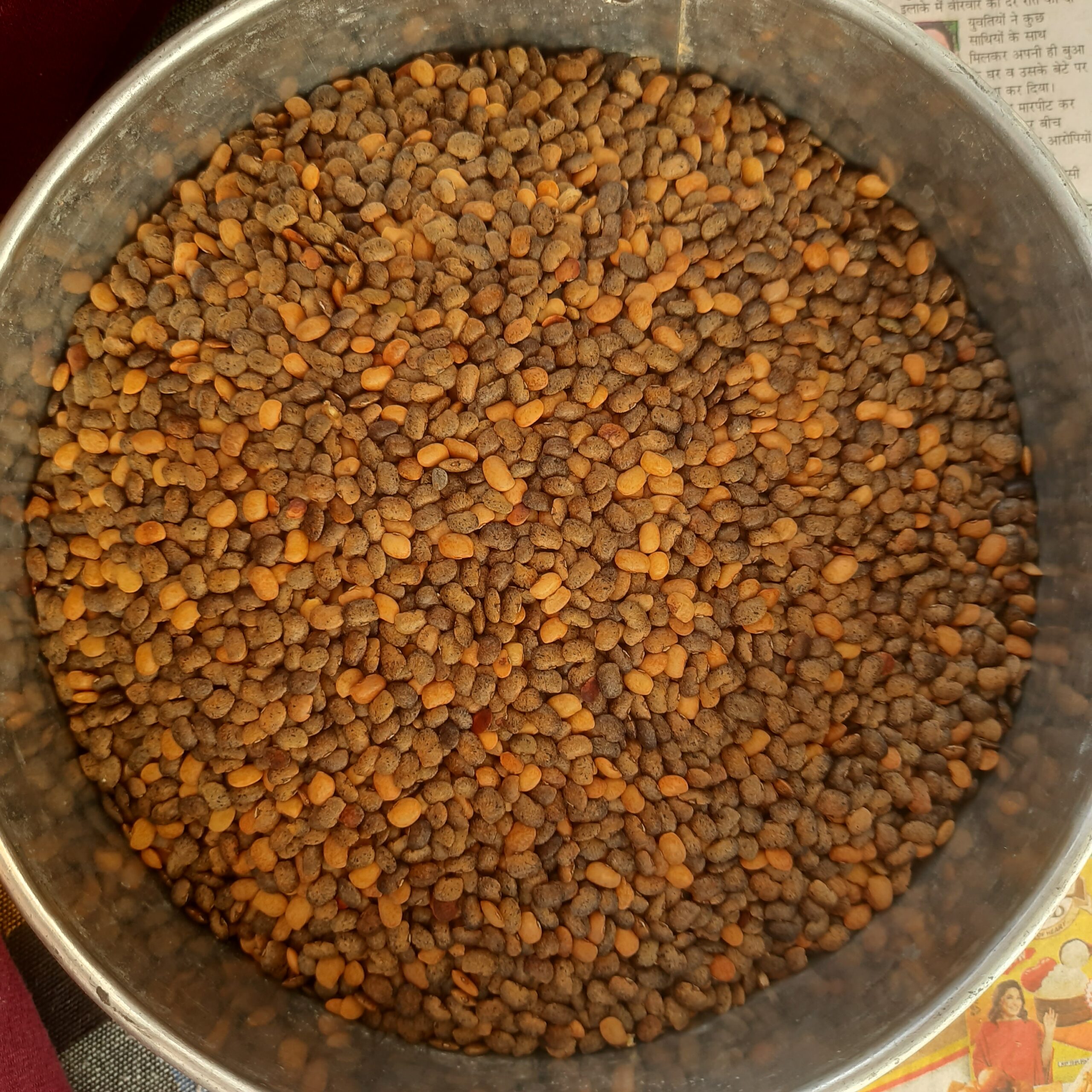
Toor dal and arhar dal are two regional names for the same legume: the pigeon pea, scientifically classified as Cajanus cajan. “Toor” (or tuvar) is the name used across Gujarat, Maharashtra, and much of South India. “Arhar” is the Hindi-belt name used across Uttar Pradesh, Bihar, Madhya Pradesh, and Delhi. Same dal, different vocabulary — the confusion is linguistic, not botanical.
Pahadi Toor Dal is a different question entirely. It is still the same species — Cajanus cajan — but it is grown differently and processed differently, and both of those differences change what ends up in your bowl. This article explains exactly what “toor dal,” “arhar dal,” and “Pahadi Toor Dal” each mean, why the naming overlaps, and what actually separates hill-grown, unpolished toor dal from the polished commercial dal sold in most Indian kitchens.
In This Article
- The Short Answer: Toor Dal and Arhar Dal Are the Same Pulse
- What Is Toor Dal / Arhar Dal (Cajanus cajan)?
- Where Does the Name Toor (Tuvar) Come From?
- Where Does the Name Arhar Come From?
- Pigeon Pea Names Across India — A Complete Regional Map
- Toor Dal in English: What Is the Correct Translation?
- Is Pahadi Toor Dal Actually Different? Terroir and Processing
- Polished vs Unpolished Toor Dal — Why It Matters
- Can You Use Them Interchangeably in Recipes?
- Where to Buy Authentic Pahadi Toor Dal
- Frequently Asked Questions
The Short Answer: Toor Dal and Arhar Dal Are the Same Pulse
Toor dal and arhar dal are two regional names for the same legume: the split, dehusked pigeon pea, botanically Cajanus cajan. There is no difference in species, appearance, or nutrition between a packet labelled “toor dal” and one labelled “arhar dal” — provided both are the same grade and processing.
The confusion exists for the same reason it exists with most Indian pulses and grains: India has dozens of regional food languages, and a staple this old has picked up a different name in nearly every one of them. Gujarati and Marathi kitchens say tuvar or toor. Hindi-belt kitchens in UP, Bihar, and MP say arhar. South Indian kitchens mostly use “tur” or “togari.” All of them are cooking the same dal.
Pahadi Toor Dal is where a genuine difference enters the picture — not in species, but in where the plant is grown and how the grain is processed afterward. That difference is real, measurable, and worth understanding before you buy.
What Is Toor Dal / Arhar Dal (Cajanus cajan)?
Toor dal comes from the pigeon pea plant, a woody, drought-tolerant shrub in the legume family (Fabaceae). Genetic and archaeological evidence points to India — most likely the eastern Deccan plateau — as the crop’s centre of domestication, going back roughly 3,500 years, making it one of the oldest pulses continuously cultivated on the subcontinent. From India, it later spread to Africa and the Caribbean, where it is now also a staple crop.
The plant produces pods containing small, round seeds that range from pale yellow to deep brown depending on variety. What is sold as “toor dal” or “arhar dal” is the split, husked form of this seed — the whole pea is dehusked and split into two lobes, the same way chana becomes chana dal or urad becomes urad dal.
Nutritionally, pigeon pea is one of India’s best plant protein sources. Per 100g of dry dal, it typically provides around 22g of protein, 15g of dietary fibre, meaningful iron and folate, and a low glycaemic index — which is part of why it has remained a daily staple across so much of the country for so long. It is also naturally gluten-free and one of the more digestible pulses when properly soaked and cooked.
Today, India is by far the world’s largest producer and consumer of pigeon pea, grown across Maharashtra, Karnataka, Uttar Pradesh, Madhya Pradesh, Gujarat, and — in smaller, less industrial volumes — the mid-altitude hill belt of Uttarakhand, where it is one component of the traditional Baranaja mixed-cropping system.
Where Does the Name Toor (Tuvar) Come From?
“Toor” — also spelled tuvar or tur — is the name used predominantly in Gujarati and Marathi, and by extension across Gujarat, Maharashtra, and much of western and southern India. It is also the name that dominates commercial packaging nationally, largely because Maharashtra and Karnataka are among India’s largest pigeon pea producing states, so “toor dal” is what appears on most large-brand packets regardless of where the buyer lives.
In Gujarati and Maharashtrian cooking, toor dal is the base for some of the most iconic everyday dishes in Indian food — Gujarati dal (sweet, tempered with jaggery and kokum), Maharashtrian varan, and the dal base for sambar in South Indian kitchens all start with toor dal. It is, by volume, the single most consumed dal in India.
Where Does the Name Arhar Come From?
“Arhar” is the Hindi name for the same pulse, used predominantly across Uttar Pradesh, Bihar, Madhya Pradesh, Rajasthan, and Delhi — the Hindi-speaking belt of North India. It is also one of the oldest recorded names for the crop in Indian food vocabulary, appearing in Hindi and Awadhi culinary tradition for centuries.
In North Indian kitchens, arhar dal is usually cooked simply — boiled with turmeric and salt, then finished with a tadka of ghee, cumin, garlic, and dried red chilli. It is the daily, unglamorous dal that shows up on most North Indian thalis, alongside roti and rice, without needing to announce itself.
Because Hindi is the most widely understood language across North and Central India, “arhar dal” is also the name most commonly used in Hindi-medium nutrition content, government agricultural data, and mandi price reporting — which is why you will see “arhar” dominate in some contexts and “toor” dominate in others, even though both refer to the same commodity in national trade statistics.
Pigeon Pea Names Across India — A Complete Regional Map
Like most staple pulses grown across the subcontinent for millennia, pigeon pea carries a different name in nearly every regional language. Here is a complete reference:
| Region / Language | Local Name for Pigeon Pea / Toor Dal |
|---|---|
| Uttar Pradesh, Bihar, MP, Delhi (Hindi) | Arhar |
| Gujarat (Gujarati) | Tuvar, Toor |
| Maharashtra (Marathi) | Toor, Tur |
| Karnataka (Kannada) | Togari Bele |
| Tamil Nadu (Tamil) | Thuvarai Paruppu |
| Andhra Pradesh / Telangana (Telugu) | Kandi Pappu |
| Uttarakhand (Garhwali / Kumaoni) | Toor, Rahar |
| Odisha (Odia) | Harada Dali |
| West Bengal (Bengali) | Arhar Dal |
| Punjab (Punjabi) | Arhar, Toor |
| English (common) | Pigeon Pea, Split Pigeon Pea, Red Gram |
| Scientific name | Cajanus cajan |
As with mandua and ragi, no single name became dominant nationally — instead, each region kept its own word, and “toor” and “arhar” happen to be the two that travelled furthest into pan-India commercial and conversational use.
Toor Dal in English: What Is the Correct Translation?
The correct English term for toor dal is split pigeon pea, or simply pigeon pea when referring to the whole grain before splitting. The scientific name is Cajanus cajan. You will also see it labelled “red gram” or “yellow dal” on some international packaging, though “pigeon pea” is the standard, internationally recognised English name.
If you search “arhar dal in English” and land on “pigeon pea,” that is correct. If you then search “toor dal in English” and get the same answer, that is also correct — because toor dal and arhar dal are the same pulse.
A quick note on the whole, unsplit form: before it is dehusked and split, the same seed is usually just called “pigeon pea” or, in Hindi, “arhar” without the “dal” suffix. Once split and husked, it becomes toor dal or arhar dal in the culinary sense.
Is Pahadi Toor Dal Actually Different? Terroir and Processing
This is where the toor-vs-arhar question turns into a genuinely different question, and most articles that cover the naming confusion stop short of it.
Pahadi Toor Dal — toor dal grown in the mid-altitude hill belt of Uttarakhand — is botanically identical to commercial toor dal from Maharashtra or Karnataka. Same species, Cajanus cajan. But two things separate it from what most Indian households buy: where it is grown, and how it is processed after harvest. Both matter more for this pulse than they do for a grain like mandua, because commercial toor dal processing is unusually aggressive.
Growing Conditions
In Uttarakhand, toor is grown as part of Baranaja — the traditional twelve-crop polyculture system practised on rain-fed hill terraces, where multiple legumes, millets, and grains are sown together in the same field rather than as a industrial monocrop. This is a fundamentally slower, lower-input growing method than the large-scale single-crop toor cultivation of Maharashtra and Karnataka, which supplies most commercial dal in India.
Polyculture farming without chemical inputs tends to produce a smaller, more compact grain with a denser texture — a pattern that shows up consistently in mixed-cropped Himalayan pulses compared to their monocropped flatland counterparts.
Processing — the Bigger Difference
This is the difference that matters most in practice. Most commercial toor dal sold in Indian supermarkets is polished — a mechanical process that removes not just the husk but also the outer bran layer, then commonly coats the split lobes in a thin layer of edible oil to give them a bright, glossy yellow shine and extend shelf life. Polishing makes the dal look more appealing on a shelf, but it also strips away fibre, polyphenols, and part of the grain’s natural nutrient layer in the process.
Pahadi Toor Dal, sourced directly from small hill farms, is typically left unpolished — no oil coating, no shine, husk and bran fully intact. It looks duller and less uniform than the bright yellow dal in a supermarket packet, and that is exactly the point: the dullness is the nutrient layer that polishing removes.
Polished vs Unpolished Toor Dal — Why It Matters
“Polished” and “unpolished” are the two categories worth understanding before you buy toor dal, because they matter more for nutrition and digestibility than the toor-vs-arhar naming question does.
Polished toor dal has had its bran layer machine-buffed away and, in many commercial batches, receives a light coating of edible oil to produce the bright, glossy yellow appearance most Indian consumers associate with “good quality” dal. This process improves shelf life and visual appeal but reduces fibre content and removes some of the naturally occurring polyphenols concentrated in the outer layer of the seed.
Unpolished toor dal — the form Pahadi Toor Dal is typically sold in — retains its natural bran layer. It looks less uniform and less glossy, cooks slightly differently (it holds its shape a little more and has a subtly nuttier flavour), and carries more of the fibre and micronutrients present in the whole grain. It is also, by most accounts from people who eat both regularly, gentler on digestion — the removal of the fibrous husk in heavily polished dal is sometimes associated with a blander, flatter dal that some people find harder to digest in large portions.
Neither is unsafe to eat. The difference is closer to the difference between brown rice and white rice, or whole wheat atta and refined maida — a processing choice that trades some nutrition and texture for shelf appeal and uniformity.
Can You Use Them Interchangeably in Recipes?
Yes — for cooking purposes, toor dal, arhar dal, and Pahadi Toor Dal are interchangeable in any recipe. Sambar, Gujarati dal, varan, and everyday tadka dal all work with any of the three; the recipe does not change.
The practical adjustment is in soaking and cooking time, not the recipe itself. Unpolished Pahadi Toor Dal, with its bran layer intact, benefits from a short 30-minute soak before cooking and generally needs about the same 3–4 pressure-cooker whistles as polished dal, though the texture stays slightly firmer and holds its shape better than heavily polished commercial dal, which tends to break down into a smoother mush. If you are used to polished dal, expect a marginally nuttier flavour and a less glossy finish with unpolished Pahadi Toor Dal — the taste difference is real but subtle, and it disappears almost entirely once the dal is tempered with ghee, cumin, and chilli.
Where to Buy Authentic Pahadi Toor Dal
Most “toor dal” available in Indian supermarkets and large e-commerce platforms is polished, oil-coated, and sourced from large-scale monocrop farming in Maharashtra and Karnataka. There is nothing wrong with that dal, but it is a different product from hill-grown, unpolished toor dal — and very little of what is labelled “Himalayan” or “Pahadi” online is actually traceable to a real hill farm.
Fyonli’s Pahadi Toor Dal is grown in traditional polyculture fields in the Uttarakhand hills and left exactly as it comes from the field — unpolished, with no oil coating and no preservatives, husk and nutrients fully intact. It has a naturally sweet flavour, a compact grain that cooks evenly, and a gentler character that is easy on the digestion. It is sourced directly from small Himalayan farms, in small seasonal batches.
If you are building out a fuller Himalayan pulse pantry, our Rudraprayag Mix Dal combines several traditional hill-grown pulses in one blend, and pairs naturally with Pahadi Toor Dal across the week.
Frequently Asked Questions
Is toor dal and arhar dal the same thing?
Yes. Toor dal and arhar dal are two regional names for the same pulse — split pigeon pea, Cajanus cajan. Toor (or tuvar) is used in Gujarat, Maharashtra, and much of South India; arhar is the Hindi name used across UP, Bihar, MP, and Delhi. They are botanically and nutritionally identical.
What is toor dal called in English?
Toor dal is called pigeon pea, or more specifically split pigeon pea, in English. Its scientific name is Cajanus cajan. “Red gram” is also used on some packaging, though “pigeon pea” is the standard English term internationally.
Is Pahadi Toor Dal different from regular toor dal?
They are the same species, but Pahadi Toor Dal is grown in Uttarakhand’s traditional hill polyculture fields and is typically left unpolished, with the bran layer and husk intact. Regular commercial toor dal is usually machine-polished and often oil-coated for shine and shelf life, a process that removes fibre and some micronutrients. The difference is real and comes from growing method and processing, not a different species.
Is unpolished toor dal healthier than polished toor dal?
Generally, yes. Unpolished toor dal retains its bran layer, which carries most of the pulse’s dietary fibre and polyphenols. Polishing — the mechanical buffing and sometimes oil-coating used to make commercial dal look bright and uniform — strips away part of that layer. Neither form is unsafe, but unpolished dal is the more nutritionally complete version of the same pulse.
Can I use toor dal and arhar dal interchangeably in recipes?
Yes, completely. Any recipe calling for toor dal will work identically with arhar dal, and vice versa, because they are the same pulse. The only variable worth adjusting for is polished versus unpolished dal, where unpolished grain may need a short soak and holds its texture slightly better during cooking.
Is toor dal good for diabetes and weight management?
Yes. Toor dal has a low glycaemic index and a high fibre and protein content, both of which slow glucose absorption and support satiety. It is a commonly recommended pulse in diabetes-friendly and weight-management diets across Indian dietary guidance. Unpolished toor dal, with its intact bran and fibre layer, offers a somewhat higher fibre load than heavily polished commercial dal.
Is toor dal gluten-free?
Yes. Toor dal, like all pigeon pea preparations, is naturally gluten-free. It is a good source of plant protein for people avoiding gluten, alongside other gluten-free pulses like moong, chana, and horse gram.
What are the other names for toor dal in India?
Toor dal is known as toor or tuvar (Gujarat, Maharashtra), arhar (Hindi belt — UP, Bihar, MP, Delhi), togari bele (Karnataka), thuvarai paruppu (Tamil Nadu), kandi pappu (Andhra Pradesh, Telangana), and harada dali (Odisha). All names refer to the same pulse, Cajanus cajan — split pigeon pea.
Curious about the same naming pattern in Himalayan grains? See Mandua vs Ragi: Same Grain, or Different? for how the same regional-name confusion plays out with finger millet — and Gahat Dal in English for the horse gram equivalent of this question.
Tempering your toor dal the Pahadi way? See Jakhya vs Rai (Mustard Seeds) — the same naming confusion shows up here too, since jakhiya is often called “wild mustard” despite coming from a completely different plant.