Description
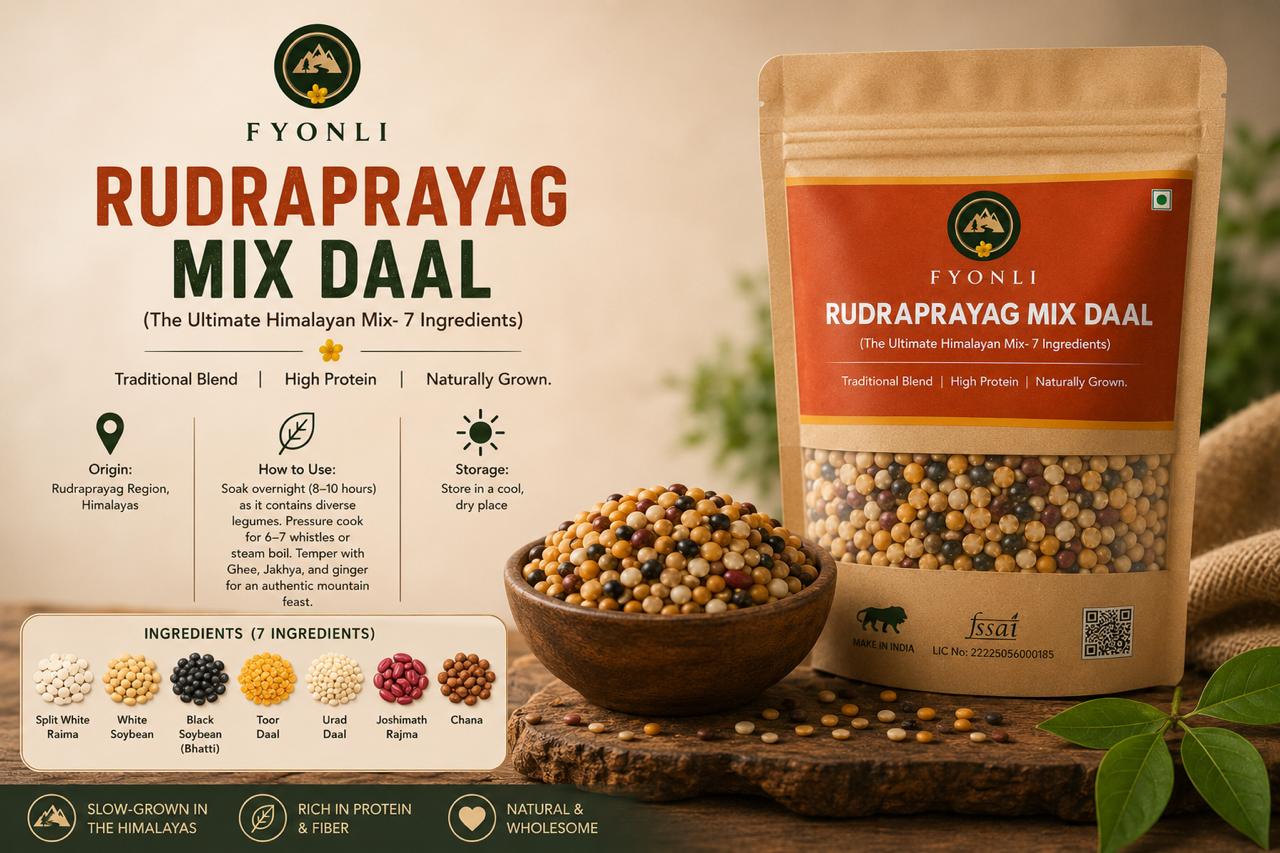
A blend of high-altitude pulses, sourced from where two rivers meet. Rudraprayag Mix Dal is a hand-selected blend of pulses from the terraced hillside farms of Rudraprayag, Uttarakhand — grown at altitude on rain-fed plots, brought to your kitchen without commercial processing or chemical treatment. No single-pulse dal delivers this range of amino acids, micronutrients and flavour in one bowl.What Is Rudraprayag Mix Dal?
Rudraprayag Mix Dal is a curated blend of high-altitude Himalayan pulses grown on terraced farms in Rudraprayag district, Uttarakhand — the town that sits at the confluence of the Alaknanda and Mandakini rivers, one of Uttarakhand’s most historically significant geographical points. Fyonli sources the pulses directly from Rudraprayag valley farms and blends them without commercial mixing or additives. The exact pulse composition can vary slightly by batch, reflecting what each season’s terraced farms actually produce — check the pack label for the specific pulses in your batch.Why This One Is Different
- Complementary amino acid profiles — different pulses contribute different amino acids, giving a more complete protein than any single-variety dal
- Broader micronutrient coverage — iron, zinc and folate from varied pulse types, rather than one narrow nutrient profile
- Rounded, complex flavour — a blend of mountain-grown pulses tastes deeper than a single-pulse dal
- Grown at altitude, rain-fed — terraced Rudraprayag farms, not irrigated lowland monoculture
- No additives, no commercial mixing — just the pulses, sourced and blended directly from the farms
Rudraprayag Mix Dal vs. Single-Variety Dal
| What You’re Buying | Single-Variety Supermarket Dal | Fyonli Rudraprayag Mix Dal |
|---|---|---|
| Amino acid profile | Limited to one pulse’s profile | Complementary profiles from multiple pulses |
| Origin | Usually unstated — pooled from multiple regions | Rudraprayag valley, Uttarakhand |
| Flavour | Single flavour note | Rounded, complex, from several pulse types |
| Growing method | Irrigated monoculture | Rain-fed, terraced hill farming |
| Farmer relationship | Bought through mandi traders | Bought direct from Rudraprayag valley farms |
Nutritional Information (per 100g, uncooked)
| Nutrient | Amount |
|---|---|
| Protein | ~20–24 g |
| Dietary Fibre | ~15–18 g |
Ingredients & Allergens
Ingredients: A hand-selected blend of Himalayan pulses grown in Rudraprayag, Uttarakhand. Composition can vary by batch — see the pack label for the full pulse list. No additives, oils, or preservatives.
Allergens: Natural legumes. Contains no gluten, dairy, or nuts. Packed in a facility that also handles other pulses and legumes.
How to Use
Soak for 4–6 hours (overnight works well). Drain and rinse. Pressure cook with fresh water (1:3 ratio) for 3–4 whistles. Prepare a tadka with ghee, cumin, garlic, tomato, and turmeric. Combine and simmer for 10 minutes. The result is a thick, hearty, complex dal.
Sourcing & Story
Rudraprayag sits at the sacred confluence of the Alaknanda and Mandakini rivers, one of Uttarakhand’s most historically significant points. Farmers here have cultivated a range of indigenous pulses on terraced hillside farms for generations, each variety adapted to the altitude, soil and climate of this high-altitude valley. Like other Himalayan legumes, these pulses are kharif crops — sown in early summer and harvested through autumn once the pods dry. Fyonli sources the pulses directly from Rudraprayag valley farms and blends them without any commercial processing.Storage & Shelf Life
Store in an airtight container in a cool, dry place, away from direct sunlight and moisture. Does not require refrigeration. Best used within 12 months of the packing date.
Who It’s For
- Cooks who want more complete nutrition in one dal — the blend’s complementary amino acids beat any single-pulse dish
- Anyone who wants a more complex, layered flavour — several pulse types in one pot, not a single flat note
- Shoppers who care about traceable sourcing — one valley, direct from the farms, no commercial mixing
Frequently Asked Questions
What pulses are in Rudraprayag Mix Dal?
It’s a hand-selected blend of high-altitude pulses grown on terraced farms in Rudraprayag, Uttarakhand. The exact composition can vary slightly by batch, reflecting what each season’s farms produce — check the pack label for the specific pulses in your batch.
Why blend multiple pulses instead of selling a single variety?
Different pulses have different amino acid profiles, so a well-formulated blend creates more complete protein in one dish than any single-pulse dal can. It also broadens micronutrient coverage — iron, zinc and folate — and gives a more complex, rounded flavour.
How do I cook Rudraprayag Mix Dal?
Soak for 4–6 hours or overnight, then drain and rinse. Pressure cook with fresh water in a 1:3 ratio for 3–4 whistles. Prepare a tadka with ghee, cumin, garlic, tomato and turmeric, then combine and simmer for 10 minutes.
How much protein and fibre does this dal blend provide?
Mixed Himalayan pulse blends typically provide around 20–24g of protein and 15–18g of dietary fibre per 100g, in line with the common range across Indian dal varieties. Because this is a blend with batch-to-batch variation, exact figures can vary slightly.
What is the shelf life of Rudraprayag Mix Dal?
Up to 12 months from the packing date when stored in an airtight container in a cool, dry place away from direct sunlight and moisture. Refrigeration isn’t required.
Are these pulses grown with pesticides or chemical fertiliser?
No. The farming families in Rudraprayag grow these pulses without chemical pesticides or synthetic fertiliser, on rain-fed terraced plots. They do not carry a formal organic certification, but the growing method has been chemical-free by practice for generations.
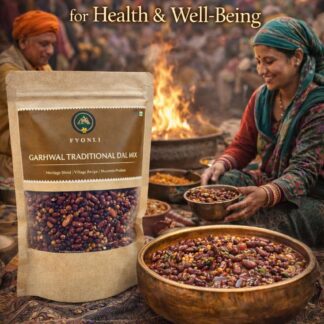
Prefer a dal mix with a clearly listed recipe? Try the four-pulse Garhwal Traditional Dal Mix (rajma, toor, urd and ryansh), or the single-species Naurangi Dal.