
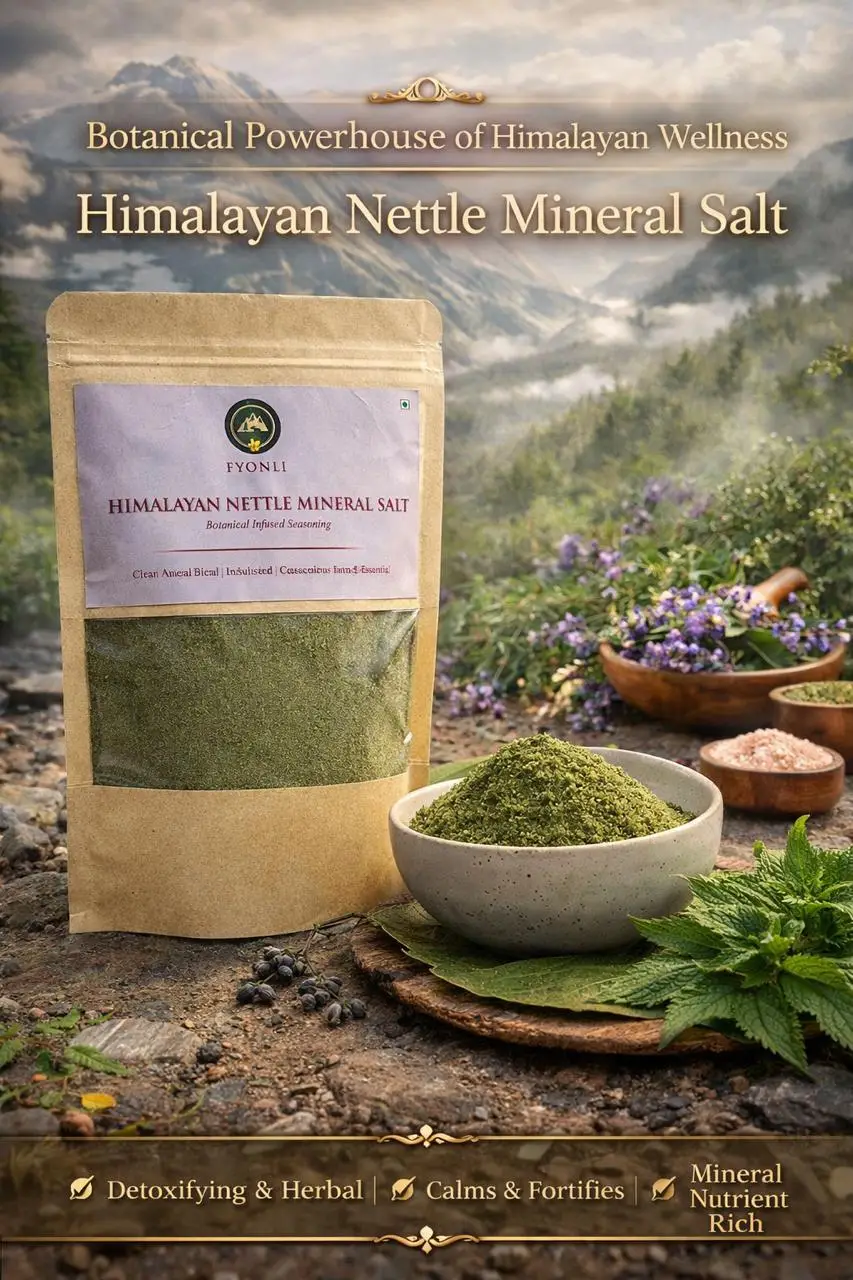
Himalayan nettle salt vs regular table salt — most people have never had to compare the two, because nettle salt has barely existed as a category until now. That is exactly the point. This is a genuinely uncommon Himalayan ingredient: wild-foraged stinging nettle, ground into a mineral-dense pink salt blend, made the way Garhwal households have seasoned food for generations — not a supermarket product with a wellness label stuck on it.
This article breaks down exactly what separates Himalayan nettle salt from the refined table salt sitting in most Indian kitchens — how each is made, what each actually contains, and whether switching is worth it for your cooking and your health.
Quick answer: Regular table salt is refined sodium chloride, stripped of trace minerals, bleached, and usually treated with anti-caking agents and synthetic iodine. Himalayan nettle salt is unrefined Himalayan pink salt blended with wild-foraged nettle powder, roasted cumin and garlic — retaining 84+ naturally occurring trace minerals from the salt itself, plus the iron, calcium, vitamin C and chlorophyll naturally present in nettle. It is not iodised, contains no anti-caking agents, and is processed by hand in small batches rather than industrially refined.
In This Article
- What Is Himalayan Nettle Salt?
- How Regular Table Salt Is Actually Made
- Himalayan Nettle Salt vs Table Salt: 5 Differences That Matter
- Why Wild Himalayan Nettle Is the Real Differentiator
- Health Benefits Worth Knowing
- Who Should Make the Switch?
- How to Use Himalayan Nettle Salt in Everyday Cooking
- A Note on Sodium and Long-Term Health
- Where to Buy Authentic Himalayan Nettle Salt Online
What Is Himalayan Nettle Salt?
Himalayan nettle salt is a botanical-infused finishing salt that combines unrefined Himalayan pink salt with wild stinging nettle (Urtica dioica), known in the Garhwal hills as bichhu ghaas. Roasted cumin and garlic are typically added to round out the flavour into a complete, ready-to-use seasoning rather than a single-note salt.
Unlike plain Himalayan pink salt — which is a single mineral ingredient — nettle salt is a functional blend. The nettle is foraged by hand from high-altitude meadows, shade-dried, and ground into a fine powder before being combined with the salt. It carries a clean, grassy earthiness that plain rock salt simply does not have, alongside the mineral density nettle is known for in Himalayan folk medicine and Ayurvedic practice.
There is very little written about this specific combination anywhere online, which is unusual for a food ingredient in 2026. Most “Himalayan salt” content online is about plain pink salt lamps and bath salts imported from Pakistan’s Khewra mines. Nettle-infused seasoning salt, made from Himalayan-foraged nettle rather than European nettle, is close to undocumented territory — which is part of why so few people know it exists yet.
How Regular Table Salt Is Actually Made
To understand what makes nettle salt different, it helps to know what happens to ordinary table salt before it reaches a shaker.
Most commercial table salt starts as either mined rock salt or salt evaporated from seawater or brine. It is then industrially refined — a process that strips out virtually every trace mineral except sodium and chloride. What remains is close to 99% pure sodium chloride, which is why refined table salt tastes sharp and one-dimensional compared to unrefined salts.
After refining, most table salt is treated further:
- Anti-caking agents — additives like sodium ferrocyanide or silicon dioxide are added so the salt flows freely and does not clump in humid conditions.
- Synthetic iodisation — potassium iodate is added to prevent iodine-deficiency disorders, a genuinely important public health measure, but one that changes the salt’s chemical composition and can leave a faint metallic aftertaste.
- Bleaching — some commercial salt is chemically treated to achieve a uniformly white appearance, removing the natural colour variation that indicates a less-processed mineral content.
None of this makes table salt unsafe. Iodised salt in particular has been a genuine public health success in preventing goitre and iodine-deficiency disorders in India. But it does mean regular table salt is a highly processed, single-mineral product — the opposite of what Himalayan nettle salt is built to be.
Himalayan Nettle Salt vs Table Salt: 5 Differences That Matter
1. Himalayan Nettle Salt vs Table Salt: Mineral Content
Refined table salt is almost pure sodium chloride — the refining process removes the trace minerals that were originally present in the raw salt. Himalayan pink salt, the base of nettle salt, is unrefined and carries over 84 naturally occurring trace minerals, including magnesium, potassium, calcium and iron, in the same crystal form they existed in millions of years ago. Nettle salt adds a second, plant-based mineral layer on top of that through the nettle itself.
2. Himalayan Nettle Salt vs Table Salt: Processing and Additives
Table salt is industrially refined and, in most cases, treated with anti-caking agents. Genuine Himalayan nettle salt is hand-processed in small batches — the salt is not chemically treated, and the nettle, cumin and garlic are dried and ground using traditional methods rather than industrial processing. There is nothing added purely for shelf appearance or flow.
3. Himalayan Nettle Salt vs Table Salt: Added Nutrition From Nettle
This is the difference that does not exist in any comparison between plain pink salt and table salt — because it comes entirely from the nettle, not the salt. Stinging nettle is one of the most mineral-dense leafy plants found in the Himalayan belt, traditionally valued for its iron, calcium, magnesium and vitamin C content, along with chlorophyll. Table salt contributes nothing nutritionally beyond sodium. Nettle salt contributes sodium plus a genuine plant-based micronutrient boost, in the quantities a seasoning is actually used in.
4. Himalayan Nettle Salt vs Table Salt: Flavour and How Much You Actually Use
Refined table salt has a flat, purely salty profile, which means the only way to add depth to a dish is to add more of it, or add separate spices on top. Nettle salt arrives with built-in complexity — the grassy earthiness of nettle, the warmth of roasted cumin, the savoury anchor of garlic — so it seasons and flavours in a single step. Many home cooks find they naturally use less of it per dish than they would plain salt, simply because the flavour is already more complete.
5. Himalayan Nettle Salt vs Table Salt: Iodine
Table salt sold in India is typically iodised by law for public health reasons. Himalayan nettle salt is not artificially iodised — it contains only the trace iodine naturally present in its raw ingredients. This is worth knowing rather than ignoring: if iodised salt is your household’s main dietary source of iodine, keep a source of iodine in your diet from elsewhere (dairy, eggs, seafood) if you switch your everyday salt to nettle salt.
Why Wild Himalayan Nettle Is the Real Differentiator
Himalayan pink salt on its own is no longer a novel ingredient — it is sold in every supermarket and health food aisle in India. What makes this particular product genuinely uncommon is the nettle.
Bichhu ghaas grows wild on the untouched, high-altitude slopes of the Garhwal Himalayas. It has a long history in Himalayan folk medicine and Ayurvedic practice, traditionally brewed as a tea or cooked as a green vegetable in mountain households — valued for its mineral density long before “nettle” appeared on any wellness brand’s ingredient list. Because it stings on contact, it has never been farmed at scale — it is foraged by hand, which naturally keeps it a small-batch, regional ingredient rather than a mass-market commodity.
Turning foraged nettle into a shelf-stable seasoning salt — rather than just a tea — is what makes this product distinct. It takes a wild, hyper-local ingredient with a real traditional-medicine pedigree and makes it usable in ordinary, everyday cooking: dal, sabzi, roasted vegetables, raita. That combination — wild Himalayan botanical plus daily-use seasoning format — is genuinely rare, which is exactly why there is so little written about it anywhere yet.
Health Benefits Worth Knowing
- Rich in trace minerals — every pinch carries the naturally occurring minerals in Himalayan pink salt alongside the botanical minerals from wild nettle.
- Natural source of iron and calcium — nettle is one of the richest plant-based sources of iron and calcium, relevant for vegetarian and plant-forward households.
- Supports digestive comfort — roasted cumin has a long history in Ayurvedic practice as a digestive aid, traditionally used to ease bloating and stimulate digestive enzymes.
- Anti-inflammatory properties — stinging nettle contains natural flavonoids and polyphenols that have been studied for anti-inflammatory effects.
- No hidden additives — free of MSG, iodine additives, silicon dioxide and the bleaching agents used in standard table salt production.
This is general nutritional information based on the traditional and known properties of these ingredients, not a medical claim. Salt of any kind should still be used in moderation, and anyone managing a specific health condition should speak to a doctor before changing their diet.
Who Should Make the Switch?
Stay with iodised table salt if:
- It is your household’s primary dietary source of iodine and you are not getting it elsewhere
- You are following a specific medical or dietary protocol that requires plain refined salt
Switch to Himalayan nettle salt if:
- You already eat iodine from dairy, eggs or seafood and want a less-processed everyday salt
- You are a vegetarian or plant-forward household looking to quietly add more iron and calcium to daily meals
- You want to reduce the number of separate spice jars you reach for — nettle salt does salt, herb and warmth in one
- You read labels, avoid additives, and want a transparent, small-batch supply chain over a mass-market one
How to Use Himalayan Nettle Salt in Everyday Cooking
- As a finishing salt — sprinkle over roasted vegetables, grilled paneer, eggs, soups or dal just before serving for a mineral-rich, aromatic lift.
- As a 1:1 table salt replacement — use directly in curries, sabzis, rice dishes and lentils in place of regular salt.
- In buttermilk and chaas — stir a pinch into chilled buttermilk with torn curry leaves for a classic North Indian digestive drink.
- In lemon or jeera water — add a pinch to morning hydration drinks for a mineral-boosting start to the day.
- On salads and raitas — use in cucumber raita, kachumber or fruit chaat, where the nettle and cumin add complexity without overpowering fresh ingredients.
- In marinades — combine with olive oil, lemon and fresh herbs for a clean, one-ingredient seasoning base for chicken, fish or vegetables.
A Note on Sodium and Long-Term Health
Switching to Himalayan nettle salt does not mean unlimited salt is suddenly fine. Sodium chloride is sodium chloride, whichever form it comes in, and excess sodium intake is linked to high blood pressure regardless of whether the salt is refined or unrefined. According to the World Health Organization, most people worldwide consume more sodium than recommended, and reducing overall intake — not just switching salt types — is what actually protects long-term cardiovascular health.
What nettle salt changes is what comes with the sodium: fewer processing additives, a broader mineral profile, and a genuine nutritional contribution from the nettle itself. It is a better everyday salt, not a licence to season without limits.
Where to Buy Authentic Himalayan Nettle Salt Online
Fyonli’s Himalayan Nettle Mineral Salt is slow-crafted in Devprayag, Tehri Garhwal, from wild nettle foraged in the high-altitude meadows of the Garhwal Himalayas, blended with Himalayan pink salt, roasted cumin and garlic. Four clean ingredients, no fillers, no anti-caking agents, no artificial flavours — FSSAI licensed (Lic. No: 22625066000185).
It is made by the same small team, in the same village, using the same wild-foraged nettle that has seasoned Garhwal kitchens for generations — just packed for yours.
Shop Himalayan Nettle Mineral Salt →
You might also like:
- Pahadi Haldi vs Lakadong Turmeric — An Honest Comparison
- Raw Mountain Honey — 5 Essential Differences From Supermarket Honey
- 7 Traditional Himalayan Wellness Foods You Should Add to Your Daily Routine
- 10 Remarkable Himalayan Superfoods You Can Buy Online in India
- How Altitude Affects Nutrition: The Science Behind Himalayan Food
- Shop Salts & Seasonings →
-
What is Himalayan nettle salt made of?
Himalayan nettle salt is a four-ingredient blend of Himalayan pink salt, wild-foraged nettle powder, roasted cumin and garlic. Unlike plain pink salt, which is a single mineral ingredient, nettle salt is a functional seasoning built to replace table salt while adding plant-based nutrition and flavour in one step.
-
Is Himalayan nettle salt healthier than regular table salt?
It is a less processed, more mineral-diverse option. Regular table salt is refined to near-pure sodium chloride and often treated with anti-caking agents and synthetic iodine. Himalayan nettle salt retains the 84+ trace minerals naturally present in unrefined Himalayan pink salt, plus the iron, calcium and vitamin C naturally present in nettle. Both are still sodium sources and should be used in moderation.
-
Does Himalayan nettle salt contain iodine?
No. It is not artificially iodised, unlike most commercial table salt sold in India. It contains only trace iodine naturally present in its raw ingredients. If iodised salt is your main dietary source of iodine, make sure you are getting iodine from other foods such as dairy, eggs or seafood if you switch your everyday salt.
-
Can I use Himalayan nettle salt as a direct substitute for table salt?
Yes. It works as a 1:1 replacement for table salt in most Indian cooking — dals, curries, sabzis and rice dishes. Because the flavour is more complex than plain salt, many people find they naturally use slightly less to reach the same seasoning effect.
-
Where does the nettle in Himalayan nettle salt come from?
The wild stinging nettle (Urtica dioica), known locally as bichhu ghaas, is foraged by hand from high-altitude meadows in the Garhwal Himalayas of Uttarakhand. It is shade-dried and ground without chemical preservatives or synthetic drying agents before being blended into the salt.
-
Why is there so little information about Himalayan nettle salt online?
Because it is a genuinely uncommon product. Most Himalayan salt content online covers plain pink salt lamps or bath salts. A seasoning blend built around wild-foraged Garhwal nettle, rather than European nettle or plain rock salt, has almost no existing coverage — it is a small-batch, regionally sourced product rather than a mass-market one.
-
Is Himalayan nettle salt safe for children and everyday family cooking?
Yes. All ingredients are natural, food-grade, and free of additives, preservatives or common allergens. As with any salt product, use age-appropriate quantities for young children, and consult a paediatrician if your child is on a sodium-restricted diet.