
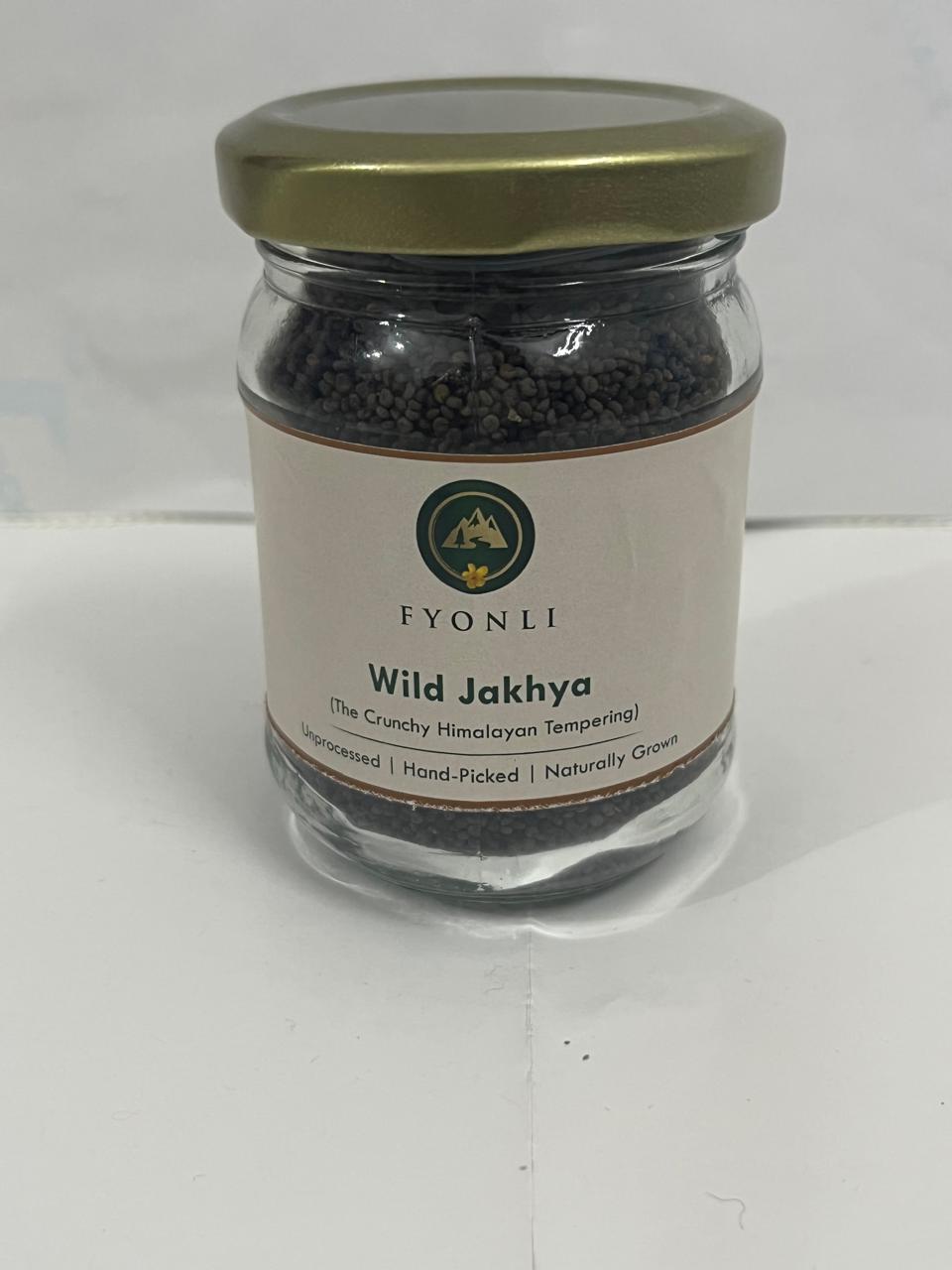
Jakhya and rai (mustard seeds) get lumped together constantly — both are small, dark, tempered in hot oil at the start of cooking, and both crackle. In Uttarakhand kitchens, jakhya is even called “wild mustard” or “dog mustard” in English. But the two seeds are not related. Jakhya comes from a completely different plant family than every mustard seed sold in India, which is exactly why it tastes, cooks, and behaves nothing like rai once it hits hot ghee.
This guide explains what jakhya actually is, how it differs from rai botanically and in the kitchen, why Garhwali and Kumaoni cooks reach for it over mustard seeds and cumin, and how to start using it at home.
In This Article
- The Short Answer: Jakhya and Rai Are Not the Same Seed at All
- What Is Jakhya?
- What Is Rai (Mustard Seeds)?
- Jakhya vs Rai: The Real Differences
- Why Uttarakhand Kitchens Reach for Jakhya Over Rai
- Health Benefits of Jakhya
- How to Cook With Jakhya
- Where Fyonli’s Jakhya Comes From
- Where to Buy Authentic Jakhya Online
- Frequently Asked Questions
The Short Answer: Jakhya and Rai Are Not the Same Seed at All
Jakhya (also spelled jakhiya) is the seed of Cleome viscosa, a wild plant in the Cleomaceae family that grows on fallow, uncultivated land across Uttarakhand. Rai is mustard seed, from plants in the genus Brassica — a member of the Brassicaceae (cabbage) family, the same family as cauliflower, cabbage, and sarson. Despite the common English label “wild mustard,” jakhya and rai are not botanically related in any meaningful way — they simply resemble each other in size and in how they crackle in hot oil.
In practice, that means you cannot always swap one for the other. Rai brings the sharp, sulphurous heat typical of mustard oil and mustard-family cooking. Jakhya is odourless when dry and, once it hits hot ghee or oil, releases a nutty, earthy, almost roasted aroma with none of mustard’s pungency — which is exactly why Garhwali and Kumaoni cooks use it as their primary tempering seed instead of rai or cumin.
What Is Jakhya?
Jakhya is the signature tempering spice of Uttarakhand — tiny, dark brown to black seeds harvested from Cleome viscosa, a wild herb that grows freely on fallow land, field edges, and roadsides across the Garhwal and Kumaon hills, as well as the Terai belt of India and Nepal. Unlike most spices in an Indian kitchen, jakhya is rarely cultivated as a dedicated crop — it is foraged from where it grows wild, which is a large part of why it has stayed a regional secret rather than a national spice-rack staple.
The seeds themselves are unremarkable to look at — small, dark, and almost odourless when dry. The transformation happens entirely in the pan. Dropped into hot oil or ghee, jakhya crackles hard and fast, releasing a toasted, nutty, faintly smoky fragrance that forms the flavour base of the dish before anything else goes into the pan.
In Garhwali and Kumaoni cuisine, jakhya is used in place of — or alongside — cumin and mustard seeds, particularly for dry vegetable preparations like aloo (potatoes) and pahadi greens, where its crunch and toasted aroma have no real substitute.
What Is Rai (Mustard Seeds)?
Rai is the Hindi name for mustard seeds — small round seeds from cultivated Brassica species, most commonly Brassica juncea (Indian/brown mustard). Rai is grown as a dedicated field crop across large parts of India, particularly Rajasthan, Madhya Pradesh, Uttar Pradesh, and West Bengal, and is one of the most widely used tempering spices in the entire country — present in dals, sabzis, pickles, and curries from Bengal to Tamil Nadu.
Mustard’s characteristic pungency comes from glucosinolates in the seed, which break down into sharp, sulphur-forward compounds when the seed is crushed or heated — the same chemical family responsible for the bite in mustard oil, wasabi, and horseradish. That sharpness is the entire reason rai is used the way it is: a small quantity added to hot oil at the start of cooking mellows the heat into a rounder, more background warmth.
Jakhya vs Rai: The Real Differences
Side by side, the two seeds separate quickly on almost every dimension that matters in the kitchen:
| Jakhya (Jakhiya) | Rai (Mustard Seeds) | |
|---|---|---|
| Botanical source | Cleome viscosa (Cleomaceae family) | Brassica juncea / related species (Brassicaceae family) |
| Grown or foraged | Wild-foraged from fallow land and field edges | Cultivated as a dedicated field crop |
| Where it’s used | Primarily Uttarakhand (Garhwal, Kumaon) and the Terai belt | Nationwide — a pan-Indian pantry staple |
| Aroma when raw | Virtually odourless | Mildly sharp, faintly sulphurous |
| Flavour once tempered | Nutty, earthy, toasted, no pungency | Warm, mellowed heat with a lingering sharpness |
| Texture | Stays distinctly crunchy after tempering | Softens and mostly disappears into the dish |
| Best suited to | Dry sabzis, pahadi greens, dal tempering | Dals, curries, pickles, coconut-based tempering |
| Availability outside its home region | Rare — sold mainly by Himalayan or regional specialty sellers | Widely available in every Indian grocery store |
The practical takeaway: they are not interchangeable in a recipe that depends on either seed’s specific character. A dish written around mustard’s sharp bite will taste flat with jakhya substituted in, and a dish built around jakhya’s nutty crunch will taste noticeably different — sharper, less toasted — with rai instead. They solve different problems even though they occupy the same slot in a tadka.
Why Uttarakhand Kitchens Reach for Jakhya Over Rai
Rai is available everywhere in India, including in the hills — so its absence from most traditional Garhwali and Kumaoni recipes is not about access. It comes down to what the dish needs. Pahadi cooking leans on simple, often single-vegetable preparations — boiled potatoes, seasonal greens, a plain dal — where the tempering has to carry most of the dish’s flavour. Mustard’s sharpness would dominate a dish that simple. Jakhya’s toasted, nutty crackle adds depth and texture without fighting the vegetable for attention.
There is also a texture argument that gets less attention than the flavour one: jakhya stays crunchy well after tempering, holding its bite through the dish in a way mustard seeds — which soften almost immediately — do not. That lingering crunch is a big part of why jakhya, once you are used to cooking with it, is hard to give up.
Health Benefits of Jakhya
Jakhya is used in Uttarakhand as more than just a flavouring agent. Seed analyses have found it to be a meaningfully protein- and fibre-dense seed, with a notable oil fraction rich in fatty acids — a reasonable nutritional bonus for a spice used mainly by the teaspoon. Traditional Ayurvedic and folk-medicine use of Cleome viscosa, documented in the Treatise on Indian Medicinal Plants (CSIR, 1991), includes the whole plant and seed being used to support digestion and to help manage fever, inflammation, bronchitis, and liver complaints, with oil pressed from crushed seeds traditionally applied for infantile convulsions.
These are traditional and folk uses rather than clinically established treatments, and none of this replaces medical care for the conditions mentioned. What is well established is the practical, everyday value: jakhya’s fibre and plant compounds make it a genuinely nutritious addition to a dish, on top of the flavour it brings — a rare spice that does real nutritional work rather than existing purely for taste.
How to Cook With Jakhya
Jakhya is used almost exactly like rai or jeera in a tadka — the difference is entirely in what comes out the other side. If you are trying it for the first time, start with the classic Garhwali dish it was built for.
Aloo Jakhiya — The Signature Dish
Boiled, roughly crushed potatoes tempered in mustard oil with whole jakhya seeds, turmeric, and green chilli is the dish most Uttarakhand households make jakhya for in the first place. It is dry, simple, and entirely dependent on the tempering doing the flavour work.
- Boil 4–5 medium potatoes until just tender, cool, peel, and roughly crush by hand — do not mash smooth
- Heat 2 tablespoons of mustard oil until it stops smoking, then add 1 teaspoon of whole jakhya seeds
- Let the seeds crackle for 15–20 seconds until fragrant — this is where the flavour comes from, so do not rush it
- Add 1–2 slit green chillies and a pinch of asafoetida (hing), then ¼ teaspoon turmeric
- Add the crushed potatoes, salt to taste, and toss until evenly coated and lightly golden, 4–5 minutes
- Finish with fresh coriander and serve with rice, roti, or dal
Jakhya for Pahadi Greens and Dry Sabzi
The same tempering method — jakhya crackled in hot oil or ghee before anything else goes into the pan — works for any dry vegetable preparation: seasonal greens, bhindi, lauki, or a simple cabbage sabzi. Add the vegetable straight after the seeds crackle and cook through as you normally would.
As a Dal Tempering
A teaspoon of whole jakhya crackled in ghee makes an excellent finishing tadka for any dal — it works especially well with Gahat Dal and Pahadi Toor Dal, where its nutty crunch stands up well against the pulse’s earthiness in a way a softer mustard tempering does not.
A note on technique: jakhya crackles harder and faster than mustard seeds, so keep the pan close and have your next ingredient ready. Because the seeds are odourless when raw, there is no way to judge readiness by smell before they hit the oil — the crackle itself is the only real signal.
Where Fyonli’s Jakhya Comes From
Our jakhya is wild-harvested from fallow hillside land across Uttarakhand, exactly the way it has always been gathered — by hand, from plants that grow without cultivation, fertiliser, or pesticide. Local families collect the seed pods during the season, sun-dry them, and clean the seeds manually before packing.
There is no large-scale farming of jakhya to fall back on, which is precisely why so little of it reaches markets outside the hills. Each batch is single-harvest and single-origin, with no blending across seasons and no additives.
Where to Buy Authentic Jakhya Online
Jakhya rarely turns up in mainstream Indian grocery stores or spice aisles, and what is sold online is often unclear about origin or freshness — an important detail for a seed whose entire value is in how strongly it crackles and how fragrant it turns in hot oil. Older, poorly stored jakhya crackles weakly and smells flat.
Fyonli’s Wild Jakhya is wild-harvested from Uttarakhand’s fallow hillsides in small batches and packed without additives — genuine Himalayan jakhya rather than a generically labelled “wild mustard.”
Shop Wild Jakhya → Shop All Spices, Nuts & Seeds →
Frequently Asked Questions
You might also like:
- Gahat Dal in English: What It Is, What It Does, and Why You Should Eat It
- Toor Dal vs Arhar Dal vs Pahadi Toor Dal: Is There Really a Difference?
- Bhangjeera (Perilla Seeds) — The Wild Himalayan Seed That Beats Flaxseeds on Omega-3
- How to Cook Jhangora: 4 Traditional Recipes + Jhangora vs Rice
- Shop Spices, Nuts & Seeds →