
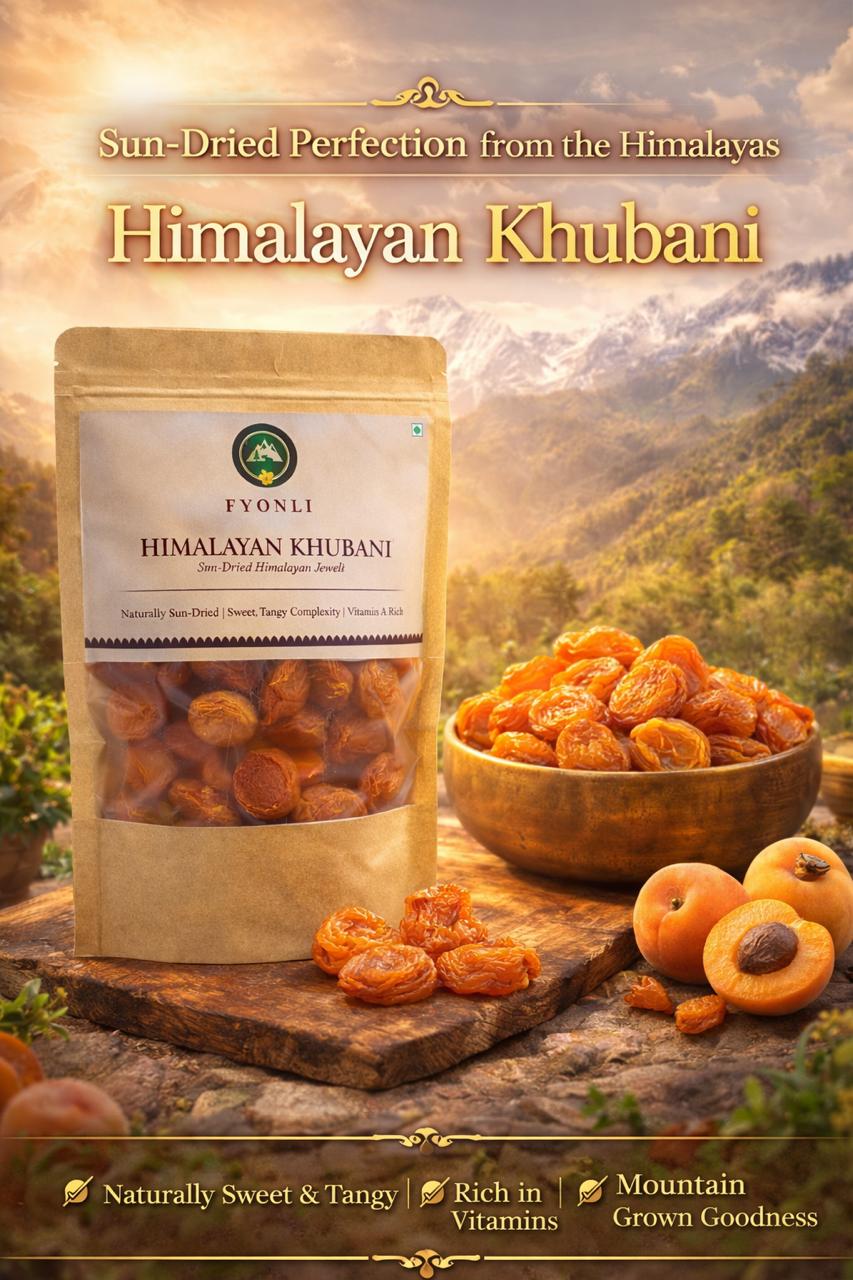
Description
Your Snack Shelf Deserves Better Than Factory Fruits
Most dried apricots you find at the supermarket have been treated with sulphur dioxide, coated in refined sugar syrup, or pumped with artificial colours to give them that unnaturally bright orange hue. They look pretty on the shelf — but what exactly are you eating?
If you have ever flipped over a packet of dried apricots and found a list of additives longer than the ingredient itself, you will understand why so many health-conscious families are searching for something better. Something real. Something that tastes the way food is supposed to taste.
Fyonli Himalayan Khubani is that something. One ingredient. No games. Just apricots, sun, and mountain air.
Introducing Himalayan Khubani — Sun-Dried Apricot from Devprayag
Fyonli Himalayan Khubani is a single-ingredient sun-dried apricot grown in the high-altitude orchards of Devprayag, Tehri Garhwal, Uttarakhand — nestled in the Garhwal Himalayas at elevations between 1,200 and 2,400 metres above sea level. At this altitude, the air is clean, the soil is mineral-rich, and the growing season is short but intense — producing fruit with a depth of flavour that flatland farming simply cannot replicate.
These apricots are slow sun-dried the traditional way: laid out under the Himalayan sun for days, not hours, allowing the natural sugars to concentrate and the flavour to deepen into that characteristic sweet-tangy complexity that makes khubani one of the most beloved dry fruits in mountain cuisine. No sulphur. No added sugar. No preservatives. Just the real thing.
Why Himalayan Khubani Works for You
- Naturally rich in beta-carotene — The deep gold-amber colour of real sun-dried apricot is a visual sign of its high beta-carotene content, a precursor to Vitamin A that supports vision, skin health, and immunity.
- Good source of dietary fibre — Approximately 7g of fibre per 100g helps support healthy digestion, steady energy levels, and a feeling of sustained fullness between meals.
- Iron and potassium content — Dried apricots are among the better plant-based sources of iron and potassium — nutrients that support blood health, muscle function, and cardiovascular wellbeing.
- Zero sulphur dioxide — Commercial apricots use SO2 to preserve colour. Ours don’t. Naturally dried apricots turn darker amber-brown — that is the honest colour of real food.
- No added sugar — The sweetness comes entirely from the fruit itself, making this a smarter snack choice for those managing sugar intake.
- Altitude-grown advantage — Higher altitudes mean slower ripening, more intense sunlight exposure, and greater concentration of natural antioxidants and phytonutrients in the fruit.
- Traditional preservation method — Sun-drying at source locks in nutrients without heat-processing or chemical intervention, keeping the fruit as close to its natural state as possible.
- Gut-friendly natural sugars — The natural fructose in sun-dried apricots provides a gentle energy lift without the crash associated with refined sugar snacks.
- Versatile and genuinely delicious — Eaten on their own, soaked overnight, blended into chutneys, or stirred into desserts — khubani adapts to your lifestyle without effort.
What’s Inside
Sun-Dried Himalayan Apricot (100%) — That is all. Every gram of this product is pure apricot — nothing added, nothing removed. The apricots are sourced from small-holding mountain farmers in the Tehri Garhwal region who have been cultivating khubani orchards for generations. The fruit is handpicked at peak ripeness, then laid out on flat surfaces under direct mountain sunlight — the same method used by Garhwali households for centuries. The result is a dried apricot that carries the full flavour profile of the original fruit: floral, tangy, gently sweet, and deeply satisfying.
How to Use Himalayan Khubani
As a direct snack: Eat 5–8 pieces straight from the pack as a mid-morning or afternoon snack. Pairs well with a handful of walnuts or almonds for a balanced trail mix.
Soaked overnight: Place 8–10 pieces in a small bowl of room-temperature water overnight. By morning, the khubani will have plumped up, softened, and released their natural juice. Eat the soaked apricots on an empty stomach for a gentle start to the day, or blend the soaking water into a smoothie.
Khubani ka meetha (traditional dessert): Simmer soaked apricots in a small amount of water with a touch of jaggery, a pinch of cardamom, and a few strands of saffron. This classic Hyderabadi-style khubani meetha is one of the most beloved uses of dried apricot in Indian cooking — and it is extraordinary when made with quality fruit.
Stirred into oats or muesli: Chop 4–5 pieces and stir into your morning porridge or overnight oats. The natural sweetness reduces or eliminates the need for added sugar, and the chewy texture adds satisfying contrast.
Who Should Use This
- Health-conscious families — A clean, additive-free snack that parents can offer children without hesitation — no artificial colours, no sulphur, no refined sugar.
- Dry fruit lovers — If you appreciate the difference between real sun-dried fruit and the chemical-preserved commercial version, this is the khubani you have been looking for.
- Natural food seekers — Those committed to clean-label, minimally processed foods will find Fyonli Khubani completely aligned with their values.
- Pregnant women and new mothers — Iron and beta-carotene are particularly valuable during pregnancy and postpartum recovery. Khubani is a traditional recommendation in many Indian households for this reason.
- Fitness enthusiasts — The natural carbohydrates in dried apricot offer a quick, clean energy source before or after exercise — without gels, additives, or artificial sweeteners.
- People managing digestive health — The fibre content and natural sorbitol in apricots can help support gentle, regular digestion — making this a functional snack, not just a tasty one.
Why Fyonli Is Different
Fyonli is not a trading company. We are a Devprayag-based food brand that works directly with the small-holding farmers of Tehri Garhwal — the same families who have been growing khubani, hemp, rajma, and other Himalayan crops on terraced hillside plots for generations. There are no middlemen between the farmer’s orchard and your packet. This means the farmer earns more, and you receive fresher, more honestly sourced food.
The altitude at which these apricots grow — between 1,200 and 2,400 metres — is not incidental. At this elevation, UV intensity is higher, growing seasons are shorter, and the slow-maturing fruit develops a more complex nutrient and flavour profile than lowland fruit. The thin mountain air and wide diurnal temperature swings (hot days, cold nights) act as a natural stress on the trees, prompting them to produce more antioxidant compounds as a survival response. That stress becomes your nutrition.
We dry these apricots the way they have always been dried in these mountains — slowly, in open air, under direct sunlight. No industrial dehydrators. No sulphur fumigation chambers. No colour enhancement. The amber-brown colour of our khubani is not a flaw — it is proof of authenticity.
Clean. Simple. Just One Ingredient.
Ingredient list: Dried Apricot.
That is it. No salt. No added oils. No artificial flavours. No preservatives. No anti-caking agents. No sulphur dioxide. No added sugar. Just apricots, grown in the Himalayas, dried under the mountain sun, packed and brought to your door.
Slow-grown in the Himalayas. In rhythm with nature.
Frequently Asked Questions
What exactly is in Fyonli Himalayan Khubani?
One ingredient: sun-dried apricot. No preservatives, no sulphur dioxide, no added sugar, no artificial colours. The apricots are grown in high-altitude orchards in Devprayag, Tehri Garhwal, Uttarakhand, and dried naturally using traditional sun-drying methods. The amber-brown colour is the natural colour of unsulphured dried apricot.
Why is this khubani darker than the apricots I usually buy?
The bright orange colour of most commercial dried apricots comes from sulphur dioxide (E220), a preservative used to prevent oxidation and maintain an artificially vivid colour. Our khubani contains no sulphur. When apricots are dried naturally without chemical treatment, they oxidise to a rich amber-brown — which is exactly what you want to see. The darker colour is a marker of clean, additive-free drying, not inferior quality.
How much Vitamin A does sun-dried apricot provide?
Sun-dried apricots are one of the richest plant-based sources of beta-carotene, which the body converts into Vitamin A. Approximately 100g of dried apricot can provide a significant portion of your daily recommended Vitamin A intake, along with dietary fibre (roughly 7g per 100g), potassium, and iron. The exact values vary by harvest and drying method, but Himalayan fruit from high-altitude orchards consistently shows strong beta-carotene concentration.
Can I eat this every day? How much is a good daily amount?
Yes — dried apricot is a wholesome, everyday snack. A typical daily serving is 5–10 pieces (approximately 30–40g), which provides a useful amount of fibre, natural energy, and micronutrients without excessive sugar load. Soaking them overnight before eating is a good habit — it makes the fruit easier to digest and releases the natural sugars more gently.
Is this suitable for children?
Absolutely. Because Fyonli Khubani contains no sulphur dioxide, no artificial colours, and no added sugar, it is one of the cleanest fruit snacks you can offer children. The natural sweetness makes it appealing to young palates, and it works well as a school snack, stirred into porridge, or mixed into homemade granola. Introduce it gradually for younger children, especially those sensitive to high-fibre foods.
How should I store Himalayan Khubani once I open the pack?
Transfer any unused apricots to an airtight container and keep in a cool, dry place away from direct sunlight. Properly stored, they remain fresh for several months. For longer storage or in humid climates, refrigeration is a good option — it extends shelf life without affecting flavour or texture.
Can I use this in cooking and desserts?
Yes — khubani is extraordinarily versatile. Use it in the classic khubani ka meetha (Hyderabadi-style apricot dessert), blend into smoothies, chop into biryanis and rice dishes, add to trail mixes, stir into oatmeal, make homemade apricot chutney, or use as a natural sweetener in energy balls and no-bake bars. The quality of the base fruit makes every preparation noticeably better.