
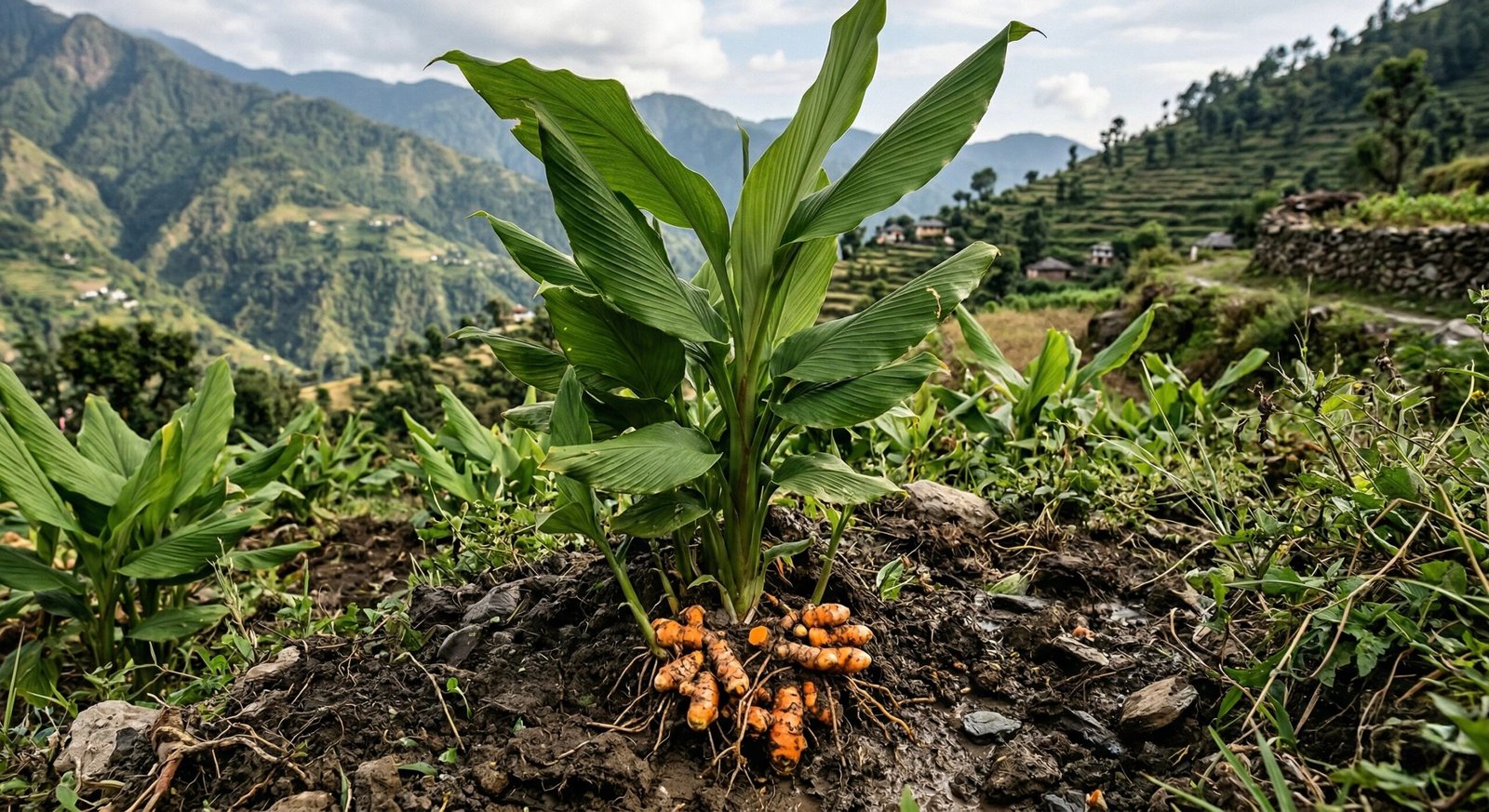
Pahadi haldi vs Lakadong turmeric — if you have been researching premium turmeric in India, you have encountered both. Lakadong from Meghalaya dominates the high-curcumin turmeric conversation right now. Pahadi haldi from Uttarakhand has been used in mountain kitchens and Ayurvedic practice for centuries without the marketing.
Both are genuinely superior to supermarket turmeric. But they are different products — in flavour, curcumin content, cooking use, and origin. This is an honest comparison to help you decide which belongs in your kitchen.
In This Article
- Why Curcumin Content Is What Actually Matters
- What Is Pahadi Haldi?
- What Is Lakadong Turmeric?
- Pahadi Haldi vs Lakadong — 3 Differences That Matter
- Which Turmeric Should You Choose?
- How to Get Maximum Benefit From Either
- A Note on Turmeric Adulteration in India
- Where to Buy Authentic Pahadi Haldi Online
Why Curcumin Content Is What Actually Matters
Before comparing pahadi haldi vs Lakadong turmeric directly, it is worth understanding why curcumin is the number everyone quotes.
Curcumin is the primary active compound in turmeric — responsible for its deep golden colour, anti-inflammatory properties, antioxidant effects, and most of its documented health benefits. It is one of the most studied natural compounds in nutritional science, linked to reduced inflammation, improved joint health, cardiovascular support, and cognitive protection.
The problem is that commercial supermarket turmeric contains very little of it. Commercial turmeric powders — often blended from multiple sources and processed under heat — typically contain 1–2% curcumin. High-curcumin varieties from specific growing regions consistently test significantly higher. That is the entire reason pahadi haldi and Lakadong command a premium over standard turmeric.
What Is Pahadi Haldi?
Pahadi haldi is turmeric grown across the mid-Himalayan belt of Uttarakhand — in districts like Chamoli, Tehri Garhwal, Pauri, and Pithoragarh. It has been a kitchen and medicinal staple in Pahadi households for as long as anyone can trace.
What makes pahadi haldi different from commercial turmeric is the growing cycle. Regular commercial turmeric is harvested after 6 months in the ground. Pahadi haldi grows for up to 3 years — this extended growing period in mineral-rich Himalayan soil at altitude produces significantly higher curcumin content and a distinctly richer, more complex flavour profile.
It is hand-harvested, traditionally stone-ground, and has never been processed industrially. The flavour is warm, deeply aromatic, and slightly earthy — integrating more naturally into Indian cooking than any alternative.
What Is Lakadong Turmeric?
Lakadong turmeric comes from the Jaintia Hills region of Meghalaya in Northeast India. It has a curcumin content that consistently tests between 7–10% — genuinely one of the highest of any turmeric variety in the world. Its colour is a deep reddish-orange, its flavour is bold and intensely pungent, and it has become the premium turmeric of choice for Indian health food brands over the last three to four years.
Farmers in Meghalaya have cultivated it traditionally for generations, and the Government of Meghalaya has actively promoted it as a regional agricultural identity. It is now widely available from most serious natural food brands in India.
Pahadi Haldi vs Lakadong — 3 Differences That Matter
1. Pahadi Haldi vs Lakadong: Curcumin Content
Lakadong leads on raw curcumin numbers — testing between 7–10% consistently. Pahadi haldi from quality Himalayan sources tests between 4–7% — meaningfully higher than commercial turmeric, though typically below peak Lakadong figures.
If maximum curcumin concentration per gram is your only metric, Lakadong wins on paper. But curcumin alone does not tell the full story — bioavailability and cooking integration matter equally for how much benefit you actually receive.
2. Pahadi Haldi vs Lakadong: Flavour in Cooking
This is where pahadi haldi holds its own decisively. Lakadong’s intensity can be overpowering — many cooks find they need to use significantly less to avoid the turmeric dominating the dish. Pahadi haldi integrates more naturally into Indian cooking — its warmth and aroma complement rather than compete with other spices.
For everyday dal, curry, and sabzi, most traditional Indian cooks find pahadi haldi more versatile. Lakadong is better suited for preparations where turmeric is the featured ingredient — golden milk, turmeric shots, health supplements.
3. Pahadi Haldi vs Lakadong: Aroma and Character
Pahadi haldi has a richer, more complex fragrance — deeper and more resinous, with a warmth that fills the kitchen when added to hot oil. Lakadong is more sharply pungent. Both are excellent — which you prefer is genuinely a matter of personal preference and cooking style.
Which Turmeric Should You Choose?
The honest answer depends entirely on what you are using it for.
Choose Lakadong if:
- You are taking turmeric primarily as a health supplement and want maximum curcumin per gram
- You are making golden milk or turmeric shots where turmeric is the featured ingredient
- You are comfortable adjusting quantities downward significantly
Choose Pahadi Haldi if:
- You cook with turmeric daily in Indian food and want something that integrates naturally
- You value aroma and flavour complexity alongside curcumin content
- You want to support Himalayan farming communities specifically
- You prefer the flavour tradition that is part of North Indian and Pahadi cooking heritage
The case for having both: Several serious home cooks keep both — Lakadong for golden milk and supplements, pahadi haldi for everyday cooking. The flavour profiles are different enough that they genuinely serve different purposes.
How to Get Maximum Benefit From Either
High curcumin content is only useful if your body can absorb it. Curcumin on its own has very low bioavailability. Two things dramatically improve absorption:
Black pepper — piperine, the active compound in black pepper, increases curcumin absorption by up to 2,000%. Add even a small pinch of freshly ground black pepper to any turmeric preparation. Traditional Indian cooking — which almost always combines these spices — has always been correct here.
Fat — curcumin is fat-soluble, meaning it absorbs far better when consumed with a fat source. Cooking pahadi haldi or Lakadong briefly in ghee or oil before adding water-based ingredients dramatically improves absorption. This is why tempering turmeric in ghee first — standard in most Indian cooking — is nutritionally correct as well as culinarily correct.
A Note on Turmeric Adulteration in India
Turmeric is one of the most commonly adulterated spices in India. Studies have found commercially sold turmeric powder frequently mixed with starch, sawdust, chalk powder, or artificial colouring — including lead chromate, which is toxic.
This makes provenance and traceability particularly important for turmeric. Buying from a seller who names the specific growing region and how the turmeric was processed is not just about getting better flavour — it is a genuine food safety issue.
Both pahadi haldi and Lakadong from reputable small-batch sources bypass this problem. The supply chains are short, the producers are named, and the volumes are small enough that adulteration is neither economically attractive nor logistically possible.
According to FSSAI’s spice quality standards, curcumin content is now a regulated quality parameter for turmeric — a recognition that the difference between high and low curcumin turmeric is significant enough to matter for consumer protection.
Where to Buy Authentic Pahadi Haldi Online
Our pahadi haldi is sourced from Uttarakhand hill farmers who grow it using traditional methods — slow-grown at altitude for up to 3 years, hand-harvested, and stone-ground without industrial processing. It is packed in small batches without blending with commercial turmeric, additives, or artificial colour.
It is the turmeric that Pahadi kitchens have used for generations — and the one that belongs in yours.
You might also like:
- Himalayan Nettle Salt vs Table Salt — What Makes It Different
- Raw Mountain Honey — 5 Essential Differences From Supermarket Honey
- Bhangjeera (Perilla Seeds) — Wild Himalayan Seed Richer in Omega-3 Than Flaxseeds
- Gahat Dal (Horse Gram) — 7 Proven Benefits Including Kidney Stone Relief
- Kashmiri Kahwa: Traditional Recipe, Health Benefits, and How It’s Different From Regular Chai
- Shop Spices, Nuts & Seeds →
-
What is the main difference between Pahadi Haldi and Lakadong turmeric?
Pahadi Haldi is a broad category of small-batch, mountain-grown turmeric from the Himalayan belt — including Uttarakhand — known for its earthy flavour, deep orange-yellow colour, and high essential oil content. Lakadong turmeric is a specific variety from the Jaintia Hills of Meghalaya and is widely recognised for its exceptional curcumin content, often between 6–9%. While Pahadi Haldi wins on aroma and culinary versatility, Lakadong is the benchmark for raw curcumin concentration.
-
Which turmeric has more curcumin — Pahadi Haldi or Lakadong?
Lakadong turmeric generally leads on curcumin content, with levels often cited between 6–9% — well above the commercial average of 2–3%. High-quality Pahadi Haldi from Uttarakhand typically contains 3–5% curcumin, which is still significantly higher than supermarket turmeric. For purely therapeutic, supplement-style use, Lakadong holds the edge. For everyday kitchen cooking with strong flavour and aroma, Pahadi Haldi is equally compelling.
-
Can I use Pahadi Haldi and Lakadong turmeric interchangeably in cooking?
Yes, but with an adjustment. Lakadong’s higher curcumin density means it can colour and lend bitterness more aggressively — use slightly less than you would with regular turmeric. Pahadi Haldi integrates more gently into dals, curries, and golden milk, delivering rich aroma without overpowering a dish. Both work beautifully in Indian cooking; the choice depends on whether you’re optimising for flavour depth or maximum curcumin intake.
-
Is Pahadi Haldi better than regular turmeric from the market?
Yes, in most meaningful ways. Regular commercial turmeric is often grown at scale in the plains, harvested early, and can lose volatile oils during prolonged storage or adulteration. Pahadi Haldi, sourced small-batch from Himalayan farms, retains higher essential oil content, stronger colour pigmentation, and a more complex earthy-woody aroma. It is also typically free of synthetic colourants and fillers — a real concern with mass-market haldi.
-
Where does Fyonli’s Pahadi Haldi come from?
Fyonli sources its Pahadi Haldi directly from small-holder farms in Uttarakhand — part of our Soil-to-Soul commitment to traceable, mountain-origin ingredients. The turmeric is harvested from high-altitude farms, sun-dried using traditional methods, and stone-milled in small batches to preserve its natural oils and pigmentation. No additives, no fillers, no artificial colour.
-
Is high-curcumin turmeric worth the extra cost?
For daily culinary use, a good Pahadi Haldi at a moderate price point gives you excellent value — strong aroma, natural colour, and meaningfully higher curcumin than plain market haldi. Lakadong, at a premium price, makes more sense if you are using turmeric therapeutically — in golden milk shots, health tonics, or supplements — where raw curcumin concentration matters most. For the Indian home cook, Pahadi Haldi is the everyday upgrade that actually makes sense.
-
u003cstrongu003eDoes turmeric curcumin content affect its colour and taste?u003c/strongu003e
Yes, directly. Curcumin is the compound responsible for turmeric’s signature golden-yellow colour — higher curcumin means deeper, more vibrant colour. It also contributes to turmeric’s characteristic mild bitterness. However, aroma in turmeric comes largely from its essential oils (turmerone, ar-turmerone), not curcumin. This is why Pahadi Haldi can smell more fragrant than some high-curcumin varieties, even if Lakadong wins on the curcumin number.