
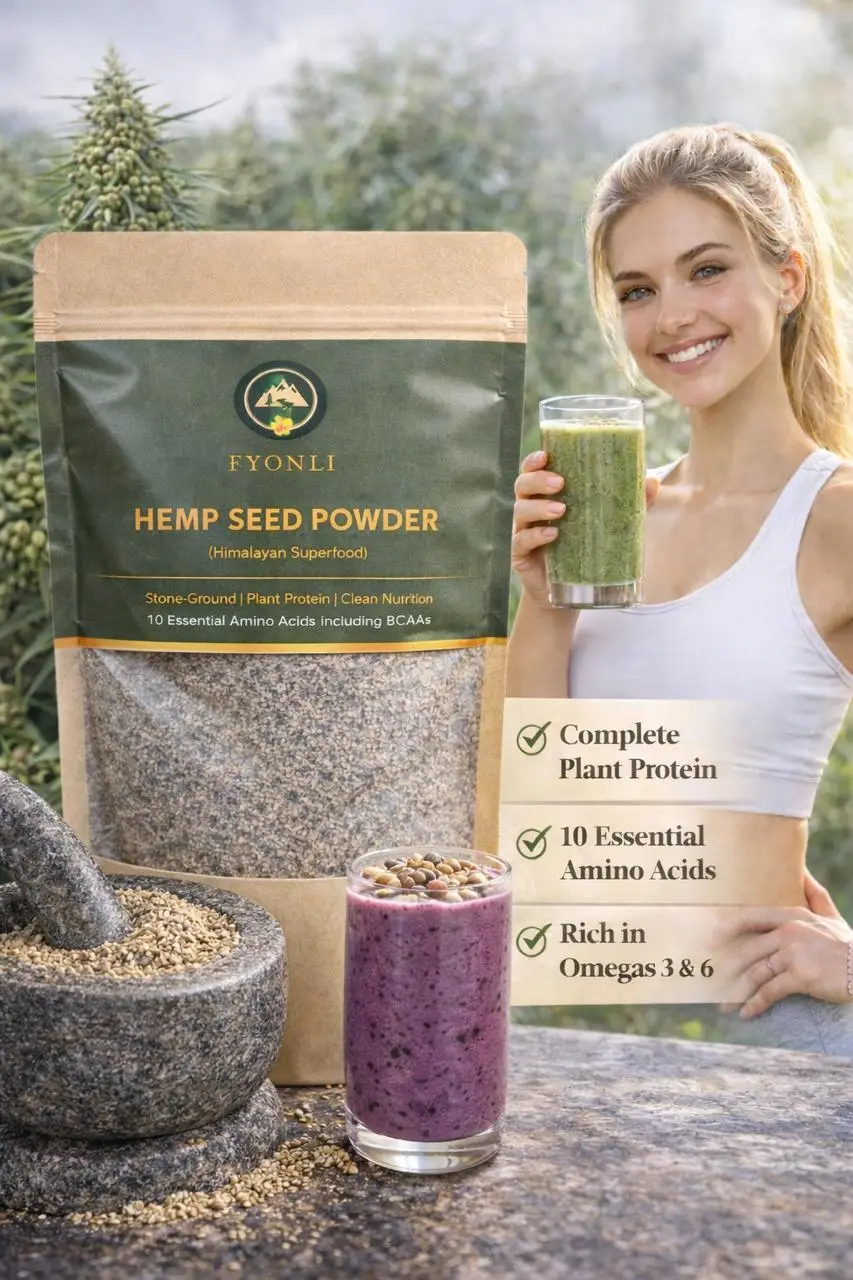
If you’ve typed “hemp protein vs whey protein” into Google before adding either to your cart, you already know the honest answer isn’t a clean win for one side. Whey wins on paper — it’s the most researched, fastest-absorbing protein on the planet. But “on paper” and “in an Indian kitchen, on an Indian budget, with an Indian gut” are two different questions. This guide answers both, with the actual lab data on what’s inside Indian whey tubs, the real lactose-intolerance numbers for Indian populations, and where a whole-food alternative like Himalayan Hemp Protein genuinely fits.
In This Article
- The Short Answer
- What Is Whey Protein?
- What Is Himalayan Hemp Protein?
- Protein Quality: PDCAAS, DIAAS and Amino Acids Compared
- Lactose, Dairy and the Indian Gut
- What’s Actually Inside Indian Whey Tubs?
- Nutrition Beyond Protein: Omega-3s, Fibre and Minerals
- Cost, Serving Size and Real Daily Use
- Who Should Choose Whey, and Who Should Choose Hemp Protein
- Can You Use Both Together?
- Where to Buy Himalayan Hemp Protein Online in India
- Frequently Asked Questions
The Short Answer
Whey protein is the higher-scoring protein by strict lab metrics — it’s a complete, fast-absorbing dairy isolate with a maximum PDCAAS score and the highest leucine content of any common protein, which is why sports science has favoured it for decades. Himalayan hemp protein cannot beat whey on that isolated metric, and no honest comparison should pretend otherwise.
But protein quality on a lab bench isn’t the only question that matters to an Indian buyer. A large share of Indians are lactose intolerant to some degree, a large share are vegetarian or vegan by choice or upbringing, and independent lab testing of the Indian protein-powder market has repeatedly found heavy-metal contamination, undeclared amino-acid spiking and mislabelled protein content in commercial whey tubs. Whole-food hemp protein sidesteps all three problems, at the cost of lower isolated protein density per gram. Which one is “better” depends on whether you’re optimising for grams of protein per rupee, or for a clean, dairy-free, whole-food source you can trust and use daily. Both answers are covered in detail below.
What Is Whey Protein?
Whey is the liquid byproduct left over when milk is curdled and strained to make cheese or paneer. That liquid is filtered and dried into a powder — whey concentrate (WPC) if less filtered and higher in lactose and fat, or whey isolate (WPI) if more heavily filtered, with most of the lactose and fat removed. Almost all whey sold internationally, including in India, is manufactured from imported or bulk-sourced dairy whey, then flavoured, sweetened and packaged domestically.
Whey’s reputation is earned: it’s a complete protein with all nine essential amino acids in a highly bioavailable ratio, it’s unusually rich in leucine — the amino acid that most directly triggers muscle-protein synthesis — and it digests fast, delivering an amino-acid spike within 20–30 minutes of drinking it. For decades, that combination has made whey the default recommendation for post-workout recovery.
What Is Himalayan Hemp Protein?
Fyonli’s Himalayan Hemp Protein is a whole-food plant protein blend built around cold-processed Himalayan hemp seed (60%), with pumpkin seed, almond, date, cinnamon and cardamom added in precise ratios. It isn’t an isolated protein powder in the whey or pea-isolate sense — it’s closer to a nutrient-dense food blend, delivering 22g of plant protein per 100g alongside omega-3 and omega-6 fats, zinc, magnesium, iron, fibre and natural energy from dates, with no added sugar, synthetic sweeteners or preservatives.
Hemp seed itself is one of the few plant foods that qualifies as a complete protein, containing measurable amounts of all nine essential amino acids — built mainly on the easily digested proteins edestin and albumin — though at lower total concentration than an isolated protein powder. If you’ve already tried Fyonli’s traditional Garhwali hemp seed chutney, this product is the same hemp seed nutrition in a format built for a daily protein shake rather than a condiment.
Protein Quality: PDCAAS, DIAAS and Amino Acids Compared
Protein quality is measured two ways: PDCAAS (Protein Digestibility-Corrected Amino Acid Score) and the newer DIAAS (Digestible Indispensable Amino Acid Score). On both, whey is close to the ceiling. A 2020 comprehensive review of plant- and animal-sourced protein quality places whey among the highest-scoring proteins tested, with a DIAAS classification of “high quality” (≥75). Hemp protein scores meaningfully lower — a PDCAAS of roughly 0.63–0.66 against whey’s perfect 1.0 — limited mainly by its lysine content and by fibre in the seed matrix that slightly reduces digestibility.
| Metric | Whey Protein (Isolate/Concentrate) | Himalayan Hemp Protein |
|---|---|---|
| Protein per 100g | 70–90g (isolated powder) | 22g (whole-food blend) |
| PDCAAS score | 1.0 (maximum) | ~0.63–0.66 |
| DIAAS classification | High quality (≥75) | No quality claim (lysine-limited) |
| All 9 essential amino acids | Yes | Yes, at lower density |
| Absorption speed | Fast (~20–30 min) | Slower — bound in a whole-food, fibre matrix |
| Source | Bovine milk byproduct, dairy-derived | Hemp seed, pumpkin seed, almond, dates |
| Lactose | Present in concentrate; minimal in isolate | None — plant-based |
| Suitable for vegans | No | Yes |
Read plainly: if the only goal is maximum grams of complete, fast-absorbing protein per rupee for competitive strength training, whey wins this section outright. Hemp protein’s case is built on everything the lab score doesn’t measure — which is the rest of this article.
Lactose, Dairy and the Indian Gut
Whey is a dairy product, and lactose intolerance is far from rare in India. A frequently cited clinical study comparing North and South Indian populations found lactose intolerance in 66.6% of subjects tested in Trivandrum and Pondicherry, against 27.4% in Delhi — a striking regional gap, but one where even the “lower” figure means roughly one in four people react to lactose. Genetics play a role: populations with a longer historical dependence on dairy farming tend to retain lactase persistence into adulthood at higher rates, which is part of why the North Indian figure runs lower.
This doesn’t mean every whey drinker in India is at risk — whey protein isolate (WPI) is heavily filtered and contains only trace lactose, so it’s usually tolerated even by mildly lactose-intolerant people. Whey concentrate (WPC), which is cheaper to produce and more common in budget Indian tubs, carries meaningfully more lactose per scoop and is a more frequent source of the bloating, gas and discomfort that leads people to quietly stop using their protein powder within a few weeks of buying it. If you’ve bought whey before and always seemed to feel “off” a couple of hours after your shake, this is worth ruling out before blaming the workout. Hemp protein removes the question entirely — it contains no dairy and no lactose in any form.
What’s Actually Inside Indian Whey Tubs?
This is the part of the comparison the supplement aisle would rather you skipped. Independent lab testing of the Indian protein-powder market has repeatedly turned up problems that have nothing to do with whey as a molecule and everything to do with how it’s manufactured and sold here. A 2024 report noted that protein products tested in India frequently failed to meet their own label claims, and a large 2025 crowd-funded independent study — the Citizens Protein Project 2 — tested 34 popular whey brands sold in India for macronutrients, amino acids, heavy metals, mycotoxins, hormones and pesticides. The findings: arsenic was the most abundant heavy metal detected, followed by lead and mercury, with cadmium and aflatoxin turning up more often in certain brands; and protein content was mislabelled beyond a 5% margin in the large majority of products tested, with some brands falling well short of their claimed protein-per-scoop.
International testing bodies like Labdoor (USA) and NSF International have separately flagged Indian-market protein products for “protein spiking” — bulking up the nitrogen reading (and therefore the apparent protein content on a lab test) with cheap free-form amino acids like taurine, glycine or creatine, which register as protein on basic testing but don’t function like real protein in the body. None of this means every whey brand sold in India is compromised — but it does mean the market has a documented, repeated pattern of exactly the kind of shortcuts that a whole, traceable, six-ingredient blend like Himalayan Hemp Protein is structurally unable to take, because there’s no isolate to spike and no nitrogen reading to game.
Nutrition Beyond Protein: Omega-3s, Fibre and Minerals
Whey is, by design, a protein-delivery vehicle. Strip out the lactose and fat during filtration, and what’s left is protein and not much else. That’s exactly what a competitive lifter chasing a specific daily protein target wants. It’s a narrower fit for someone using a protein powder as a general nutritional top-up to an otherwise varied diet.
Himalayan Hemp Protein carries a wider nutritional load in every scoop: naturally occurring omega-3 and omega-6 fatty acids from hemp seed in a favourable ratio, zinc, magnesium and iron from pumpkin seed, vitamin E and monounsaturated fats from almond, complex carbohydrates from date for sustained energy, and warming Ayurvedic spices — cinnamon for blood sugar support, cardamom for digestion — instead of artificial flavouring. None of this replaces a varied diet, but it means the same scoop that adds protein to your morning is also doing several other jobs a stripped dairy isolate simply can’t.
Cost, Serving Size and Real Daily Use
Whey wins on raw cost-per-gram-of-protein, and there’s no point pretending otherwise. Whey is sold in bulk 1–2kg tubs at 70–90g protein per 100g, and manufacturing it at that scale and density is simply cheaper per gram of protein delivered than any whole-food blend can be. If your only metric is rupees spent per gram of isolated protein, whey is the more economical choice — provided the tub you bought actually contains what the label says, which, per the previous section, is not something you can take for granted in the Indian market.
Himalayan Hemp Protein isn’t priced or portioned to compete on that metric, because it isn’t trying to be a bulk isolate — it’s a daily whole-food addition. At ₹399 for a 150g pack, used at the recommended 15g serving, that’s roughly ₹40 per serving, taken once or twice a day mixed into milk, a smoothie, or overnight oats. The honest comparison isn’t “which gives more protein per rupee” — it’s “which one are you actually going to keep using in six months, and what else is it giving you besides protein.”
Who Should Choose Whey, and Who Should Choose Hemp Protein
Choose whey protein isolate if you’re a competitive or serious strength athlete with a specific daily protein target to hit, you tolerate dairy well, and you buy from a brand that publishes independent, batch-level lab testing rather than just a label claim. For pure post-workout muscle-protein synthesis on a tight budget, whey isolate remains the evidence-backed default.
Choose Himalayan Hemp Protein if you’re vegetarian or vegan, lactose-sensitive or simply tired of feeling bloated after a shake, wary of what’s actually in a mass-market whey tub, or looking for a food-first daily protein top-up rather than a competition-lifter’s isolate. It’s also the better fit if you want a single scoop to deliver more than protein — omega-3s, minerals and steady energy alongside it.
Can You Use Both Together?
Yes, and for many people this is the most practical answer of all. There’s no metabolic conflict between whey and hemp protein — plenty of people use whey isolate around training sessions for the fast-absorbing amino-acid hit, and Himalayan Hemp Protein on rest days, in breakfast bowls, or blended with warm milk in the evening for its wider nutritional profile. If you already eat bhatt (black soybean) or gahat dal regularly, you’re already stacking Himalayan whole-food protein sources across your day — hemp protein simply makes that easier to hit consistently in a single scoop. For the broader philosophy behind building a diet on real, whole-food ingredients rather than isolates and additives, see our guide to clean eating for Indian kitchens.
Where to Buy Himalayan Hemp Protein Online in India
Fyonli’s Himalayan Hemp Protein is available directly at ₹399 for a 150g pack — six whole-food ingredients, cold-processed, blended in Devprayag, Uttarakhand, with no artificial flavours, refined sugar or preservatives. It ships pan-India and works straight out of the pack in milk, water, smoothies or overnight oats.
Frequently Asked Questions
-
Is hemp protein as good as whey protein for building muscle?
Not by the strict lab metrics — whey has a higher PDCAAS/DIAAS score, more leucine, and absorbs faster, all of which matter for maximising muscle-protein synthesis around a workout. Hemp protein is a lower-density, whole-food protein source better suited to daily, general nutrition than to hitting a precise competitive-lifter protein target.
-
Does hemp protein cause any side effects?
Hemp protein is generally very well tolerated. Because it retains fibre from the whole seed, introducing a large serving too quickly can cause mild digestive adjustment in some people — the usual fix is to start with a smaller serving (10g) and increase gradually.
-
Can I replace my whey protein with hemp protein completely?
You can, but if you’re training seriously and relying on your protein powder to hit a specific daily gram target, you’ll likely need a larger serving or an additional whole-food protein source (dal, paneer, eggs, tofu) to make up the difference, since hemp protein is far less protein-dense per gram than an isolate.
-
Is Himalayan Hemp Protein suitable for vegetarians and vegans?
Yes. It contains no dairy, whey or any animal-derived ingredient, making it fully vegan and lactose-free.
-
Does hemp protein contain THC? Is it legal in India?
No. Hemp seed is sourced from food-grade industrial hemp and does not contain the psychoactive compound found in cannabis flowers and resin. India’s FSSAI standard for hemp seed and seed products, notified in November 2021, permits hemp seed, hemp seed oil and hemp seed flour to be sold as food, which is why hemp protein is legally available from food retailers across India.
-
Which is cheaper — whey protein or hemp protein?
Per gram of isolated protein, whey is cheaper — it’s manufactured at higher protein density and larger scale. Himalayan Hemp Protein is priced and portioned as a whole-food daily addition (roughly ₹40 per 15g serving) rather than a bulk protein isolate, so the two aren’t a direct rupee-for-rupee comparison.
-
Is whey protein bad for lactose-intolerant Indians?
It can cause bloating, gas or discomfort in lactose-intolerant individuals, particularly with whey concentrate (WPC), which retains more lactose than whey isolate (WPI). Given that lactose intolerance affects a substantial share of the Indian population — with documented rates as high as 66.6% in some South Indian populations tested — this is worth checking before assuming a protein powder simply doesn’t agree with you for unrelated reasons.
-
How much Himalayan Hemp Protein should I take daily?
Mix 10–15g (1–2 tablespoons) in milk or plant-based milk once or twice a day for general use, or 15–20g post-workout blended with a frozen banana and chilled water or coconut milk for recovery.