
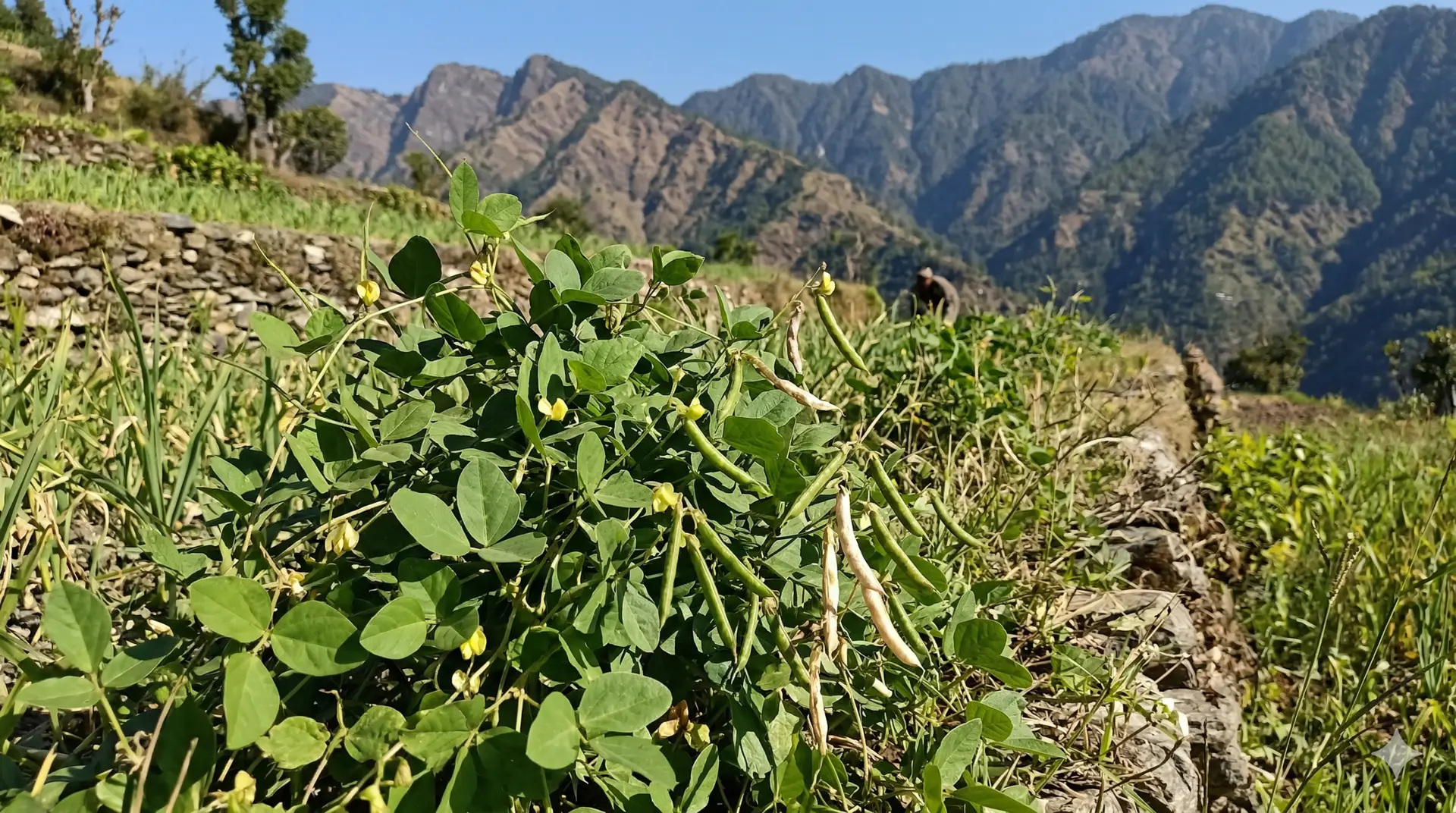
Gahat dal — known in English as horse gram — is one of the most nutritionally powerful pulses in the Himalayan diet, and one of the least known outside Uttarakhand. Grown across the terraced hillsides of Tehri Garhwal, Kumaon, and Chamoli for thousands of years, gahat dal horse gram has been both a daily food and a traditional medicine for mountain communities long before modern nutritional science began validating its properties.
This article covers everything — what gahat dal is in English, why it is recommended for kidney stones in Ayurveda, its full nutritional profile, and exactly how to cook and use it at home.
In This Article
- What Is Gahat Dal? Horse Gram in English Explained
- Gahat Dal for Kidney Stones — The Ayurvedic and Scientific Case
- 7 Proven Health Benefits of Gahat Dal Horse Gram
- Gahat Dal Nutrition — Full Profile
- How Gahat Dal Is Used in Traditional Uttarakhand Cooking
- How to Cook Gahat Dal Horse Gram at Home
- Where to Buy Authentic Gahat Dal Online
What Is Gahat Dal? Horse Gram in English Explained
Gahat dal is horse gram in English — a small, dark brown legume from the species Macrotyloma uniflorum, native to tropical South Asia and widely grown across the Himalayan belt of India. In different parts of the country it is called Kulthi (Hindi), Kollu (Tamil), Ulavalu (Telugu), and Hurali (Kannada). In Uttarakhand’s Garhwal and Kumaon regions, it is universally known as Gahat.
Gahat dal horse gram is one of the hardiest pulse crops in existence. It thrives in poor, rocky soil, requires minimal rainfall, needs no chemical inputs, and produces reliably in adverse mountain conditions where other pulses fail. This resilience made it a staple crop for Himalayan farming communities for whom food security depended entirely on what could grow at altitude without irrigation.
The grain itself is small, flat, and knobbly — darker than most dals with a distinctly earthy, slightly astringent flavour that deepens significantly with slow cooking. It is nothing like the mild, creamy dals most urban Indian kitchens are used to. Gahat dal has a character entirely its own.
Gahat Dal for Kidney Stones — The Ayurvedic and Scientific Case
This is the most well-known property of gahat dal horse gram — and it deserves to be taken seriously rather than dismissed as folklore.
In the hilly regions of Garhwal and Kumaon, gahat dal has long been regarded as a remarkable cure for kidney stones. Ayurveda explains that gahat or horse gram is invaluable for getting rid of stones because it is a diuretic — a substance that increases urine flow. Down To Earth
The traditional Uttarakhand practice involves drinking the water in which gahat dal has been soaked overnight, or consuming a slow-cooked gahat broth twice daily for a sustained period. Gahat soup consumed twice a day for about a month is considered the most effective approach, with regular gahat dal consumption helping avoid the formation of new stones. Down To Earth
Modern research supports this traditional understanding. Due to its diuretic properties, horse gram is effective in assisting in the removal of kidney stones. Horse gram contains certain compounds that make kidney stones more soluble, and regular consumption aids in avoiding the formation of new stones. Isha Foundation
Specifically, gahat dal horse gram contains polyphenols and flavonoids that inhibit the formation of calcium oxalate crystals — the most common type of kidney stone. Its diuretic effect increases urine flow, which creates pressure on deposited stones and helps flush them from the urinary system.
Important note: Gahat dal horse gram is a traditional dietary support for kidney health — not a substitute for medical treatment. If you have kidney stones, consult a doctor alongside any dietary changes.
How to prepare gahat dal for kidney stone support:
- Soak 3–4 tablespoons of gahat dal in 500ml of water overnight
- In the morning, strain and drink the soaking water on an empty stomach
- Cook the soaked gahat dal normally for the day’s meal — nothing is wasted
- Continue consistently for best results
7 Proven Health Benefits of Gahat Dal Horse Gram
1. Kidney Stone Prevention and Management
As detailed above — gahat dal horse gram has the most credible traditional and scientific evidence of any pulse for kidney stone support.
2. Exceptional Protein Content
Gahat dal horse gram contains approximately 22–24g of protein per 100g — among the highest of any pulse available in India. For vegetarians relying on dal as their primary protein source, gahat is one of the most efficient options available.
3. Blood Sugar Management
Gahat dal has a low glycaemic index, meaning it releases energy slowly without causing blood sugar spikes. For weight reduction or diabetes control, gahat dal is particularly effective due to its low glycaemic effect. TrueMed The combination of high protein, high fibre, and slow-releasing carbohydrates makes it one of the most diabetes-friendly pulses available.
4. Weight Management
The high fibre and protein content of gahat dal horse gram promotes sustained fullness — reducing overall food intake naturally without calorie counting. Traditional Ayurvedic texts describe gahat as having Medohara properties — the ability to help reduce excess body fat.
5. Heart Health
Gahat dal contains compounds that reduce total cholesterol, LDL cholesterol, and triglyceride levels — all cardiovascular risk factors. Its high fibre content also supports healthy blood pressure management.
6. Iron-Rich — Valuable for Vegetarians
Gahat dal horse gram is one of the richest vegetarian sources of iron available in India. For women with high iron requirements and vegetarians managing anaemia, regular consumption of gahat dal provides meaningful iron alongside protein and fibre.
7. Digestive Health
The high dietary fibre in gahat dal supports gut health, prevents constipation, and promotes healthy bowel function. Its traditional use as a warming winter food in Uttarakhand also reflects its role in supporting digestion during cold seasons when digestive function can slow.
Gahat Dal Nutrition — Full Profile
Per 100g of gahat dal horse gram (raw):
- Protein: 22–24g — among the highest of any Indian pulse
- Dietary Fibre: 5–8g — supports digestion and fullness
- Iron: 7mg — approximately 39% of daily recommended intake for men
- Calcium: 287mg — among the highest calcium levels of any pulse
- Carbohydrates: complex, slow-releasing
- Fat: low
- Glycaemic Index: low — suitable for diabetics
- Polyphenols and Flavonoids: potent antioxidant compounds
How Gahat Dal Is Used in Traditional Uttarakhand Cooking
In Uttarakhand, gahat dal horse gram appears in several distinct preparations depending on region and season.
Gahat ki Dal — The Classic Preparation
The most common preparation across both Garhwal and Kumaon. Gahat pressure cooked until soft, then tempered with ghee, cumin seeds, whole dried red chilli, and generous amounts of garlic. The result is thick, earthy, and deeply warming — a dal that tastes like the mountains it comes from.
Served with steamed Jhangora millet or rice, this is the combination that has sustained Pahadi communities through winters for generations.
Phanu — Garhwal’s Slow-Cooked Speciality
A more elaborate Garhwali preparation where gahat dal is soaked overnight, roughly ground, and then slow-cooked for several hours until it becomes thick and porridge-like. Towards the end, finely chopped greens — spinach, radish leaves, or coriander — are stirred in. Served with rice, it is the ultimate cold-weather Pahadi comfort food.
Gahat Broth — The Medicinal Preparation
Gahat dal horse gram cooked slowly in water with minimal spicing, then the liquid strained and consumed as a warm, restorative broth. This is the preparation specifically used for its kidney stone properties — drunk twice daily, warm, as a sustained dietary intervention.
How to Cook Gahat Dal Horse Gram at Home
Gahat dal requires planning — it is not a pulse you can cook without soaking. But the method itself is straightforward.
Basic Gahat Dal — step by step:
- Soak overnight — essential, not optional. 8 hours minimum, 12 hours better. Gahat has a tough outer skin that needs extended soaking to soften and cook evenly
- Drain soaking water — save it and drink it in the morning if using for kidney health support
- Pressure cook — add fresh water (3:1 ratio water to dal) and pressure cook for 5–6 whistles on high, then 10 minutes on low. Gahat takes longer than most dals
- Check texture — dal should be soft and beginning to break down. Some whole grains remaining is fine and traditional
- Prepare the tempering — heat generous ghee, add cumin seeds, whole dried red chilli, and 4–5 cloves of sliced garlic. Let the garlic turn golden — gahat dal loves garlic more than almost any other dal
- Combine and simmer — pour the tempering over the cooked dal, add salt, and simmer together for 10 minutes
- Serve with rice, Jhangora millet, or roti — with bhang ki chutney if available
The soaking water: Do not discard the overnight soaking water. Strain it and drink a glass on an empty stomach in the morning. This is the traditional Uttarakhand practice for kidney health support — and it costs nothing extra since you are soaking the dal anyway.
Where to Buy Authentic Gahat Dal Online
Most gahat dal horse gram sold online does not specify a growing region and is sourced from commercial suppliers. The nutritional profile may be similar, but the story — and often the flavour — is not.
Authentic Pahadi gahat dal from Tehri Garhwal farming families, grown at altitude without chemical inputs, is a genuinely different product. It is unpolished, retaining its natural outer layer where much of the nutritional and medicinal value is concentrated.
At Fyonli, our gahat dal comes directly from Tehri Garhwal farming communities. It is unpolished, unsorted for cosmetic appearance, and packed in small seasonal batches without blending or additives. It looks exactly as gahat dal should — rustic, dark, and real.
Shop Tehri Garhwal Gahat Dal →
You might also like: