
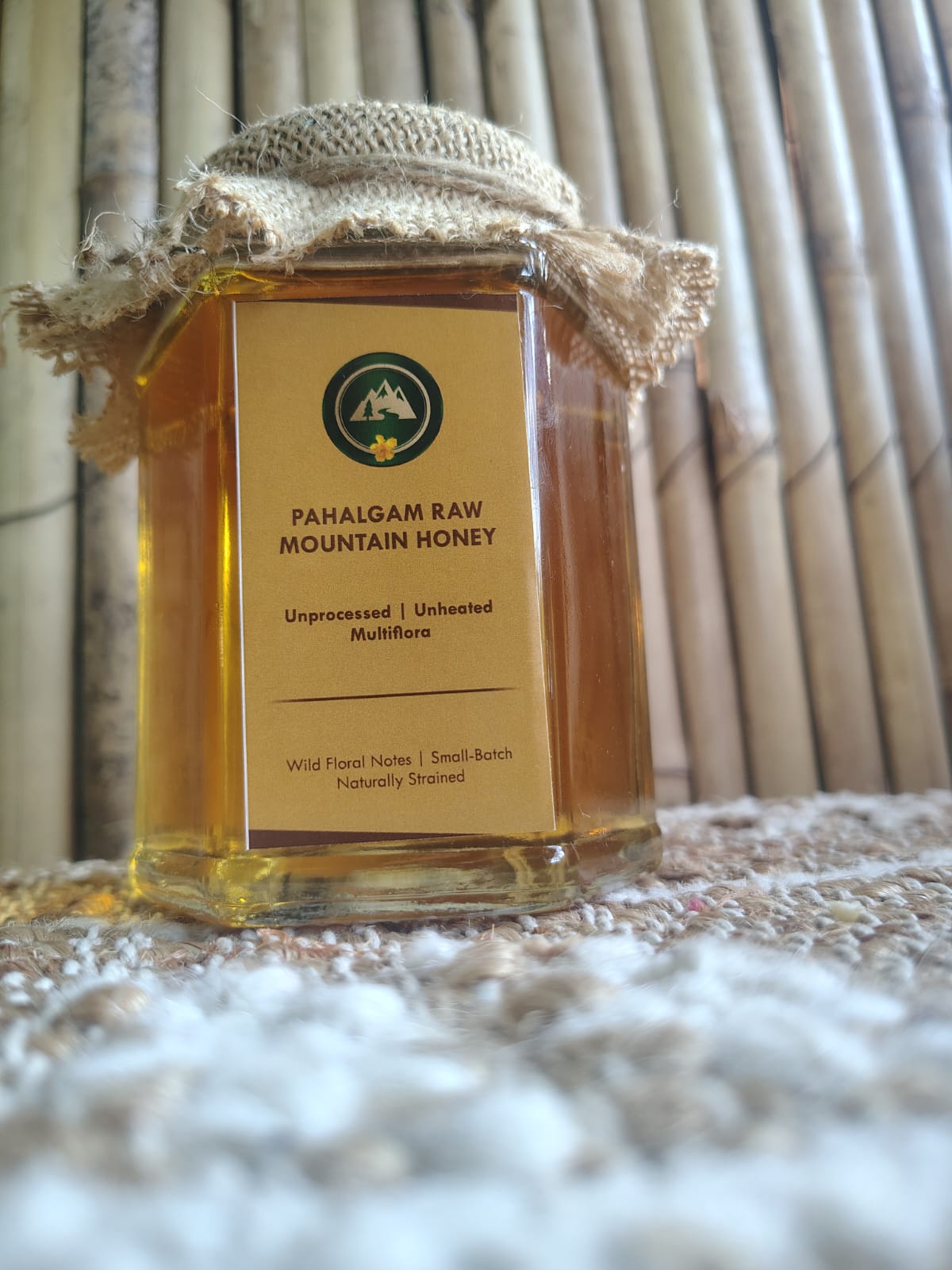
Most Indians have eaten honey their entire lives without ever tasting wild honey. What is sold in supermarkets — even bottles labelled “pure,” “organic,” or “natural” — is almost always beekept honey. Managed hives, controlled environments, processed and filtered before bottling.
Wild mountain honey is something entirely different. And if you have never tried it, the gap between the two is larger than you might expect.
What Is Wild Mountain Honey?
Wild mountain honey is honey produced by bees that forage freely across high-altitude Himalayan terrain — not kept in boxes by beekeepers but living in natural hives in rock crevices, hollow trees, and cliff faces.
The bees source nectar from whatever is blooming across the mountain landscape — rhododendron, buransh, wild thyme, alpine wildflowers, forest herbs — in combinations that change with the season, the elevation, and the year. No beekeeper controls what the bees visit. The honey they make reflects the full complexity of the mountain ecosystem around them.
This is what makes wild mountain honey taste the way it does — layered, complex, slightly different every season, carrying the character of a specific place at a specific time.
Where Does Fyonli’s Honey Come From?
Our mountain honey is sourced from the mountains of Uttarakhand, Himachal and Kashmir.
At this elevation, the flora is dramatically different from the plains. The bees forage across a landscape of alpine meadows, dense mixed forests, and wild herb-covered hillsides. The nectar sources include plants that simply do not exist at lower altitudes — which is why high-altitude Himalayan honey has a flavour profile that cannot be replicated anywhere else.
We source in small batches directly from local honey hunters and harvesters who have been collecting from these wild hives for generations. Each batch is seasonal and limited — when it is gone, the next one comes from the following season’s harvest and may taste slightly different, because wild honey is never exactly the same twice.
Beekept Honey vs Wild Honey — The Real Difference
This is the distinction most honey buyers in India do not know to ask about — and it matters more than organic certification or brand reputation.
Beekept honey comes from managed hives where a beekeeper controls the colony, the location, and often the nectar source. The bees are healthy and well-managed, but their foraging is limited to whatever is planted or growing near where the keeper places the hives. Most raw honey in India, including many premium brands, is beekept honey.
Wild honey comes from feral colonies living in their natural habitat. The bees forage freely across a far wider and more diverse range of nectar sources. Nobody controls what they visit. The resulting honey carries a complexity and depth that beekept honey rarely achieves.
Neither is inferior — both can be excellent. But they are genuinely different products, and wild mountain honey at high altitude is rarer, harder to harvest, and flavourfully more complex.
What Does Raw Mean — And Why Does It Matter?
Raw honey means honey that has not been heated above the natural temperature of a beehive — approximately 35°C. It has not been pasteurised, has not been ultra-filtered, and retains everything the bees produced: live enzymes, natural pollen, propolis traces, antioxidants, and all its natural antimicrobial properties.
Most supermarket honey — including bottles labelled “pure” by major Indian brands — is heated to high temperatures during processing. This makes it easier to filter, gives it a uniform clear appearance, extends shelf life, and prevents crystallisation. It also destroys most of the enzymes and beneficial compounds that make honey nutritionally valuable.
Raw honey looks different. It is often darker, slightly cloudy, and more viscous. The flavour is more complex and less uniformly sweet than processed honey.
How to Identify If Your Honey Is Actually Raw
Several simple observations help:
Colour and clarity — Raw honey is typically amber to dark brown and slightly opaque. Perfectly clear, golden honey has usually been filtered under heat.
Taste — Processed honey tastes uniformly sweet with little complexity. Raw honey has layers — floral, slightly tangy, with a warmth that lingers. Wild mountain honey adds earthiness and depth on top of this.
Foam — A thin layer of natural foam or bubbles on the surface of raw honey is normal and a good sign. It indicates active natural enzymes.
Label honesty — Genuine raw honey producers will tell you the specific region and floral source. Vague terms like “Himalayan honey” or “forest honey” with no further detail are often marketing language rather than traceable claims.
The Mountain Difference — Why Elevation Changes Everything
Honey produced at altitude is different from plains honey for several compounding reasons.
Flora diversity — High-altitude Himalayan terrain supports plant species that do not grow below 1,000 metres. Rhododendron, wild thyme, Himalayan sage, buransh flowers, alpine clovers — these give the honey its characteristic floral complexity and mineral depth.
Slower seasons — At 1,500 to 2,000 metres, the flowering season is shorter and more intense. Bees forage across a compressed burst of bloom in spring and early summer, concentrating nectar from many plants into a shorter harvest window.
Cleaner environment — No industrial agriculture, no pesticide drift, no urban pollution. The bees forage in one of the least chemically contaminated environments in India.
Mineral-rich water sources — Bees need water as well as nectar. In the Garhwal highlands, water comes from glacial streams and natural springs — mineral-rich and clean in ways that affect the honey’s trace mineral content.
The result is a honey that carries the character of a specific mountain landscape in a way that plains honey simply cannot.
How to Use Raw Mountain Honey
Raw mountain honey is not just a sweetener — it is an ingredient with its own flavour that deserves to be used thoughtfully.
Best uses that preserve its character:
- A spoonful in warm (not hot) water with lemon first thing in the morning
- Drizzled over fresh fruit, yoghurt, or cheese
- As a glaze on roasted vegetables — apply after cooking, not before
- Stirred into chai or herbal tea after it has cooled slightly
- On warm roti or paratha with a little ghee
What to avoid:
- Adding to boiling water or hot tea — temperatures above 40°C destroy the enzymes
- Using in high-heat baking as the primary sweetener — save it for finishing
- Storing in the refrigerator — this accelerates crystallisation and dulls the flavour
On crystallisation: If your raw honey crystallises — and it likely will over time — simply place the jar in warm water (not hot) for a few minutes and stir gently. It will return to liquid. Crystallisation is a sign of quality, not spoilage.
A Note on Adulteration in the Indian Honey Market
India has a documented problem with honey adulteration. Investigations by the Centre for Science and Environment found that a significant portion of honey sold by major Indian brands contained added sugar syrups — particularly rice syrup, which is difficult to detect with standard tests.
This is not a fringe issue. It affects well-known brands sold in major supermarkets.
The safest approach is to buy from producers who can tell you exactly where the honey came from, who harvested it, and what season it is from — and who are small enough that their reputation depends on every jar being genuine.
Wild-harvested, small-batch honey from named Himalayan regions with direct farmer sourcing is about as far from adulterated supermarket honey as it is possible to get.
Shop Fyonli’s Raw Mountain Honey →
You might also like: