
Description
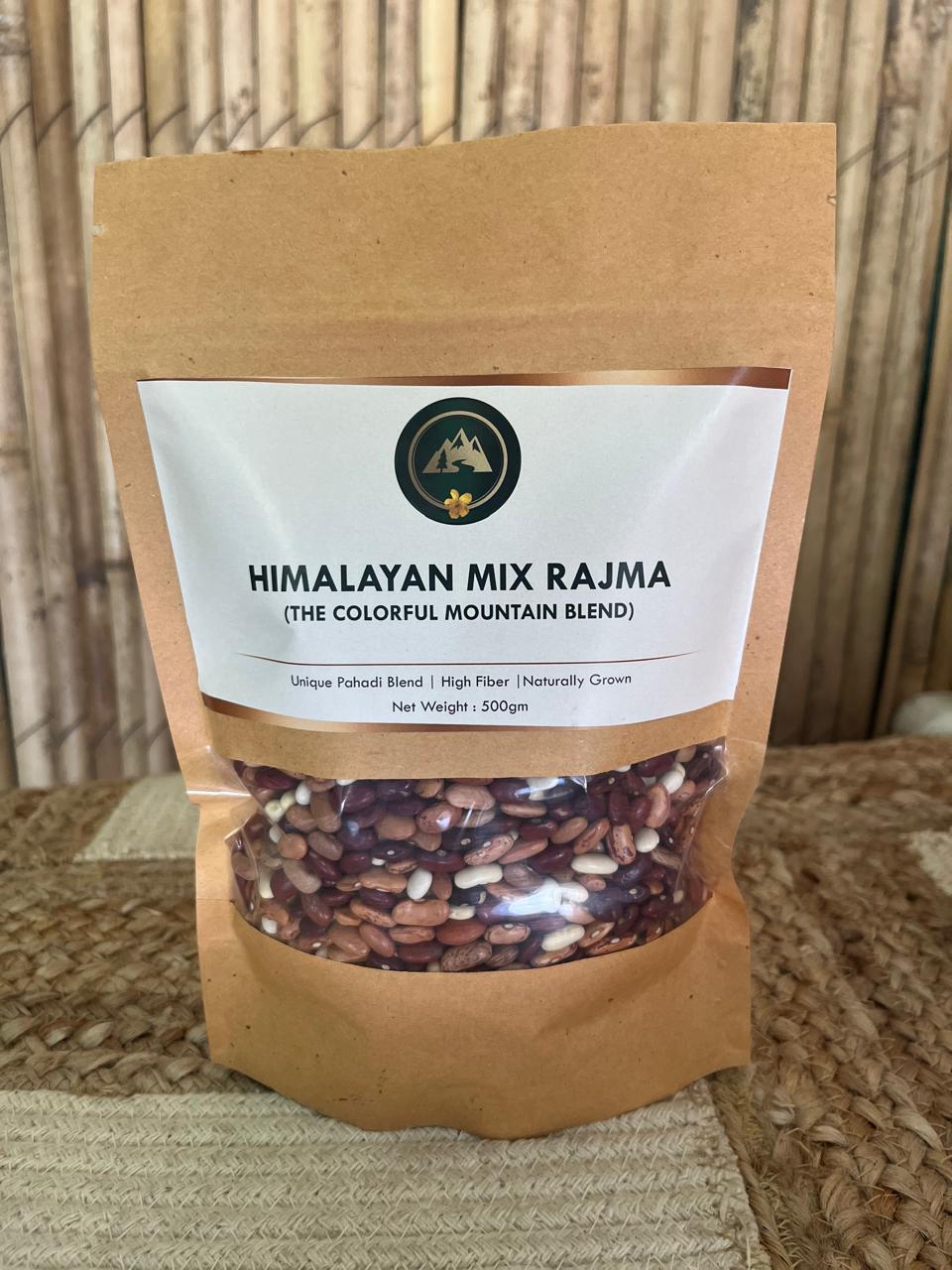
Single-variety rajma is common. This is something rarer. The terraced fields of the Himalayas don’t grow just one bean. For generations, farmers have cultivated multiple varieties side by side — different colours, different textures, different flavours — all in the same mountain soil. Our Himalayan Mix Rajma brings this biodiversity straight to your kitchen. Each bean carries its own character, and together they create a depth of flavour and nutrition that a single variety simply cannot.What Is Himalayan Mix Rajma?
Himalayan Mix Rajma is a multi-variety kidney bean blend sourced across several high-altitude growing valleys in Uttarakhand, rather than tied to one single district. Where Fyonli’s other mixed blend, Rudraprayag Mix Rajma, is a polyculture from one region’s terrace fields, this one draws on heirloom varieties from across the wider Himalayan growing belt — a broader sampler of the colours and textures found in mountain rajma farming. Available in 450g and 900g packs.Why This One Is Different
- Broader varietal range — draws on heirloom bean varieties from across multiple Himalayan growing valleys, not one single terrace field
- Layered flavour — several distinct varieties in one pot means more complexity than a single-cultivar bag
- Varied textures — some beans cook creamier, some hold a firmer bite
- Naturally thick gravy — the mixed starch content thickens the dish without any added thickener
- Grown without chemical inputs — no pesticides or synthetic fertiliser on these mountain smallholdings
Himalayan Mix Rajma vs. Supermarket Rajma
| What You’re Buying | Supermarket Rajma | Fyonli Himalayan Mix Rajma |
|---|---|---|
| Variety | Single commercial cultivar, sorted for uniformity | Multiple heirloom varieties from across the Himalayan belt |
| Origin | Usually unstated — pooled from multiple regions | High-altitude Himalayan growing valleys, Uttarakhand |
| Texture | Uniform — same bite throughout | Multi-textured — creamy and firm beans in the same pot |
| Flavour | Single flavour note | Layered, from several distinct varieties |
| Farmer relationship | Bought through mandi traders | Bought direct from mountain farming communities |
Nutritional Information (per 100g, uncooked)
| Nutrient | Amount |
|---|---|
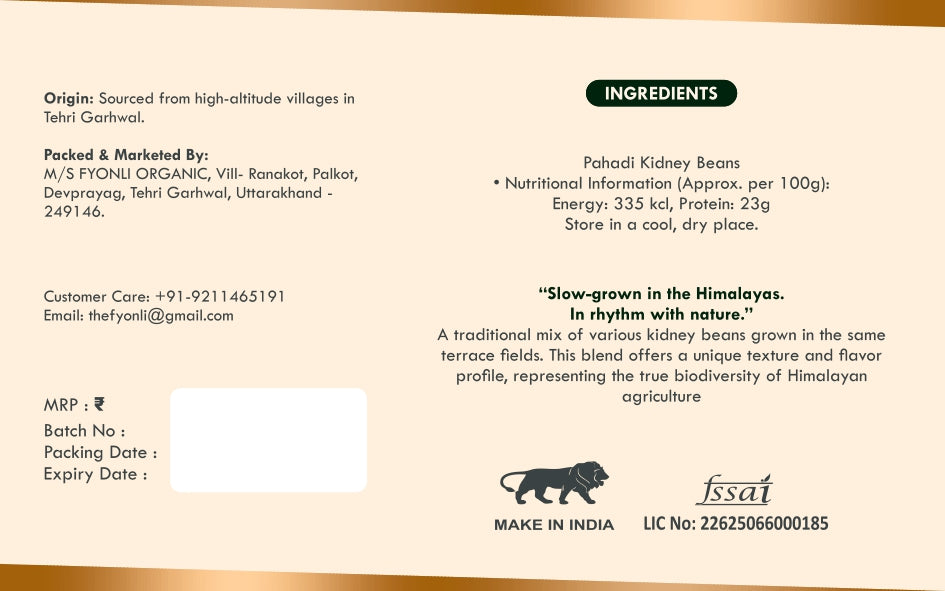
| Energy | 333 kcal |
| Protein | 23.6 g |
| Total Fat | 0.8 g |
| Carbohydrate | 60 g |
| Dietary Fibre | 24.9 g |
Ingredients & Allergens
Ingredients: Himalayan Kidney Beans — a mixed-variety blend (Phaseolus vulgaris). Nothing else — no added salt, oil, or preservatives.
Allergens: A natural legume. Contains no gluten, dairy, or nuts. Packed in a facility that also handles other pulses and legumes.
How to Use
Soak overnight (8–10 hours) as varieties differ in size. Pressure cook for 5–6 whistles on medium heat. Best cooked as a thick, slow-simmered gravy — the varied beans create a natural body without needing any thickener.
Sourcing & Story
Rajma farming across Uttarakhand’s Himalayan belt has always leaned on varietal diversity — smallholder families growing several traditional bean types rather than a single monoculture, a practice that spreads risk across a growing season and keeps yields stable even in a poor year for any one variety. Himalayan Mix Rajma draws on that diversity across several of the growing valleys Fyonli sources from, rather than one district alone. Like other Himalayan rajma, it’s a kharif crop — sown in May and June, harvested in September and October once the pods dry on the vine.Storage & Shelf Life
Store in a cool, dry place in an airtight container, away from direct sunlight and moisture. Does not require refrigeration. Best used within 12 months of the packing date.
Who It’s For
- Cooks who want variety in one bag — a broader spread of heirloom textures and flavours than a single-region blend
- Anyone building a high-protein vegetarian plate — around 24g protein per 100g dry weight, a serious plant-protein staple
- Shoppers who want to sample Himalayan rajma diversity — before committing to one single-origin variety
Frequently Asked Questions
What is Himalayan Mix Rajma exactly?
It’s a multi-variety kidney bean blend sourced across several high-altitude growing valleys in Uttarakhand, rather than one single district. It draws on heirloom bean varieties from across the wider Himalayan growing belt, giving a broader mix of colours, sizes and textures than a single-region blend.
How is this different from Rudraprayag Mix Rajma?
Rudraprayag Mix Rajma is a polyculture blend grown together on terrace fields within one region — Rudraprayag. Himalayan Mix Rajma draws on heirloom varieties sourced across several Himalayan growing valleys rather than one district, making it a broader sampler of mountain rajma diversity.
How much protein does Himalayan Mix Rajma contain?
Dry kidney beans contain approximately 23.6g of protein per 100g (USDA reference values for the species). Since this is a mixed-variety blend, individual beans may vary slightly around this figure. A typical 50g dry serving provides roughly 12g of protein before cooking.
How long should I soak and cook this rajma?
Soak overnight for 8–10 hours, since the different varieties vary in size and need time to hydrate evenly. Pressure cook for 5–6 whistles on medium heat, then slow-simmer for the best texture — the mixed beans build a naturally thick gravy on their own.
What sizes is Himalayan Mix Rajma available in?
It’s available in 450g and 900g packs, both drawn from the same multi-variety blend.
Is this rajma grown with pesticides or chemical fertiliser?
No. The mountain farming communities this blend is sourced from grow rajma without chemical pesticides or synthetic fertiliser. It does not carry a formal organic certification, but the growing method has been chemical-free by practice for generations.
What is the shelf life of Himalayan Mix Rajma?
Up to 12 months from the packing date when stored in an airtight container in a cool, dry place away from direct sunlight and moisture. Refrigeration isn’t required.
Not sure why mountain-grown rajma is different from the supermarket kind? Read the full pahadi vs regular rajma comparison. Prefer a single-region blend? Try Rudraprayag Mix Rajma, or a single-origin bean like Bageshwar White Rajma.