
Description
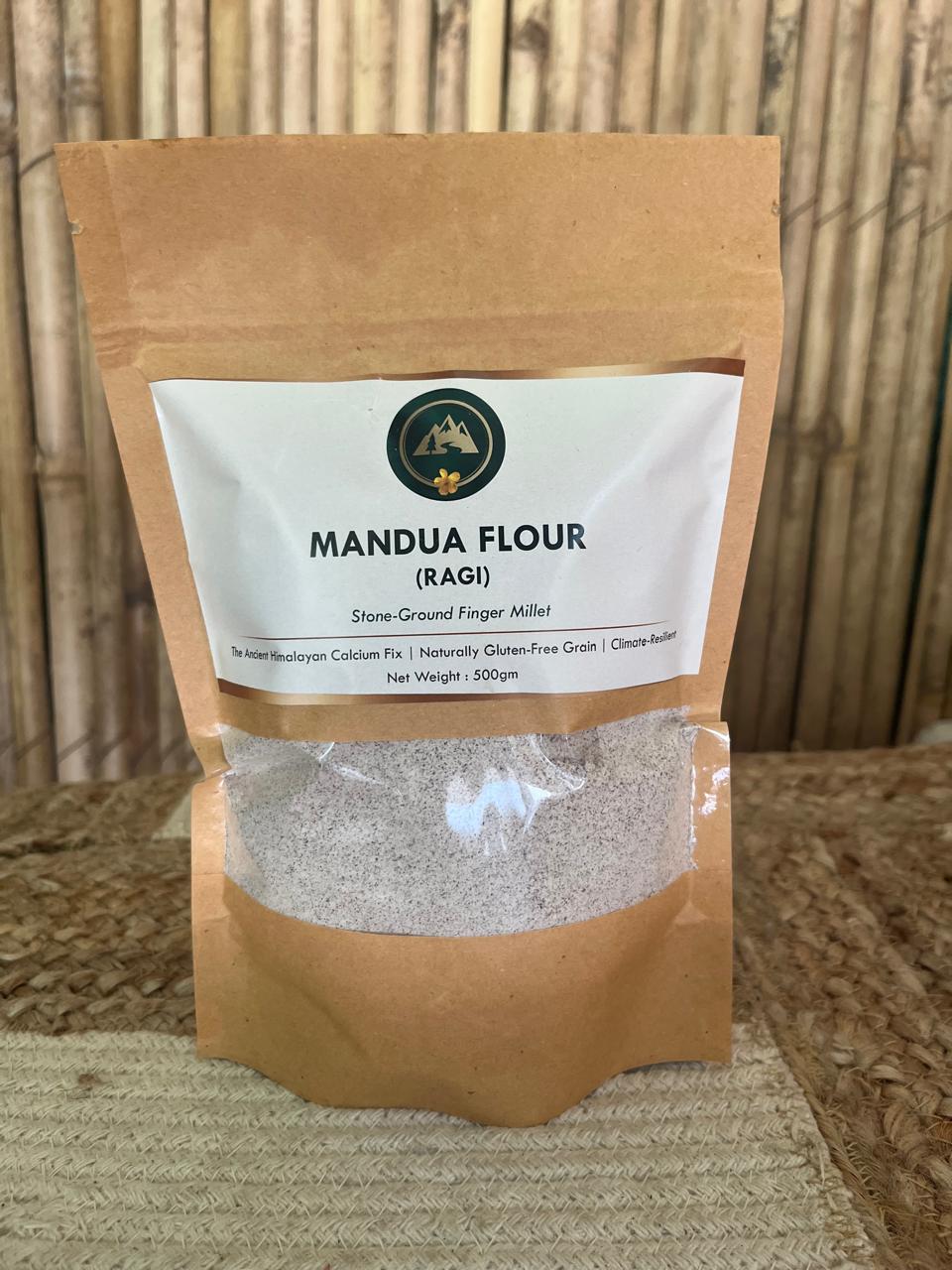
Your family’s daily bread can do more than fill a stomach. Mandua — finger millet — has fed mountain communities in Uttarakhand for centuries. It requires almost no water to grow, thrives without chemicals, and gives back to the soil rather than depleting it. Our Mandua is sourced directly from smallholder farmers and stone-ground to retain its protective husk and all its natural goodness. The result is a flour that’s genuinely nutritious — not just labelled that way.What Is Mandua Flour?
Mandua Flour is stone-ground finger millet (Eleusine coracana, also known as ragi), a traditional Himalayan grain grown by small-holder farmers in the high-altitude villages of Tehri Garhwal, Uttarakhand. It’s one of the most calcium-dense grains in the Indian diet, and one of the hardiest — finger millet needs almost no irrigation and thrives on marginal hill land where other crops struggle. Fyonli sources it directly from those farming families and stone-grinds it to keep the husk and nutrients intact, rather than machine-milling it into a refined white flour.Why This One Is Different
- Exceptionally calcium-rich — finger millet is the most calcium-dense cereal commonly eaten in India, well ahead of wheat or rice
- Naturally gluten-free — a genuine whole-grain alternative for anyone avoiding gluten
- Stone-ground, not machine-milled — retains the husk and nutrients that refined milling strips away
- High in iron and fibre — nourishing and filling in a way refined flours aren’t
- Grown without irrigation or chemical inputs — one of the most drought-resilient traditional Himalayan crops
Mandua Flour vs. Commercial Ragi Flour
| What You’re Buying | Commercial Ragi Flour | Fyonli Mandua Flour |
|---|---|---|
| Milling | Machine-milled, often refined | Stone-ground, husk and nutrients retained |
| Origin | Usually unstated — pooled from multiple regions | High-altitude villages, Tehri Garhwal |
| Processing heat | Machine milling generates heat that can degrade nutrients | Stone-grinding stays cool, no heat damage |
| Freshness | Milled well ahead of sale, often months old | Milled in small batches close to packing |
| Farmer relationship | Bought through mandi traders | Bought direct from Garhwal smallholder farmers |
Nutritional Information (per 100g)
| Nutrient | Amount |
|---|---|
| Energy | 336 kcal |
| Protein | 7.3 g |
| Total Fat | 1.5 g |
| Carbohydrate | 72 g |
| Dietary Fibre | 11.2 g |
| Calcium | 344 mg |
| Iron | 3.9 mg |
Ingredients & Allergens
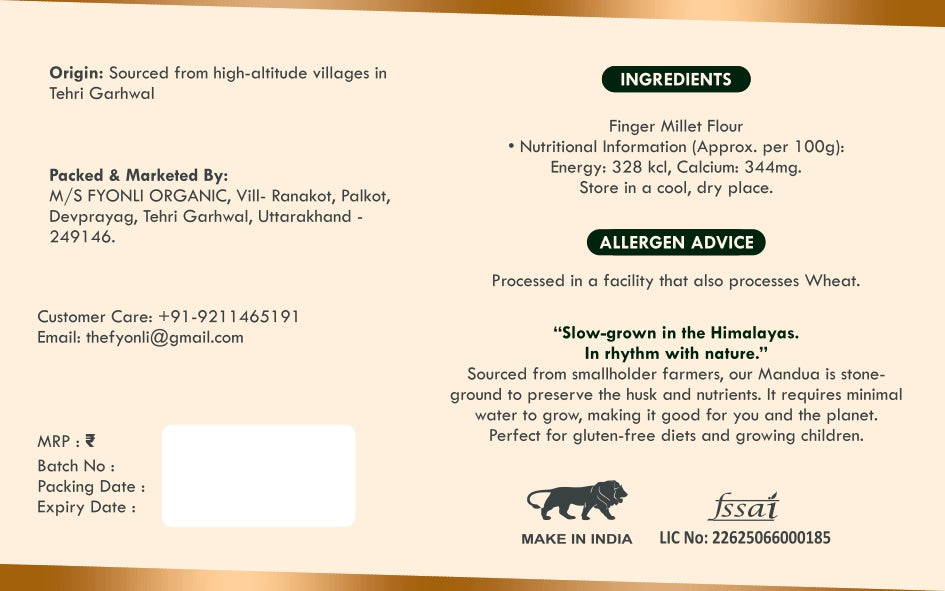
Ingredients: Mandua Flour (stone-ground finger millet). Nothing else — no added salt, oil, or preservatives.
Allergens: Naturally gluten-free. Processed in a facility that also processes wheat.
How to Use
Mix with warm water to make a smooth dough for rotis. Add to pancake batter or porridge for a nutritious breakfast. Blend with wheat flour for everyday chapatis. Works beautifully in traditional dishes like Mandua ki Roti served with ghee and jaggery.
Sourcing & Story
Finger millet has been grown in Tehri Garhwal’s high-altitude villages for centuries, prized precisely because it needs almost no irrigation and improves rather than depletes the soil it grows in — a rare trait among staple grains. It’s a kharif crop, sown with the monsoon and harvested in autumn once the seed heads dry. Traditionally milled by hand between stone wheels, the process Fyonli still uses today, it keeps the husk and germ intact rather than stripping them away for a whiter, more refined flour. Fyonli buys the grain directly from the farming families who grow it and mills it in small batches.Storage & Shelf Life
Store in an airtight container in a cool, dry place, away from direct sunlight and moisture. Does not require refrigeration. Best used within 6 months of the packing date — whole-grain stone-ground flour has a shorter shelf life than refined flour, since the germ and husk are still intact.
Who It’s For
- Growing children and anyone building bone density — one of the most calcium-dense grains commonly eaten in India
- Anyone avoiding gluten — a genuinely traditional gluten-free flour, not a modern substitute
- Health-conscious families rethinking daily rotis — swap in partially or fully for wheat flour in everyday cooking
Frequently Asked Questions
What is Mandua Flour?
Mandua Flour is stone-ground finger millet (Eleusine coracana), also known as ragi, a traditional Himalayan grain grown by small-holder farmers in the high-altitude villages of Tehri Garhwal, Uttarakhand. It’s one of the most calcium-dense cereals commonly eaten in India.
Is Mandua Flour gluten-free?
Yes, finger millet is naturally gluten-free. This product is processed in a facility that also handles wheat, so anyone with celiac disease or severe gluten sensitivity should factor in that cross-contact risk.
How much calcium does Mandua Flour contain?
Finger millet provides approximately 344mg of calcium per 100g (ICMR reference values), making it one of the most calcium-dense cereals in the Indian diet — well ahead of wheat or rice.
How do I use Mandua Flour?
Mix with warm water to make a dough for rotis, add it to pancake batter or porridge, or blend it with wheat flour for everyday chapatis. Mandua ki Roti served with ghee and jaggery is a classic Himalayan preparation.
What is the shelf life of Mandua Flour, and why is it shorter than regular flour?
Up to 6 months from the packing date, stored in an airtight container in a cool, dry place. Because it’s stone-ground with the husk and germ intact, it has a shorter shelf life than refined, machine-milled flour — buy it in quantities you’ll use within a few months.
Is Mandua Flour grown with pesticides or chemical fertiliser?
No. The farming families in Tehri Garhwal grow finger millet without chemical pesticides or synthetic fertiliser — it’s one of the most drought-resilient traditional crops and needs very little irrigation. It does not carry a formal organic certification, but the growing method has been chemical-free by practice for generations.
Looking for other traditional Himalayan grains? Try the light, gluten-free Devprayag Jhangora, or the earthy Pahadi Makki Atta.