


Description
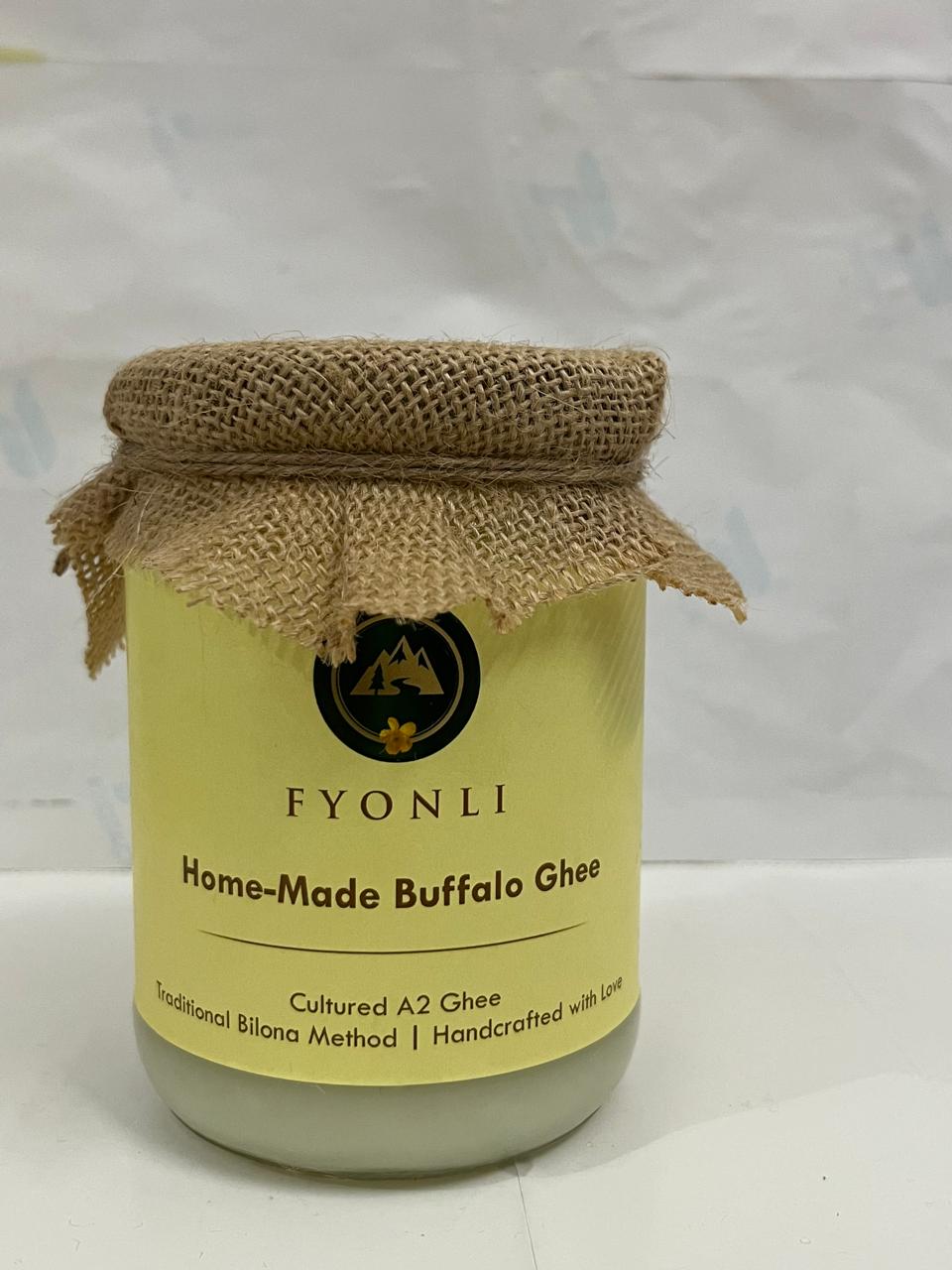
Factory ghee is made in minutes. Ours takes days. Using the ancient Bilona method, fresh curd is hand-churned and slow-cooked until it transforms into a rich, grainy, aromatic ghee — the way it was always meant to taste.What Is Home-Made Buffalo Ghee?
Home-Made Buffalo Ghee is a small-batch, Bilona-method A2 ghee made from buffalo milk sourced from Bewal Village, Mahendragarh district, Haryana — home to the Murrah buffalo, the breed dairy farmers across India regard as the finest milch buffalo for its rich, high-fat milk. Unlike Fyonli’s other products, this one isn’t a Himalayan-grown item — it’s a traditional, hand-churned buffalo ghee made the way rural Haryana households have always made it, and Fyonli sells it exactly as it’s made, without shortcuts.Why This One Is Different
- Murrah buffalo milk — the breed prized across India for its high fat content, which is what gives real buffalo ghee its characteristic richness and grain
- Traditional Bilona method — milk is cultured into curd first, then hand-churned to butter, then slow-cooked to ghee, not machine-separated from cream
- Rich, grainy texture — the slow-cook process leaves a natural granular texture factory-made ghee doesn’t have
- Higher fat, deeper flavour than cow ghee — buffalo milk runs richer in fat than cow milk, giving a heavier mouthfeel and more pronounced aroma
- No shortcuts — no added colour, no cream separators, no industrial clarification
Buffalo Ghee vs. Commercial Ghee
| What You’re Buying | Commercial/Supermarket Ghee | Fyonli Home-Made Buffalo Ghee |
|---|---|---|
| Method | Machine cream separation, factory clarification | Traditional Bilona — cultured curd, hand-churned, slow-cooked |
| Milk source | Usually unstated — pooled dairy supply | Murrah buffalo milk, Bewal Village, Mahendragarh, Haryana |
| Texture | Smooth, uniform | Naturally grainy from slow-cooking |
| Additives | May include added colour or flavour | None — pure ghee only |
| Batch size | Large-scale factory production | Small-batch, hand-made |
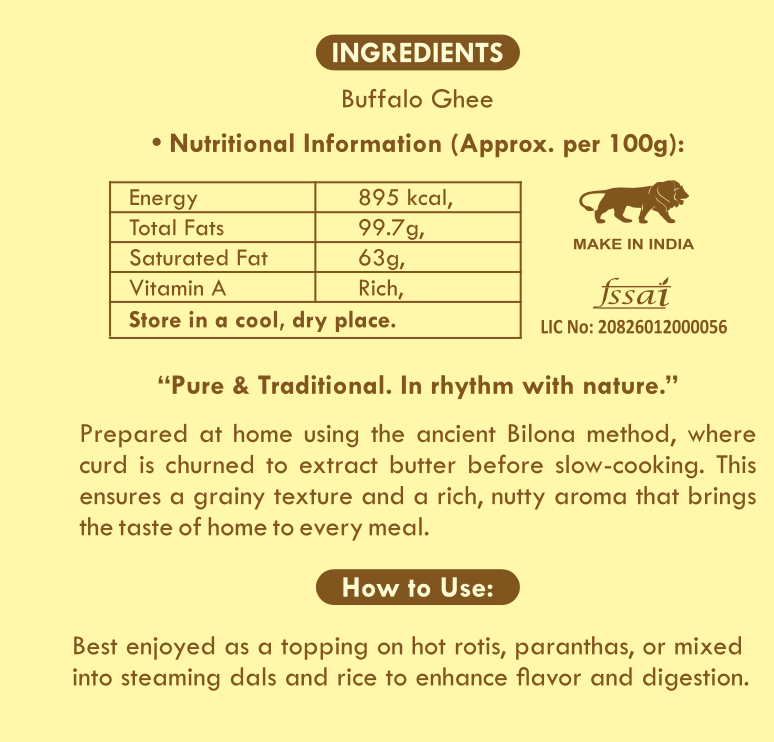
Nutritional Information (per 100g)
| Nutrient | Amount |
|---|---|
| Energy | 900 kcal |
| Total Fat | 99.7 g |
| Saturated Fat | 65 g |
| Protein | 0.3 g |
| Carbohydrate | 0 g |
Ingredients & Allergens
Ingredients: Buffalo Ghee (clarified butter from cultured buffalo milk). Nothing else — no salt, no added colour, no preservatives.
Allergens: Contains milk. Not suitable for anyone with a dairy allergy or intolerance to milk fat.
How to Use
Add a spoonful to warm milk at bedtime, spread on hot rotis, stir into dal or khichdi, use as a base for tadka, or drizzle over rice. A staple of the Ayurvedic kitchen — best used daily in moderate amounts as part of a balanced diet.
Sourcing & Story
This ghee is made in Bewal Village, Mahendragarh district, Haryana — part of the traditional breeding tract of the Murrah buffalo, a breed dairy farmers across India and abroad rate as the finest milch buffalo for its rich, high-fat milk. The milk is first cultured into curd, then hand-churned using a wooden bilona to separate the butter, which is then slow-cooked over a gentle flame until it turns into clear, aromatic ghee with the characteristic grainy texture that sets true Bilona ghee apart from factory-clarified versions. This is a home-style product, made the way rural Haryana households have made buffalo ghee for generations — not a Himalayan-sourced item, and Fyonli doesn’t claim it as one.Storage & Shelf Life
Store in a cool, dry place away from direct sunlight. Does not require refrigeration. Shelf life: 12 months from the packing date.
Who It’s For
- Households who grew up on buffalo ghee — richer and more full-bodied than cow ghee, the way many North Indian kitchens prefer it
- Anyone who wants a genuinely traditional Bilona ghee — hand-churned from cultured curd, not machine-separated cream
- High-fat, high-smoke-point cooking — ideal for tadka, sautéing and deep-frying
Frequently Asked Questions
Is Home-Made Buffalo Ghee sourced from the Himalayas?
No. Unlike most of Fyonli’s catalogue, this ghee is made in Bewal Village, Mahendragarh district, Haryana, using milk from Murrah buffaloes — the breed native to that region and widely regarded as India’s finest dairy buffalo. It’s a traditional, hand-made Bilona ghee, not a Himalayan-sourced product.
What is the Bilona method?
The Bilona method is a traditional way of making ghee: milk is first cultured into curd, then hand-churned with a wooden churner (bilona) to separate the butter, which is then slow-cooked over a gentle flame until it becomes ghee. It’s slower than machine cream-separation, and produces a richer, grainier texture.
How is buffalo ghee different from cow ghee?
Buffalo milk is naturally higher in fat than cow milk, so buffalo ghee tends to be richer, heavier in mouthfeel, and whiter in colour than cow ghee, which is typically more golden and slightly lighter. Both are made the same traditional way here, but buffalo ghee has a more pronounced richness.
What is the fat content of this ghee?
Buffalo ghee runs close to 99.7g of fat per 100g, of which roughly 65g is saturated fat, with essentially no protein or carbohydrate — it’s a pure fat product, based on published nutrition reference data for the food category.
What is the shelf life and how should I store it?
12 months from the packing date. Store in a cool, dry place away from direct sunlight — refrigeration isn’t required.
Is this ghee suitable for someone with a dairy allergy?
No. Ghee is clarified butter made from milk, so it contains milk fat and is not suitable for anyone with a dairy allergy or milk intolerance, even though most of the milk solids are removed during clarification.
Looking for a Himalayan-sourced ghee instead? Try Mountain Cow Ghee, made from herb-fed cows across Kashmir and Uttarakhand.