Description
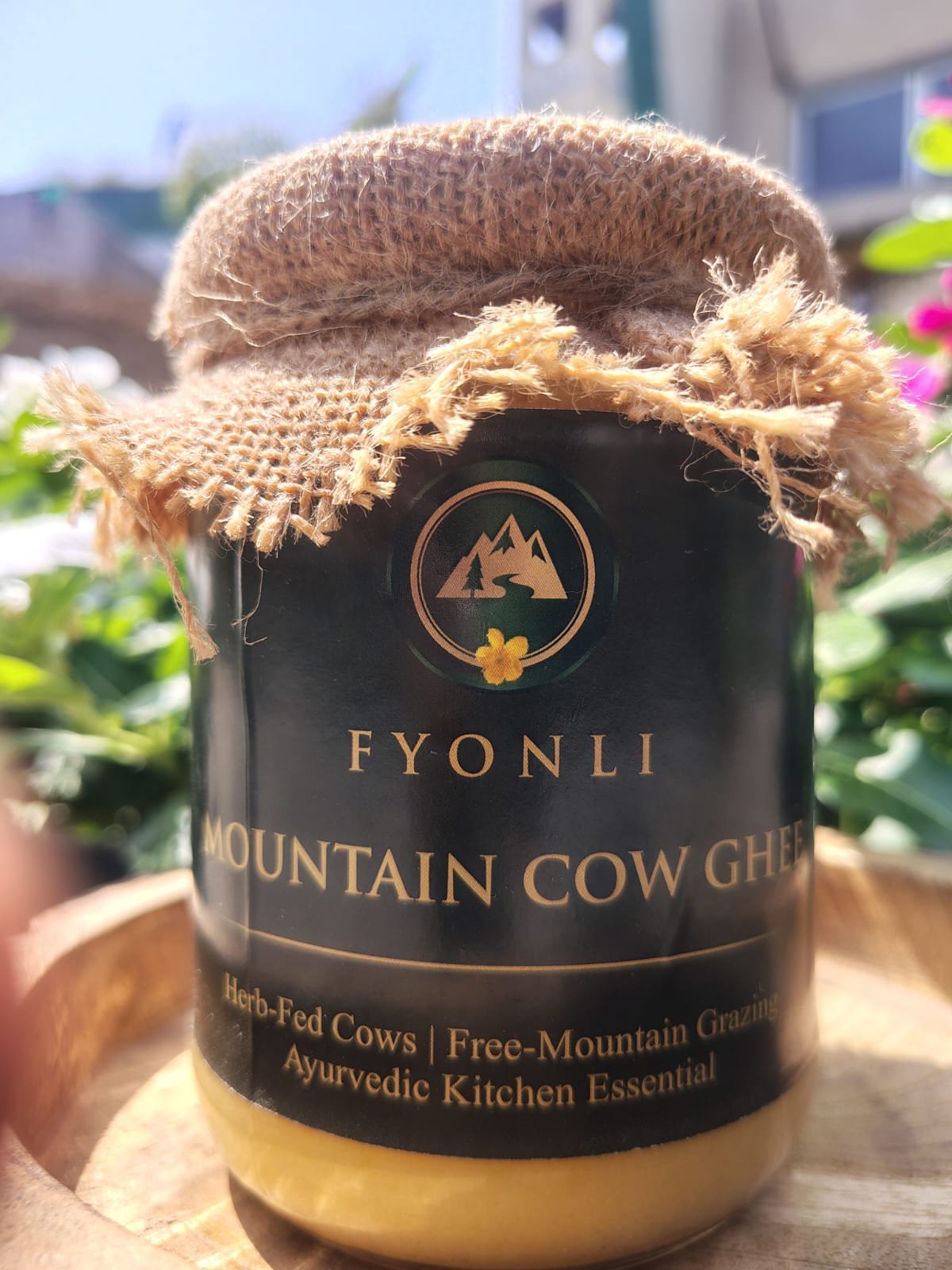
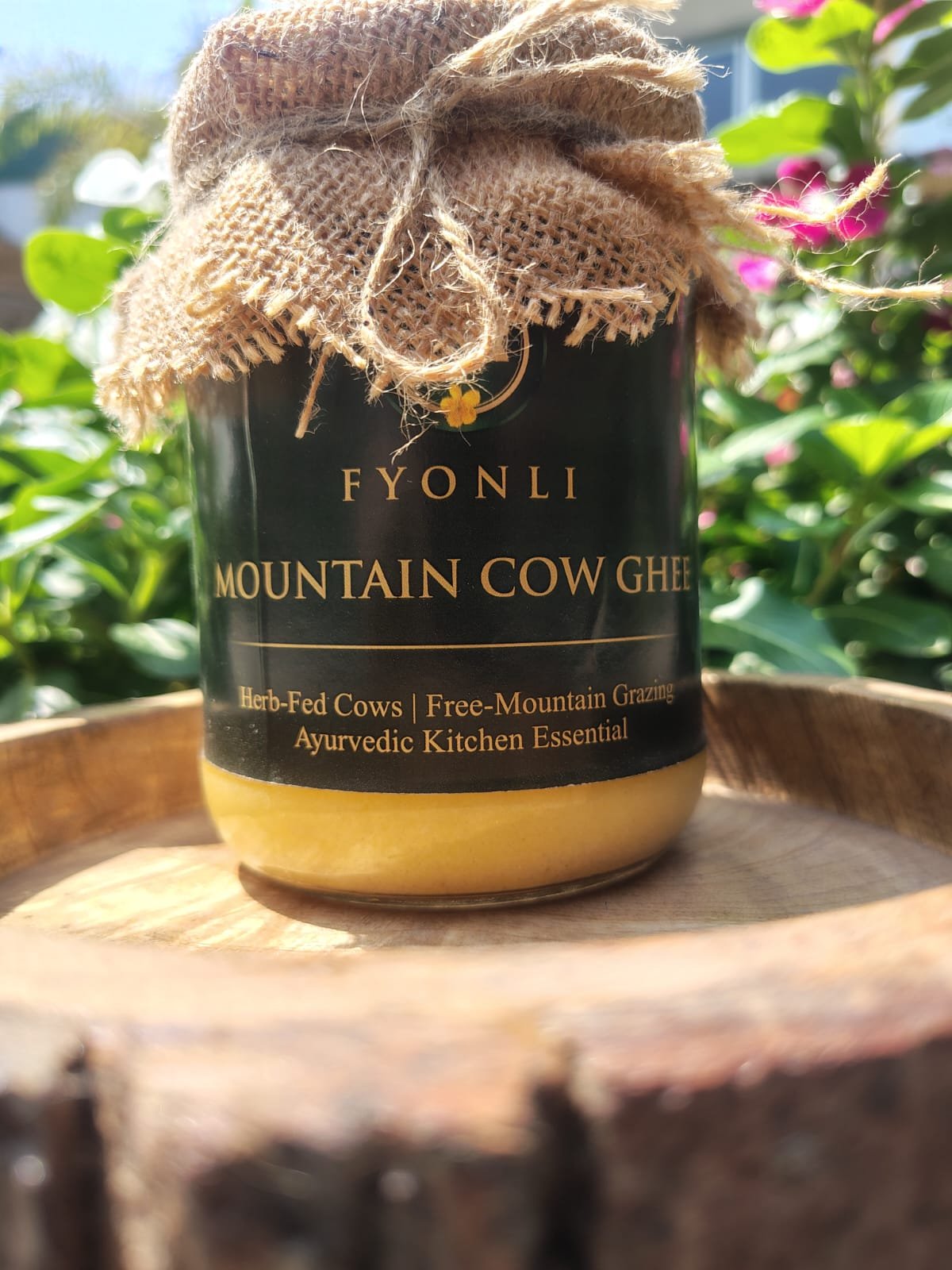
Pure & Traditional. In Rhythm With Nature. Fyonli Mountain Cow Ghee is prepared from the milk of cows grazing freely on diverse mountain grasses and medicinal herbs across the high-altitude valleys of Kashmir and Uttarakhand. These are not factory-farmed cows — they roam the Himalayan meadows at elevations above 6,000 feet, feeding on wild herbs that give the ghee its distinctive golden colour, aromatic depth, and natural grain.What Is Mountain Cow Ghee?
Mountain Cow Ghee is a Bilona-method A2 ghee made from the milk of desi Pahari cows that graze freely across high-altitude pastures in Kashmir and Uttarakhand, above 6,000 ft. Unlike stall-fed dairy cows on a fixed feed, these cows forage on a changing mix of wild mountain grasses and herbs through the seasons, which is what gives this ghee its distinctive golden colour and aromatic depth. Fyonli makes it the traditional way — curd first, then hand-churned, then slow-cooked — not machine-separated from cream.Why Mountain Cow Ghee Is Different
- Higher CLA (Conjugated Linoleic Acid) — grass-fed cows produce milk richer in CLA, associated with better metabolic health
- Rich in Fat-Soluble Vitamins — A, D, E, K2 from herb-grazing cows
- A2 Protein Cows — Desi mountain cows (Pahari breed) are A2 milk producers
- High Smoke Point (~250°C) — ideal for Indian cooking: tadka, sautéing, deep-frying
- Butyric Acid — supports gut lining health, an Ayurvedic cornerstone
Mountain Cow Ghee vs. Commercial Ghee
| What You’re Buying | Commercial/Supermarket Ghee | Fyonli Mountain Cow Ghee |
|---|---|---|
| Milk source | Stall-fed dairy cows, fixed feed | Free-grazing Pahari cows, Kashmir & Uttarakhand highlands |
| Protein type | Often A1/A2 mixed-breed milk | A2 milk from desi Pahari cows |
| Method | Machine cream separation | Traditional Bilona — cultured curd, hand-churned, slow-cooked |
| Texture | Smooth, uniform | Naturally grainy from slow-cooking |
| Grazing altitude | Typically lowland dairy farms | Above 6,000 ft Himalayan meadows |
Nutritional Information (per 100g)
| Nutrient | Amount |
|---|---|
| Energy | 885 kcal |
| Total Fat | 98 g |
| Saturated Fat | 62 g |
| Protein | 0.3 g |
| Carbohydrate | 0 g |
Ingredients & Allergens
Ingredients: Cow Ghee (clarified butter from cultured cow milk). Nothing else — no salt, no added colour, no preservatives.
Allergens: Contains milk. Not suitable for anyone with a dairy allergy or intolerance to milk fat.
How to Use
Add a spoonful to warm milk at bedtime, spread generously on rotis, stir into dal or khichdi, use as a base for tadka, or drizzle over rice. A staple of the Ayurvedic kitchen, ghee is best used daily in moderate amounts as part of a balanced diet.
Sourcing & Story
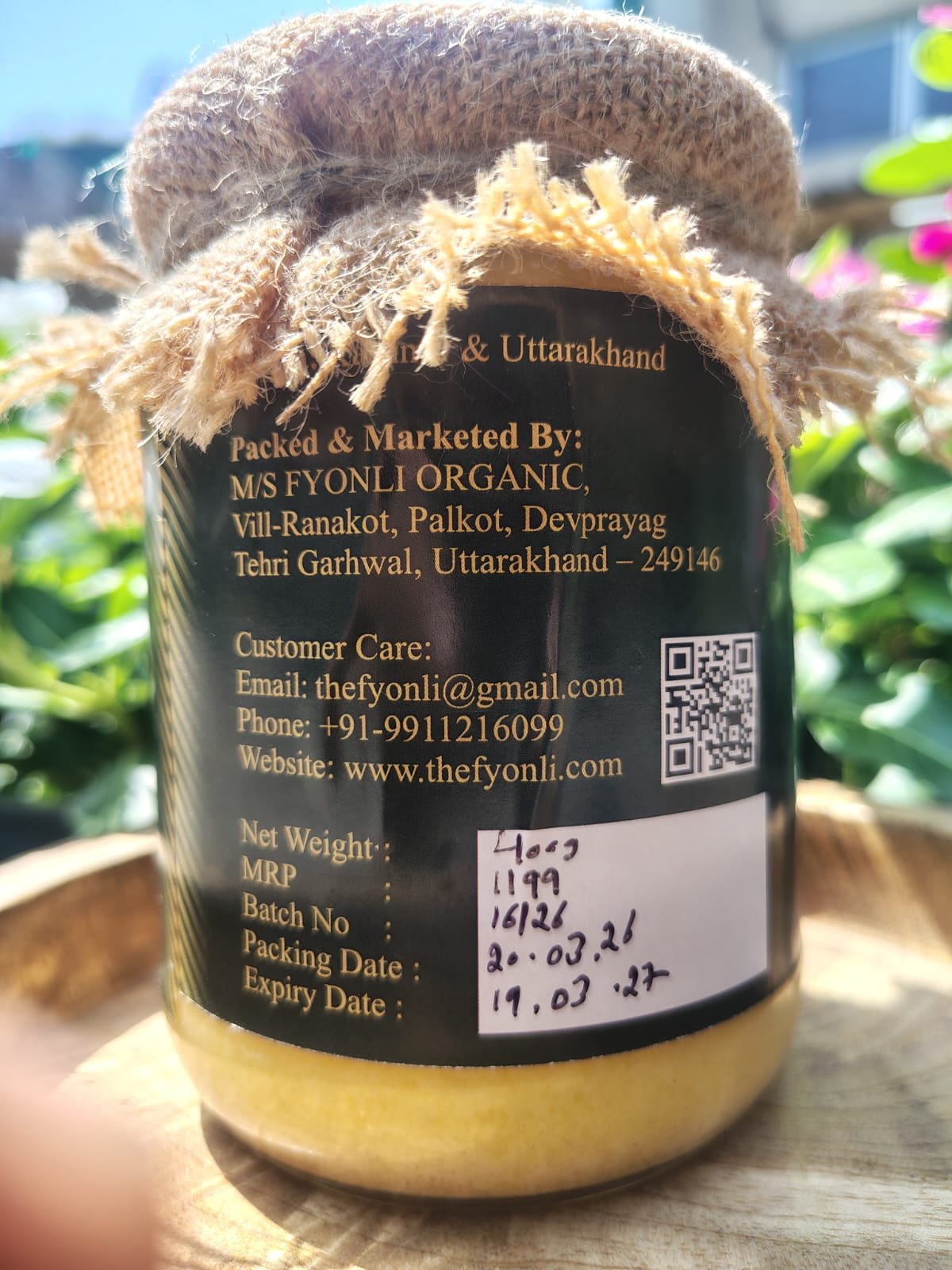
The fresh milk is first cultured into curd, then traditionally churned using a wooden bilona to extract butter. This butter is slow-cooked over a gentle flame until it transforms into clear, aromatic ghee with the characteristic rich, grainy texture that distinguishes true Bilona ghee from factory-clarified variants. No additives, no preservatives — just pure ghee the way it has been made in the mountains for centuries. Packed and marketed by M/S Fyonli Organic, Vill-Ranakot, Palkot, Devprayag, Tehri Garhwal, Uttarakhand – 249146.Storage & Shelf Life
Store in a cool, dry place away from direct sunlight. Does not require refrigeration. Shelf life: 12 months from the packing date.
Who It’s For
- Anyone building an Ayurvedic daily-ghee habit — a spoon in warm milk, dal or rice is a genuine daily-use product, not an occasional treat
- Cooks who want a high-smoke-point fat — ideal for tadka, sautéing and deep-frying without breaking down
- Households that prefer A2 cow milk products — made from desi Pahari cow milk rather than crossbred dairy cattle
Frequently Asked Questions
What makes Mountain Cow Ghee different from regular cow ghee?
It’s made from the milk of desi Pahari cows that free-graze on wild mountain grasses and herbs above 6,000 ft across Kashmir and Uttarakhand, rather than stall-fed dairy cattle on a fixed feed. The changing seasonal diet is what gives this ghee its distinctive golden colour and aromatic depth, and it’s made using the traditional Bilona method rather than machine cream separation.
Is this ghee A2?
Yes. It’s made from the milk of desi Pahari cows, an indigenous Himalayan breed that produces A2 milk, as opposed to the A1 milk more common in crossbred dairy cattle.
What is the Bilona method?
The Bilona method is a traditional way of making ghee: milk is first cultured into curd, then hand-churned with a wooden churner (bilona) to separate the butter, which is then slow-cooked over a gentle flame until it becomes ghee. It produces a richer, grainier texture than machine-separated ghee.
What is the fat and calorie content of this ghee?
Mountain Cow Ghee provides approximately 885 kcal and 98g of fat per 100g, of which about 62g is saturated fat, with negligible protein and carbohydrate — typical for a pure ghee product.
What is the shelf life and how should I store it?
12 months from the packing date. Store in a cool, dry place away from direct sunlight — refrigeration isn’t required.
How is this different from Fyonli’s Buffalo Ghee?
Mountain Cow Ghee is made from A2 cow milk sourced from free-grazing Pahari cows in the Himalayan highlands of Kashmir and Uttarakhand. Fyonli’s Home-Made Buffalo Ghee, by contrast, is made from Murrah buffalo milk sourced from Haryana — richer and higher in fat, with a heavier mouthfeel. Both use the traditional Bilona method.
Want a richer, higher-fat ghee? Try Home-Made Buffalo Ghee, made from Murrah buffalo milk using the same traditional Bilona method.