
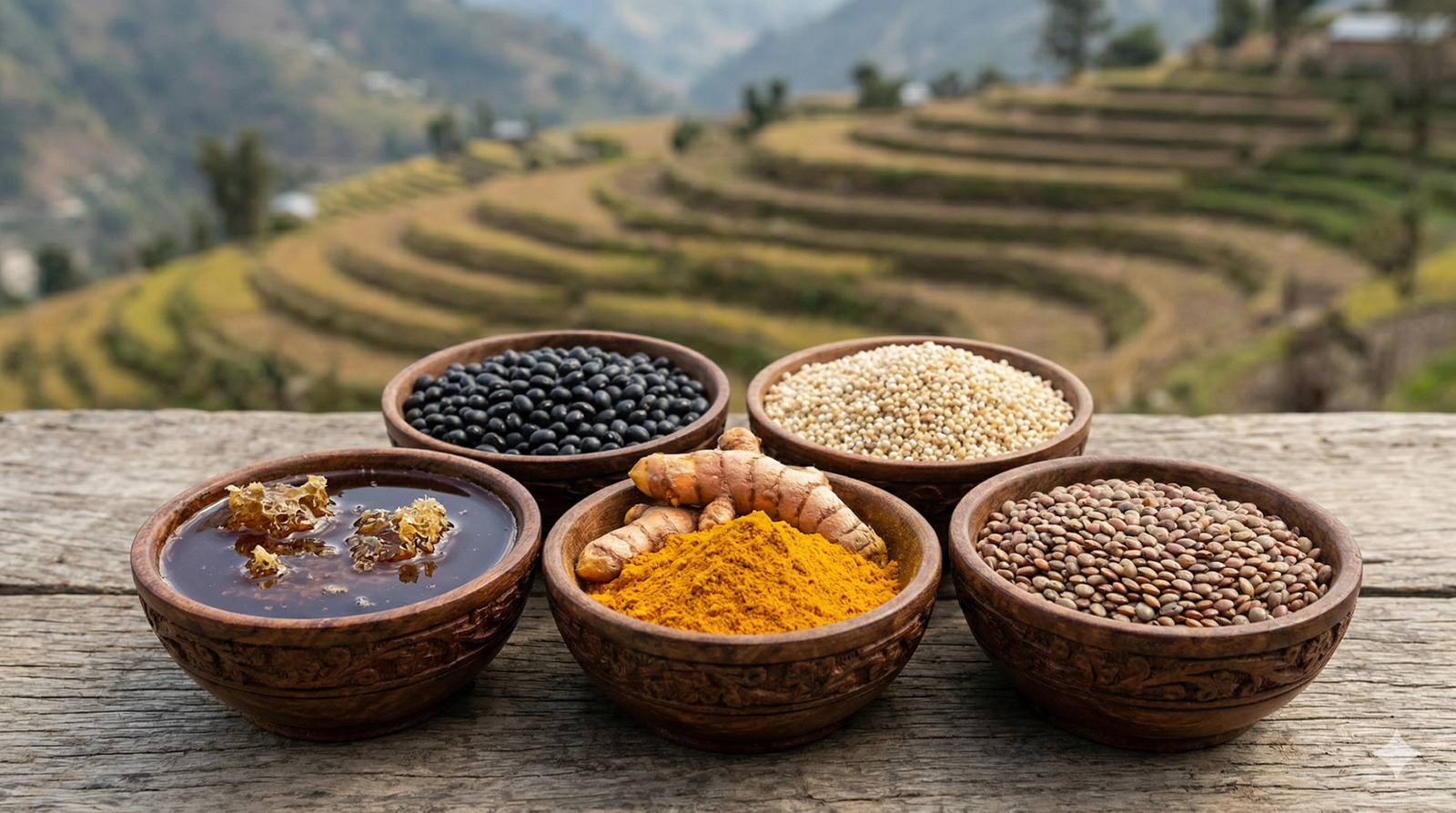
Himalayan superfoods have been feeding mountain communities for thousands of years. While India spent the last decade importing quinoa, chia seeds, and kale from abroad, the Uttarakhand and Kashmir Himalayan belt has been quietly producing foods that outperform most imported superfoods on every nutritional measure.
The difference is that nobody marketed them. That is now changing — and you can buy all of these genuine Himalayan superfoods online in India today, delivered directly from mountain farming communities to your door.
According to the National Institute of Nutrition, traditional Indian foods grown at altitude consistently show higher micronutrient density than commercially cultivated equivalents — a finding that validates what Himalayan communities have always known empirically.
Here are the ten most remarkable ones, what makes each exceptional, and exactly where to find them.
In This Article
- 1. Bhangjeera — Wild Himalayan Perilla Seeds
- 2. Gahat Dal — Horse Gram for Kidney Stones
- 3. Pahadi Haldi — High Curcumin Himalayan Turmeric
- 4. Jhangora — Barnyard Millet Better Than Rice
- 5. Raw Wild Mountain Honey — Nothing Like Supermarket Honey
- 6. Himalayan Black Soyabean Bhatt — Antioxidant Powerhouse
- 7. Chakrata Rajma — Single-Origin Mountain Kidney Beans
- 8. Mandua Flour — Stone-Ground Himalayan Finger Millet
- 9. Snow White Akhrot — Rare Grade Kashmiri Walnuts
- 10. Wild Jakhya — Uttarakhand’s Secret Tempering Spice
1. Bhangjeera — Wild Himalayan Perilla Seeds
Himalayan superfoods don’t get more overlooked than bhangjeera. Wild-harvested perilla seeds from the slopes of Devprayag in Garhwal, bhangjeera is the same seed celebrated in Korean and Japanese cooking as egoma — except it has grown wild in Uttarakhand and fed Pahadi communities for centuries before anyone called it a superfood.
Why it is exceptional: Bhangjeera contains one of the highest concentrations of alpha-linolenic acid (ALA) omega-3 of any plant food — higher than flaxseeds. For vegetarians who cannot get omega-3 from fish, bhangjeera is one of the most potent and culturally rooted alternatives available in India. It also contains rosmarinic acid — a powerful natural anti-inflammatory compound.
How to use it: Dry roast and grind with green chilli and garlic for bhangjeera chutney — the signature Pahadi condiment. Add whole seeds to hot ghee as a tempering for any dal. Mix into yoghurt with salt for a simple raita.
Who should eat it: Anyone increasing plant-based omega-3 intake, anyone curious about traditional Pahadi cooking, anyone looking for a genuinely different and delicious chutney base.
2. Gahat Dal — Horse Gram for Kidney Stones
Of all the Himalayan superfoods on this list, gahat dal horse gram has the most impressive traditional medicinal reputation — and the most modern scientific validation to back it up.
Why it is exceptional: Gahat dal — known in English as horse gram — contains compounds that inhibit the formation of calcium oxalate kidney stones and has diuretic properties that help flush existing stones. It also contains approximately 22–24g of protein per 100g, among the highest of any pulse in India, with a low glycaemic index that makes it valuable for diabetics. Traditional Uttarakhand communities have eaten it for centuries — both as daily nutrition and as a specific remedy for urinary health.
How to use it: Soak overnight, pressure cook for 5–6 whistles, temper generously with ghee and garlic. Drink the soaking water on an empty stomach in the morning for kidney health support — this costs nothing extra since you are soaking the dal anyway.
Who should eat it: Anyone managing kidney stones or at risk, diabetics, vegetarians needing high-protein pulses, anyone wanting deeply flavourful winter dal.
Shop Tehri Garhwal Gahat Dal →
3. Pahadi Haldi — High Curcumin Himalayan Turmeric
Most Indian kitchens use commercial turmeric containing 1–2% curcumin — the active anti-inflammatory compound. Pahadi haldi from Uttarakhand — grown slowly at altitude for up to 3 years rather than the standard 6 months — consistently tests between 4–7% curcumin. The difference in both flavour and therapeutic effect is real and measurable.
Why it is exceptional: Curcumin is one of the most studied natural anti-inflammatory compounds in science — linked to joint health, cardiovascular support, cognitive protection, and immune function. The commercial turmeric in most Indian kitchens delivers too little of it to be meaningful. Pahadi haldi delivers enough to matter — with an aroma and flavour that is richer, warmer, and more complex than any supermarket alternative.
How to use it: Always cook briefly in ghee or oil before adding water — this activates the curcumin. Always add a pinch of black pepper — piperine increases curcumin absorption by up to 2,000%. These two steps turn good turmeric into genuinely effective turmeric.
Who should eat it: Everyone who uses turmeric daily and actually wants the health benefits they are expecting from it.
4. Jhangora — Barnyard Millet Better Than Rice
Jhangora is Uttarakhand’s name for barnyard millet — a small white grain grown on terraced Himalayan hillsides in Devprayag and surrounding Garhwal valleys for thousands of years. It has fed mountain communities through winters and fasts without ever being marketed to the rest of India. That is changing as the millet movement gains momentum.
Why it is exceptional: Jhangora barnyard millet has a glycaemic index of approximately 50 versus white rice at 72 — significantly lower blood sugar impact. It contains nearly 4 times more dietary fibre than white rice, more iron, more protein, and is naturally gluten-free. Uttarakhand Jhangora has even been applied for Geographical Indication status — a recognition that this specific Himalayan variety is genuinely distinct from barnyard millet grown elsewhere.
How to use it: Cook exactly like rice — 1 cup grain, 2 cups water, 15 minutes. Serve with any dal. Also makes exceptional Jhangore ki Kheer — the beloved Pahadi dessert cooked slowly in full-fat milk with cardamom and dry fruits.
Who should eat it: Diabetics, anyone managing weight, anyone wanting to reduce rice consumption without sacrificing satisfaction, anyone interested in ancient grains.
5. Raw Wild Mountain Honey — Nothing Like Supermarket Honey
Raw wild mountain honey from the Garhwal Himalayan belt is produced by bees foraging freely across alpine terrain at 1,500–2,000 metres elevation. It has never been heated, pasteurised, or processed. It is fundamentally different from every jar on a supermarket shelf — not a premium version of the same thing but a genuinely different product.
Why it is exceptional: Raw mountain honey retains all its live enzymes, natural pollen, propolis traces, and antioxidants — all destroyed by the pasteurisation process that commercial honey undergoes. The flavour is layered and complex — slightly floral, earthy, with mineral depth from the diversity of alpine nectar sources. Wild honey at altitude adds further complexity from flora that simply does not exist below 1,000 metres.
How to use it: A spoonful in warm water with lemon first thing in the morning. Drizzled over yoghurt or fresh fruit. Stirred into cooled chai. Never add to boiling water — above 40°C destroys the live enzymes that make raw honey valuable.
Who should eat it: Everyone — but particularly anyone who has been consuming commercial honey expecting health benefits and wondering why they are not noticing any.
Shop Pahalgam Raw Mountain Honey → Shop Wild Forest Mountain Honey →
6. Himalayan Black Soyabean Bhatt — Antioxidant Powerhouse
Bhatt is a rare black soyabean variety grown at altitude across Uttarakhand — smaller and darker than commercial soyabean, with a dense earthy flavour and a nutritional profile that makes most imported Himalayan superfoods look ordinary by comparison.
Why it is exceptional: Bhatt is extraordinarily rich in anthocyanins — the same dark pigment antioxidants found in blueberries and acai berries that health enthusiasts pay premium prices to import from abroad. It is also high in protein, iron, and isoflavones. It grows naturally in Himalayan villages and has been eaten for generations without ever being marketed as a superfood — which makes it one of the most genuinely undervalued foods on this list.
How to use it: Cook like any bean — soak overnight, pressure cook until soft, temper with cumin and garlic. The flavour is deeper and more complex than white soyabean. Works exceptionally well in simple dal preparations or mixed into rice dishes.
Who should eat it: Anyone interested in antioxidant-rich foods, anyone wanting the Indian equivalent of expensive imported superberries — grown in their own country, supporting Indian farmers.
Shop Himalayan Black Soyabean Bhatt →
7. Chakrata Rajma — Single-Origin Mountain Kidney Beans
Rajma is one of India’s most loved dishes — but most people have never tasted rajma grown at altitude in mineral-rich Himalayan soil, hand-picked at the right stage of ripeness, and traceable to a specific valley. Chakrata rajma from the Chakrata hills of Uttarakhand is that product.
Why it is exceptional: Altitude-grown rajma develops a deeper, earthier flavour and a creamy interior texture — holding its shape while melting when pressed — that plains-grown commercial rajma simply cannot replicate. The thin skin means it cooks faster too. Single-origin rajma from a named Himalayan region is to commercial supermarket rajma what estate coffee is to instant powder — genuinely the same category but a completely different experience.
How to use it: Soak for 4–6 hours, pressure cook for 3–4 whistles. Cook your masala separately and combine — the beans contribute enough flavour that the gravy needs far less work than with commercial rajma.
Who should eat it: Anyone who cooks rajma regularly and wants to understand what it can actually taste like.
Shop Chakrata Rajma → View All Himalayan Rajma →
8. Mandua Flour — Stone-Ground Himalayan Finger Millet
Mandua is the Garhwali name for finger millet — a grain grown on Himalayan terraces for generations and now gaining recognition as one of the most calcium-rich plant foods available anywhere in India. Stone-ground Mandua flour from Uttarakhand retains all its nutritional value in a way that factory-processed ragi flour cannot.
Why it is exceptional: Mandua contains more calcium than most dairy products — making it exceptionally valuable for vegetarians, lactose-intolerant individuals, and anyone concerned about bone health. It is naturally gluten-free, has a low glycaemic index, and is rich in iron and essential amino acids. Stone-grinding at low temperature preserves these nutrients and the grain’s natural aroma in a way that industrial milling simply does not.
How to use it: Mix with wheat flour for rotis — start with 30% Mandua, 70% wheat and adjust to taste. Use for porridge, pancakes, or dosas. The flavour is slightly nutty and earthy — distinctly different from plain wheat flour in a way most people find immediately appealing.
Who should eat it: Anyone looking to increase calcium intake naturally, anyone avoiding gluten, anyone wanting to bring traditional mountain grains into daily cooking.
9. Snow White Akhrot — Rare Grade Kashmiri Walnuts
Most walnuts sold in India are bitter — dark, astringent kernels that most people eat reluctantly rather than enthusiastically. Snow White Akhrot from Anantnag in Kashmir is the premium exception — pale cream kernels, zero bitterness, and a mild buttery flavour that is in an entirely different category.
Why it is exceptional: The Snow White grade is the rarest walnut kernel grade from Kashmir — selected for its pale colour, which indicates lower tannin content and consequently zero bitterness. Walnuts are among the most nutritionally dense nuts available — rich in omega-3, antioxidants, and compounds that support brain and cardiovascular health. The Snow White variety delivers all of this without the bitterness that makes most people eat walnuts reluctantly.
How to use it: Eat straight from the pack — the flavour needs no accompaniment. Add to oatmeal, salads, or yoghurt. Use in baking where walnut flavour is wanted without bitterness.
Who should eat it: Anyone who has been put off walnuts by bitterness — which is most Indians who have only ever tried commercially available walnuts.
Shop Anantnag Snow White Akhrot →
10. Wild Jakhya — Uttarakhand’s Secret Tempering Spice
Jakhya is a wild seed foraged from Himalayan forests in Uttarakhand — used as a tempering spice the way mustard seeds or cumin are used across the rest of India. Outside of Uttarakhand, almost nobody knows what it is. Inside it, nobody cooks dal without it.
Why it is exceptional: Jakhya has a unique crunchy, slightly bitter, intensely aromatic quality when fried in hot ghee that no other tempering spice replicates. It is not a substitute for mustard or cumin — it is its own thing entirely. The flavour it gives to a simple dal or sabzi is immediately recognisable as Pahadi food — an entire regional cuisine captured in one small wild seed.
How to use it: Add a teaspoon to hot ghee at the beginning of any dal preparation. The seeds crackle and darken — the moment they smell nutty and fragrant, proceed with the recipe. One use is enough to understand why this spice has anchored Pahadi cooking for generations.
Who should eat it: Anyone cooking Indian food who wants to explore regional spice traditions beyond the standard pantry.
Shop Wild Jakhya → Shop All Spices, Nuts & Seeds →
Why These Himalayan Superfoods Are Not in Most Indian Kitchens Yet
The honest answer is distribution and marketing — not quality. Every food on this list has been eaten in the mountains for generations, in some cases for thousands of years. The farming communities that grow them have always known their value.
What was missing was a supply chain that could bring these genuine Himalayan superfoods to urban India with their provenance and quality intact — without the blending, industrial processing, and traceability loss that comes with mass commercial distribution.
That is exactly what small-batch Himalayan food brands are building. The window to discover these foods before they go mainstream is now.
Shop the Full Fyonli Collection →
Explore individual ingredients:
- Bhangjeera — Wild Himalayan Perilla Seeds
- Pahadi Til vs Sesame Seeds — Nutrition Compared
- Gahat Dal — Himalayan Horse Gram
- Jhangora — Devprayag Barnyard Millet
- Pahadi Haldi — High Curcumin Turmeric
- Raw Mountain Honey from Garhwal
- Kashmiri Kahwa — Traditional Recipe, Benefits & Kahwa vs Chai
- Himalayan Nettle Salt vs Table Salt — What Makes It Different
Note: These are traditional foods with well-known nutritional benefits. This is not medical advice. Please consult a healthcare professional for specific health conditions.
-
Is Himalayan food genuinely healthier or just marketing?
The nutritional difference is real and measurable. Altitude, mineral-rich glacial soil, slower growing seasons, and the absence of chemical inputs all contribute to higher micronutrient density in Himalayan-grown foods. Research from institutions including the Centre for Aromatic Plants, Uttarakhand confirms that crops grown at altitude in traditional farming systems show consistently higher nutritional profiles than commercially cultivated equivalents.
-
What is bhangjeera and where can I buy it online?
Bhangjeera is the Garhwali name for wild perilla seeds — one of India’s richest plant-based omega-3 sources, grown naturally in the Devprayag region of Uttarakhand. It is used in traditional Pahadi cooking as a chutney base and tempering spice. You can buy authentic Devprayag bhangjeera online from Fyonli with pan-India delivery.
-
Which Himalayan superfood is best for kidney stones?
Gahat dal — known in English as horse gram or kulthi — is the traditional Himalayan remedy for kidney stones. It has diuretic properties that increase urine flow and contains compounds that inhibit the formation of calcium oxalate crystals. Drinking the water in which gahat has been soaked overnight is the traditional Uttarakhand practice for kidney stone support.
-
Which Himalayan superfood is best for diabetes?
Jhangora (barnyard millet) and gahat dal (horse gram) are the most beneficial Himalayan superfoods for diabetics. Both have a low glycaemic index, meaning they release energy slowly without causing blood sugar spikes. Pahadi haldi with black pepper also supports blood sugar regulation through its high curcumin content.
-
Are Himalayan superfoods available for delivery across India?
Yes — all Fyonli Himalayan superfoods are delivered pan-India with free shipping on orders above ₹499. Products are sourced directly from Uttarakhand and Kashmir farming communities and packed in small batches for freshness.
-
What makes Himalayan superfoods different from regular foods?
Himalayan superfoods are grown at altitude — typically between 1,500 and 2,500 metres — in mineral-rich glacial soil without chemical inputs. The slower growing seasons, colder temperatures, and clean environment concentrate nutrients and flavour in ways that plains-grown
Related: Ajwa Dates vs Medjool Dates: Which Is Actually Better for Daily Eating in India