
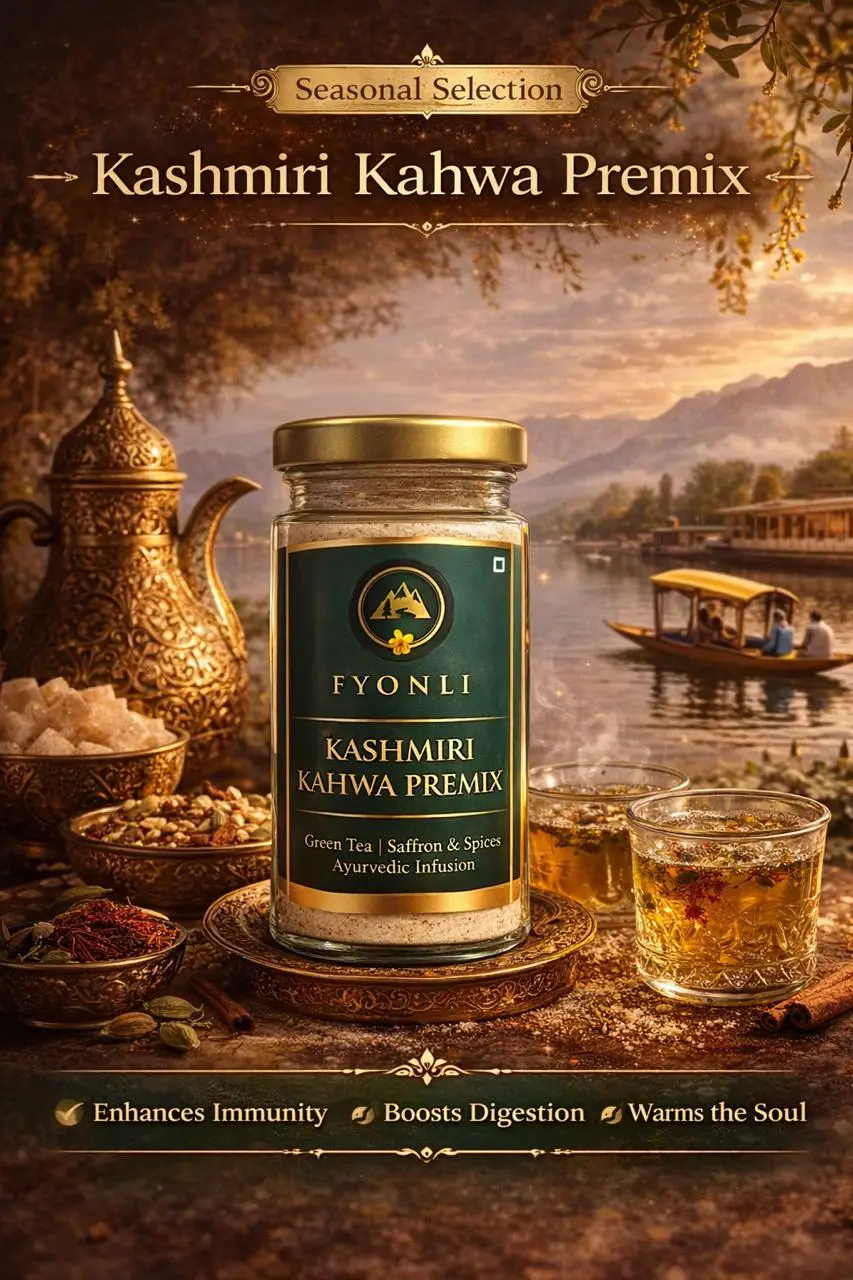
Kahwa — sometimes spelled qahwa or kehwa — is Kashmir’s traditional spiced green tea, simmered with cardamom, cinnamon, cloves, and a few strands of saffron, and served without milk. It is not the same drink as regular Indian chai, and the differences go well beyond taste. This guide gives you the authentic Kashmiri recipe exactly as it is made in the Valley, the quick premix method for when you want it in minutes, a side-by-side comparison with regular chai, and what the research actually says about kahwa’s health benefits.
Key Takeaways
- Kahwa is a Kashmiri green tea simmered with whole spices (cardamom, cinnamon, cloves) and finished with saffron — it is never made with milk.
- Kahwa vs chai, in one line: kahwa is green tea, water, spices, and saffron; regular chai is black tea, milk, and sugar. The base leaf, the liquid, and the brewing method are all different.
- Kahwa has less caffeine than milk chai and no dairy, which is why it’s often recommended as a lighter, gut-friendlier alternative.
- The traditional method simmers whole spices in water for 10–15 minutes in a samovar or saucepan; a good premix gets you the same flavour in under 3 minutes.
- Real saffron, not colouring, is what separates authentic kahwa from the instant sachets sold as “Kashmiri tea” in supermarkets.
In This Article
- What Is Kashmiri Kahwa?
- Kahwa vs Regular Chai: What’s Actually Different
- Health Benefits of Kashmiri Kahwa
- Traditional Kashmiri Kahwa Recipe (From Scratch)
- The 3-Minute Shortcut: Kahwa from a Premix
- Best Time to Drink Kahwa & Who Should Be Careful
- Where to Buy Authentic Kashmiri Kahwa Online in India
- Frequently Asked Questions
What Is Kashmiri Kahwa?
Kahwa is a traditional green-tea preparation from the Kashmir Valley, where it has been the centrepiece of hospitality for over a thousand years — historically linked to trade routes that carried tea, saffron, and spices between Central Asia and the subcontinent. Unlike a quick tea-bag steep, kahwa is slow-simmered: whole green tea leaves are cooked gently with cardamom, cinnamon, and cloves, then finished with a pinch of saffron and often a few slivers of almond or walnut.
The name itself comes from qahwa, the Arabic root shared with “coffee,” a nod to the drink’s origins as a warming, ceremonial infusion rather than an everyday thirst-quencher. In Kashmiri households it is traditionally brewed in a samovar — a tall, ornate copper or brass urn with a central fire chamber — and served in small cups (kesar cups) at weddings, during winter gatherings, and alongside every guest who walks through the door.
What makes kahwa distinct from every other Indian tea is what it deliberately leaves out: no milk, ever. The clarity of the green tea and the saffron’s colour and aroma would be lost under dairy, which is why kahwa is always a clear, amber-gold brew.
Kahwa vs Regular Chai: What’s Actually Different
“Kahwa” and “chai” both mean tea, which is why people use them loosely — but the two drinks are built differently from the base leaf up. Here is the direct comparison.
| Kashmiri Kahwa | Regular Indian Chai | |
|---|---|---|
| Base tea | Green tea | Black tea (CTC/Assam) |
| Liquid | Water only | Water + milk (often mostly milk) |
| Spices | Cardamom, cinnamon, cloves, saffron | Usually ginger, sometimes cardamom or a masala blend |
| Sweetener | Light, or none | Usually generous sugar |
| Brewing method | Slow-simmered, 10–15 minutes | Boiled briskly, 3–5 minutes |
| Caffeine (per cup) | Lower — green tea base | Higher — black tea + longer boil |
| Colour | Clear amber-gold | Opaque milky brown |
| Dairy | None | Yes, typically |
The practical difference shows up in how each drink sits with you. Chai’s black tea base plus milk fat and sugar makes it heavier and higher in caffeine — comforting, but more likely to cause a mid-morning crash or sit uneasily with a sensitive stomach. Kahwa’s green tea base is naturally lower in caffeine and carries L-theanine, an amino acid that produces calmer, steadier alertness rather than a spike. Without milk, it is also naturally lactose-free and lighter on digestion, which is part of why it is traditionally served after heavy Kashmiri meals (wazwan) rather than as an all-day beverage.
None of this makes kahwa “better” than chai — they serve different moods. But if you are cutting back on dairy, watching caffeine, or just want a lighter everyday tea, kahwa is the more natural swap than trying to make a “diet” version of milk chai.
Health Benefits of Kashmiri Kahwa
Kahwa’s reputation as a “healthy tea” isn’t just marketing — each core ingredient has a reasonably well-studied role, though it’s worth being precise about what’s established science versus traditional use.
- Rich in antioxidants: Green tea is one of the best-studied dietary sources of catechins, particularly EGCG, which help counter oxidative stress at the cellular level.
- Gentler, steadier energy: Green tea’s caffeine is moderated by L-theanine, producing focused calm rather than the jitteriness associated with coffee or strong black tea.
- Digestive support: Cardamom and ginger (when used) are long-standing Ayurvedic digestives, traditionally used to ease bloating and support gut motility after meals.
- Saffron’s mood and cognition research: Saffron’s active compounds, crocin and safranal, have been studied for their association with improved mood and mental alertness — a promising but still-developing area of research, not a substitute for treatment of clinical conditions.
- Metabolic support: Green tea and cinnamon are both widely studied for a supportive role in healthy blood-sugar regulation, though neither replaces medical management of diabetes.
- Warming and immune-supportive: Cloves and cinnamon carry natural antimicrobial and anti-inflammatory compounds, which is part of why kahwa is culturally treated as a cold-weather, cold-and-flu-season drink.
Taken together, a daily cup of properly made kahwa is a reasonable, low-sugar, low-caffeine alternative to sweetened milk tea or coffee — not a cure for anything, but a genuinely better everyday default. For the fuller picture on why less-processed, regionally sourced foods tend to carry more of these benefits intact, see our guide to clean eating for Indian kitchens.
Traditional Kashmiri Kahwa Recipe (From Scratch)
This is kahwa made the way Kashmiri households make it — slow-simmered, not steeped. The technique that matters most is heat control: a gentle simmer draws out the spices without turning the green tea bitter.
Ingredients (serves 4)
- 4 cups water
- 2 teaspoons loose Kashmiri green tea leaves
- 4–5 green cardamom pods, lightly crushed
- 1 small cinnamon stick
- 3–4 whole cloves
- A generous pinch of saffron strands (8–10 strands)
- 1 teaspoon sugar, or to taste (optional)
- A few slivered almonds or pistachios, to garnish
Method
- Bloom the saffron. Soak the saffron strands in a tablespoon of warm water for 5–10 minutes while you prepare everything else. This coaxes out the colour and aroma before it hits the pot.
- Simmer the spices. Bring the water to a boil in a saucepan, then add the cardamom, cinnamon, and cloves. Reduce to a low simmer and let the spices infuse for 8–10 minutes, uncovered.
- Add the tea. Take the pan off direct high heat, add the green tea leaves, and let it steep in the hot spiced water for 2–3 minutes. Do not let it come back to a rolling boil once the tea is in — it turns bitter.
- Add the saffron and sugar. Stir in the bloomed saffron (with its soaking water) and sugar, if using. Let it sit for another minute.
- Strain and serve. Strain into small cups, discarding the whole spices and leaves. Garnish with slivered almonds or pistachios and serve hot.
Total time: ~20 minutes. Kahwa is meant to be drunk fresh and hot — it doesn’t keep well once brewed, so make only what you’ll finish in one sitting.
The 3-Minute Shortcut: Kahwa from a Premix
Sourcing real saffron and getting the spice ratios right is where most home attempts at kahwa go wrong — too little saffron and it’s just spiced green tea; too much cardamom and it turns medicinal. A well-made Kashmiri kahwa premix solves this by pre-blending hand-picked green tea, real saffron strands, and the four warming spices in the right proportion, so all you add is hot water.
Fyonli’s Kashmiri Kahwa Premix is sourced from Kashmir and blended in small batches in the Himalayas, with real saffron strands (not colouring) and no artificial flavours or preservatives. To brew:
- Heat water to just below boiling (85–90°C) — a rolling boil makes green tea bitter.
- Stir in 1.5–2 teaspoons (roughly 3–4g) of premix per 150–180ml cup.
- Steep for 2–3 minutes, stir once, and strain into a cup.
A 100g pack makes approximately 25–30 cups. It’s the same flavour as the simmered version above, at a fraction of the time — useful for a weekday cup, but keep the traditional method for when you’re serving guests and want the full ceremony.
Best Time to Drink Kahwa & Who Should Be Careful
Kahwa works at several points in the day, for different reasons:
- Morning: A calmer, lower-caffeine start than coffee or strong chai — no cortisol spike, no crash.
- After meals: Traditionally served after Kashmiri feasts (wazwan) — the digestive spices genuinely help with post-meal heaviness.
- Mid-afternoon: The gentle caffeine and saffron make it a better 3pm pick-me-up than a second cup of coffee.
- Winter evenings: Its warming spice profile makes it a natural cold-weather comfort drink, without the late-night caffeine hit of black tea.
A few groups should be more careful: pregnant women, since kahwa contains caffeine and spices including cloves, should check with their doctor on quantity; anyone on blood-thinning medication should be aware that cinnamon (in large amounts) and green tea can interact with certain medications; and children should stick to small, weak servings given the caffeine content, even though it’s lower than black tea.
Where to Buy Authentic Kashmiri Kahwa Online in India
A lot of what’s sold online as “Kashmiri kahwa” or “Kashmiri tea” is really just green tea with cardamom flavouring and artificial saffron colouring — cheaper to produce, but not the real thing. When buying kahwa online, look for three markers of authenticity:
- Real saffron strands, not “saffron flavour” or colouring — the ingredient list should say saffron, not natural/artificial flavouring or FD&C colours.
- Named sourcing — ingredients traceable to Kashmir, not a generic imported tea blend repackaged with a Kashmiri label.
- A clean ingredient list — green tea, whole spices, saffron, and little else. No artificial colours or preservatives.
Fyonli’s Kashmiri Kahwa Premix meets all three — sourced from Kashmir, blended in small batches in the Himalayas, with real saffron strands and no artificial colours, flavours, or preservatives. It’s ready in under 3 minutes and makes roughly 25–30 cups per 100g pack.
Buy Fyonli Kashmiri Kahwa Premix →
Frequently Asked Questions
Is Kashmiri kahwa the same as green tea?
No. Green tea is kahwa’s base, but kahwa is a spiced infusion — simmered with cardamom, cinnamon, and cloves, and finished with saffron. Plain green tea doesn’t have this warming, aromatic profile or saffron’s mood-supporting compounds.
What is the difference between kahwa and chai?
Kahwa is green tea simmered in water with whole spices and saffron, served without milk. Regular chai is black tea boiled with milk and sugar. Kahwa has less caffeine, no dairy, and a clear amber colour; chai is stronger, sweeter, and opaque from the milk.
Does kahwa contain caffeine?
Yes, kahwa contains the natural caffeine present in green tea, but at a lower level than black tea or coffee. The L-theanine in green tea moderates the effect, producing calmer, steadier energy rather than a sharp spike or crash.
Can kahwa be made with milk?
Traditional Kashmiri kahwa is always made with water, never milk. Milk masks the saffron and spice notes that define the drink. If you add milk, you’ve essentially made a spiced green tea latte, not kahwa.
Is kahwa good for weight loss?
Kahwa is low-calorie (especially without sugar) and its green tea base is associated with modest support for metabolism, which is why it’s often included in weight-conscious diets. It isn’t a weight-loss drink on its own — it works best as a lower-sugar, lower-calorie swap for sweetened milk chai or flavoured lattes.
How many cups of kahwa can I drink in a day?
Two to three cups a day is a reasonable amount for most healthy adults, given its moderate caffeine content. As with any caffeinated drink, pregnant women, those sensitive to caffeine, and anyone on relevant medication should check with a doctor on quantity.
Where can I buy authentic Kashmiri kahwa online?
You can buy authentic Kashmiri kahwa as a ready premix from Fyonli’s Kashmiri Kahwa Premix — made with real saffron strands, sourced from Kashmir, and blended in small batches with no artificial colours or flavours. Look for products that list saffron as an ingredient, not “saffron flavour” or added colour.
You might also like: