
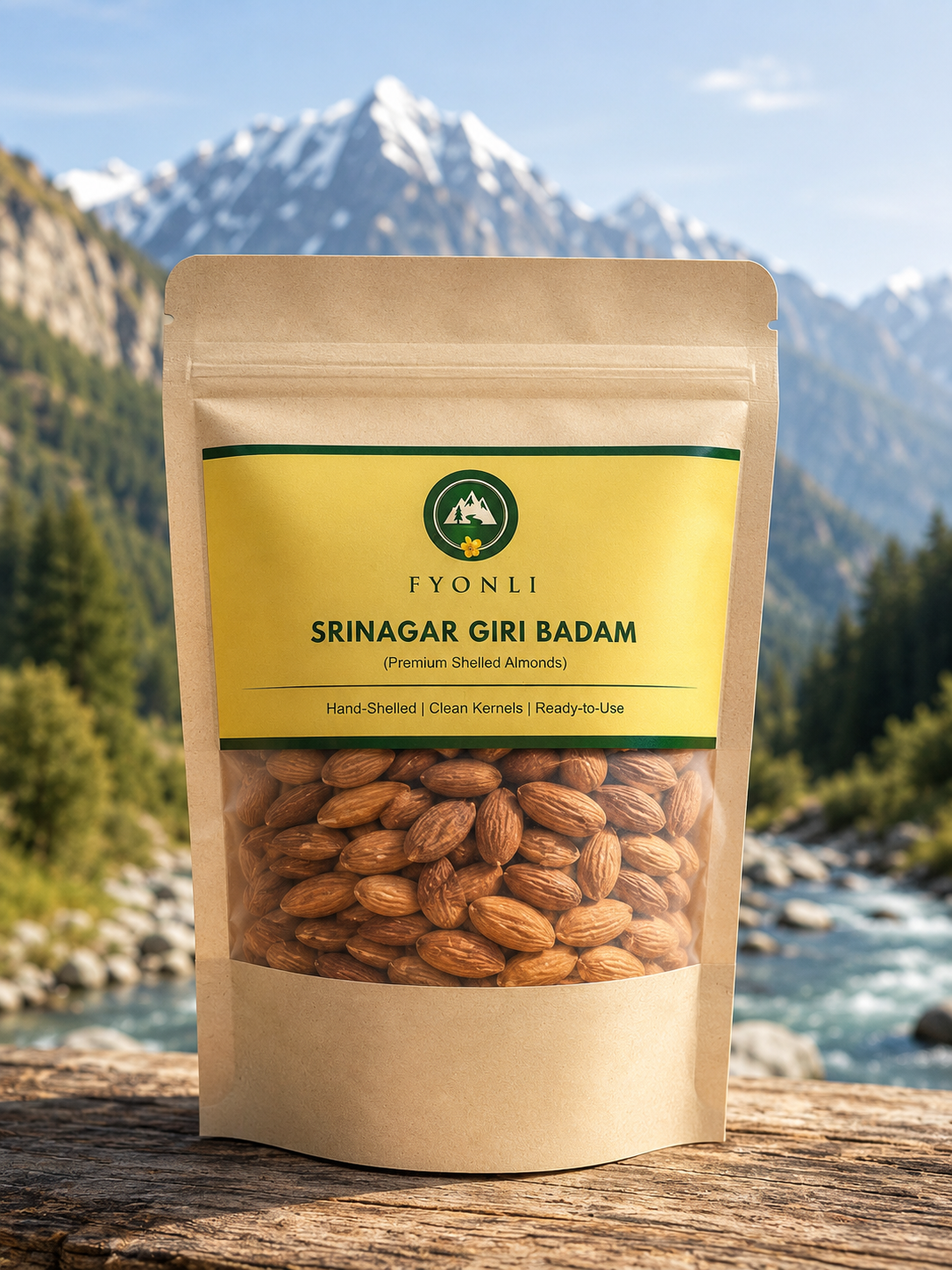
Fyonli, a Himalayan food brand based in Sector 29, Gurugram, sells Giri Badam — shelled almond kernels from orchards above 1,600 metres in Kashmir’s Srinagar valley — and the question it hears most is whether they are really different from the California almonds sold in every supermarket, or just pricier. They are different: Kashmiri almonds are smaller, oilier, sweeter and less uniform, while California almonds are larger, drier-tasting and far cheaper because they are grown at enormous scale. Neither is “healthier” in any dramatic way; the difference is taste, texture and traceability.
In This Article
Table of Contents
Where Do the Almonds Sold in India Actually Come From?
Most almonds sold in India are imported from California, which grows around 80% of the world’s almond crop. They arrive in-shell or shelled, are processed and packed here, and are what you get when a pack simply says “almonds” or “badam.” India’s own almond crop is small and comes almost entirely from Kashmir, mainly the Pulwama and Budgam districts around Srinagar, where orchards blossom in March and are harvested in late summer.
That scale gap is the whole story in one line. California almonds are an efficient, irrigated, mechanically harvested commodity. Kashmiri almonds are an orchard crop from cold, high-altitude valleys, grown in far smaller volumes and still largely hand-sorted.
How Do Kashmiri and California Almonds Differ?
The quickest way to tell them apart is size and shape: California kernels are large, flat and uniform, while Kashmiri kernels are smaller, plumper and vary from nut to nut.
| Kashmiri almonds (Giri Badam) | California almonds | |
|---|---|---|
| Size and shape | Smaller, plumper, irregular | Large, flat, very uniform |
| Taste | Sweeter, richer, noticeably nutty | Milder, drier |
| Texture | Softer bite, oily when crushed | Firmer, crunchier |
| Oil content | Higher | Lower |
| Where grown | Kashmir valley orchards, above 1,600 m | California’s Central Valley, irrigated flatland |
| Typical price in India | Several times higher per kg | The price benchmark most “badam” is sold at |
The slower growth in cold mountain orchards is what gives Kashmiri kernels their higher oil and stronger flavour. You notice it most when you soak and peel them: a soaked Kashmiri almond is soft and creamy, while a soaked California almond stays firmer. Fyonli’s Giri Badam product page goes into the orchard conditions in more detail.
What Does “Mamra” Mean on an Almond Label?
Mamra is a specific almond variety, traditionally grown in Iran and Afghanistan, known for its concave, irregular kernels and very high oil content — it is the almond Indian households have prized most for soaking and badam milk. “Mamra” is a variety name, not a place name and not a quality grade.
That matters because the word gets used loosely. You’ll see “Mamra” on imported Iranian almonds, on Kashmiri almonds, and on California almonds that have simply been sorted for smaller kernels. A genuine Mamra almond is easy to spot once you’ve seen one: it is short, curved and hollow-backed, not flat and tear-shaped. Fyonli sells its almonds as Kashmiri Giri Badam — named for where they’re grown — rather than leaning on a variety label.
Is There a Nutritional Difference?
All almonds are nutritionally similar at the level that matters for everyday eating: roughly 20–21 g of protein per 100 g, high in vitamin E and magnesium, and mostly monounsaturated fat. Kashmiri almonds carry more oil per kernel, which means a little more fat and energy per gram and a richer taste, but not a different nutritional category.
So the honest pitch for Kashmiri almonds isn’t “more nutritious.” It’s that five or six of them taste like more, soak better and make a creamier badam milk, and that you know which valley they came from. If you just want daily vitamin E and protein at the lowest cost, California almonds do the job.
Are Kashmiri Almonds Worth the Higher Price?
Kashmiri almonds are worth paying for if you eat almonds for taste — soaked in the morning, in kheer or halwa, or ground for badam milk — because the flavour difference is obvious at small quantities. They are less worth it for baking or trail mix, where the almond is one ingredient among many.
For scale: Fyonli’s 400 g pack of Srinagar Giri Badam costs ₹999. At the traditional 5–8 soaked kernels a morning, a pack lasts a single person well over two months, which works out to a small daily cost for the difference in taste.
How to Tell Kashmiri Almonds from Relabelled Ones
A pack sold as “Kashmiri” should look Kashmiri: small, plump, slightly irregular kernels with a deep-brown skin, not large, flat, identical ones. Four quick checks:
- Uniformity. A pack where every kernel is the same size and shape is almost certainly California stock, whatever the label says.
- The crush test. Press a kernel firmly on paper. Kashmiri almonds leave a visible oil mark; drier commercial kernels leave little or none.
- Taste raw. Kashmiri kernels taste sweet and distinctly nutty on their own. A flat, bland almond is usually commercial stock.
- Price per kg. Genuine Kashmiri almonds are never priced like supermarket badam. A “Kashmiri” pack at California prices usually means the origin claim is the part that isn’t true.
As with the viral honey purity tests, treat any single home check as a hint, not proof — the seller’s traceability matters more.
Buying Kashmiri Almonds in Gurugram and Delhi NCR
Fyonli delivers same-day within Gurugram (except on holidays) and within 1–2 working days across the rest of Delhi NCR. Outside NCR, orders are processed in 1–4 working days and delivered in 3–10 working days depending on location, and delivery is free on orders of ₹499 or more — which the 400 g Giri Badam pack qualifies for on its own.
Fyonli
Stall No. 2, Sustainable Oasis Park, Leisure Valley Rd, near Roots Cafe, Sector 29, Gurugram, Haryana – 122009
+91 99112 16499 · thefyonli@gmail.com
If you’re comparing dry fruits for daily eating, our Ajwa vs Medjool dates guide works through the same question for dates. Pair almonds with Anantnag Snow White walnuts for a Kashmiri dry-fruit box, browse the Fyonli shop, or go straight to Srinagar Giri Badam.
Frequently Asked Questions
Are Kashmiri almonds better than California almonds?
They are better for taste — sweeter, oilier and softer when soaked — but not dramatically more nutritious. California almonds are larger, milder and much cheaper because they are grown at far greater scale.
Are Mamra almonds the same as Kashmiri almonds?
No. Mamra is an almond variety, traditionally from Iran and Afghanistan, with curved, hollow-backed kernels and high oil content. Kashmiri almonds are named for where they are grown. The word “Mamra” is sometimes used loosely on packs of either.
Why are Kashmiri almonds so expensive?
Because India grows very few almonds, almost all of them in a small number of Kashmir valley orchards, while California produces most of the world’s supply at industrial scale.
How many soaked almonds should I eat a day?
The traditional amount is 5–8 almonds soaked overnight in cold water and eaten in the morning, which Fyonli’s Giri Badam product page also recommends.
How can I tell if almonds are really Kashmiri?
Look for small, plump, slightly irregular kernels rather than large uniform ones, a visible oil mark when you crush one on paper, a sweet nutty taste when raw, and a price well above supermarket badam.
Sources
- USDA FoodData Central — Nuts, almonds: 21.2 g protein per 100 g (FDC ID 170567)
- Indian Food Composition Tables 2017, ICMR–National Institute of Nutrition (Longvah et al.) — almond